
HINDU PANTHEON PARK & ROYAL RAMAYANA
Discovering the Echoes of Indian Mythology in Laos
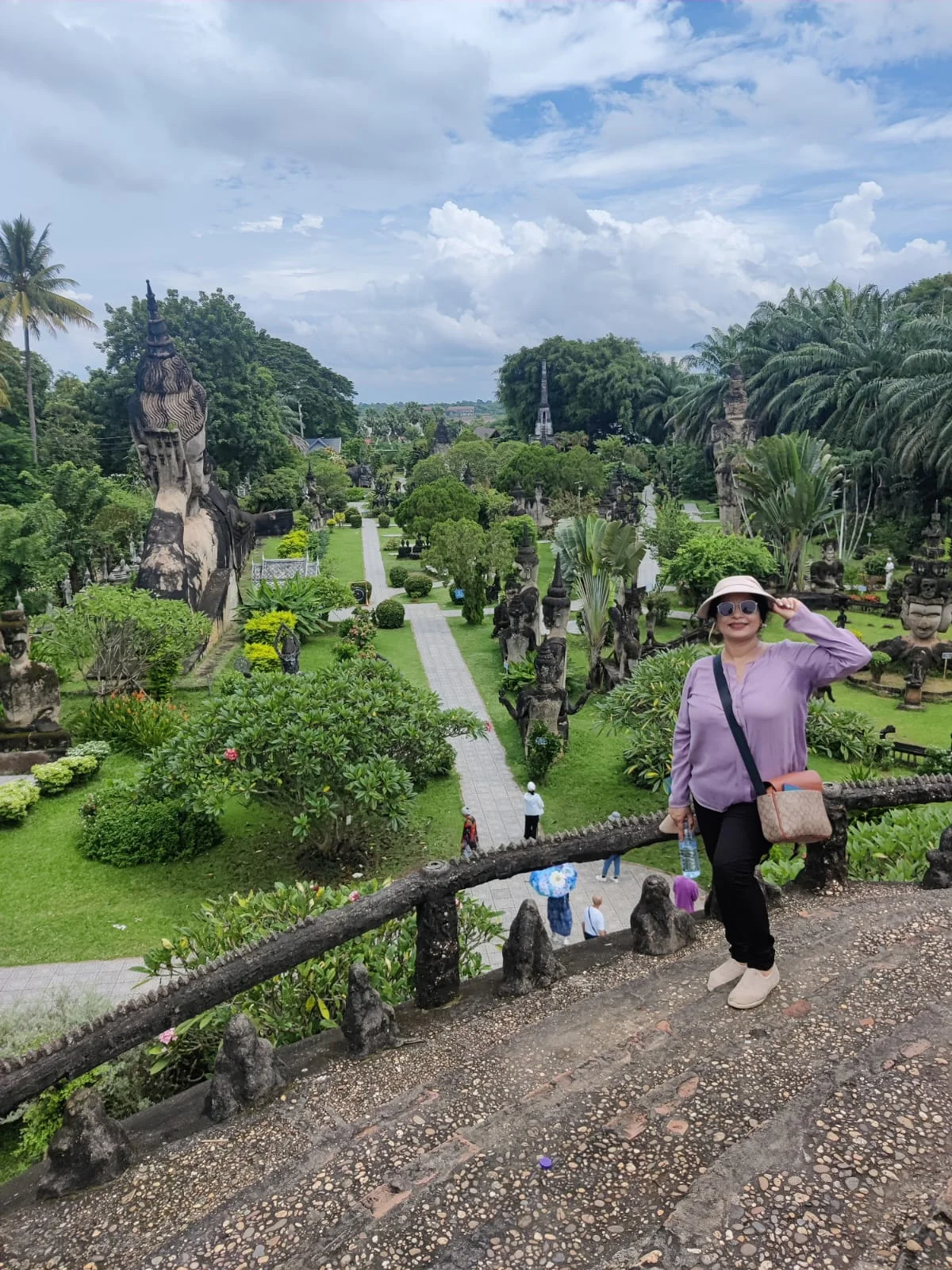
Panoramic Terrace of Xieng Khuan: Standing amidst the surreal garden of deities, demons, and celestial beings founded by Bunleua Sulilat in 1958
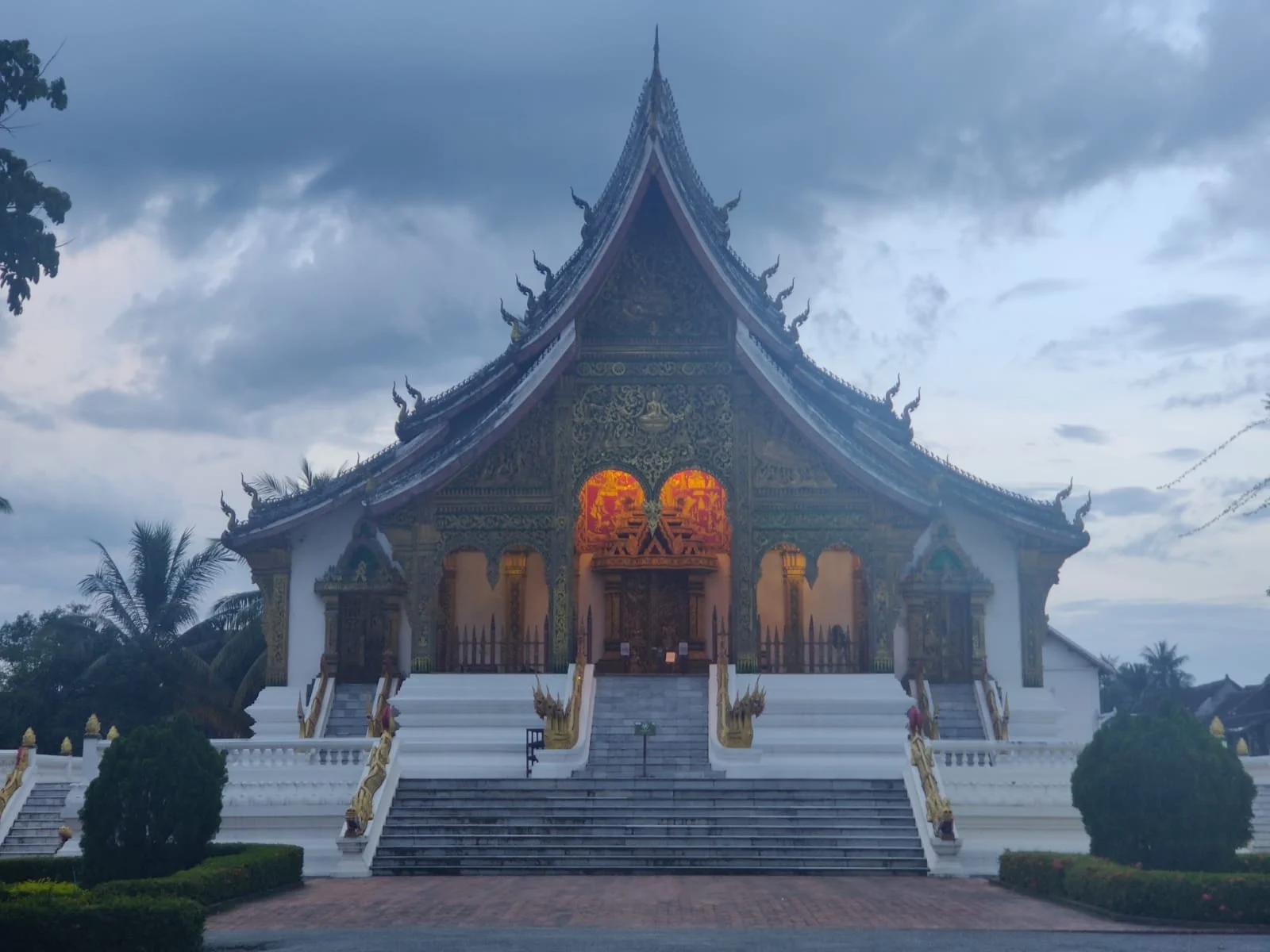
Golden Haw Pha Bang Sanctum: The royal chapel illuminated against the twilight sky on the grounds where Phra Lak Phra Lam comes alive
Hindu Pantheon Park, Vientiane: Where Hinduism Meets Buddhism
“Filled with more than 200 sculptures inspired by Hindu and Buddhist mythology, the park felt almost surreal. Walking through it, we were struck by how naturally Hindu and Buddhist imagery appeared alongside one another.”
— Field Journal Entry · Wanderers At 50Located outside Vientiane, Buddha Park, also known as Xieng Khuan, was one of the most unusual and fascinating places we visited in Laos.
Filled with more than 200 sculptures inspired by Hindu and Buddhist mythology, the park felt almost surreal. Giant images of Shiva, Vishnu, Indra, demons, celestial beings, and Buddhist figures stood scattered across the peaceful grounds, creating an extraordinary landscape of religious symbolism and artistic imagination.
Walking through the park, we were struck by how naturally Hindu and Buddhist imagery appeared alongside one another, reflecting the cultural exchanges that have shaped Southeast Asia for centuries.
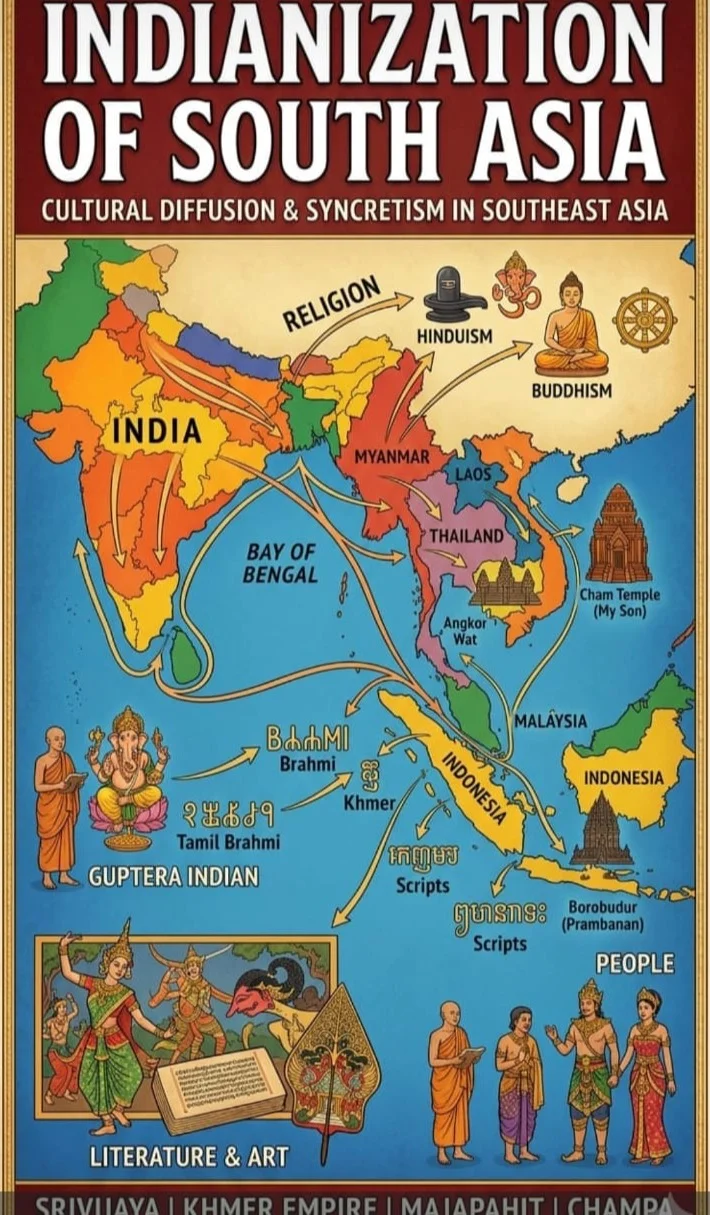
Cultural Diffusion Routes: Tracing the ancient maritime and inland trade arteries that carried Indian philosophical traditions and epics into Laos
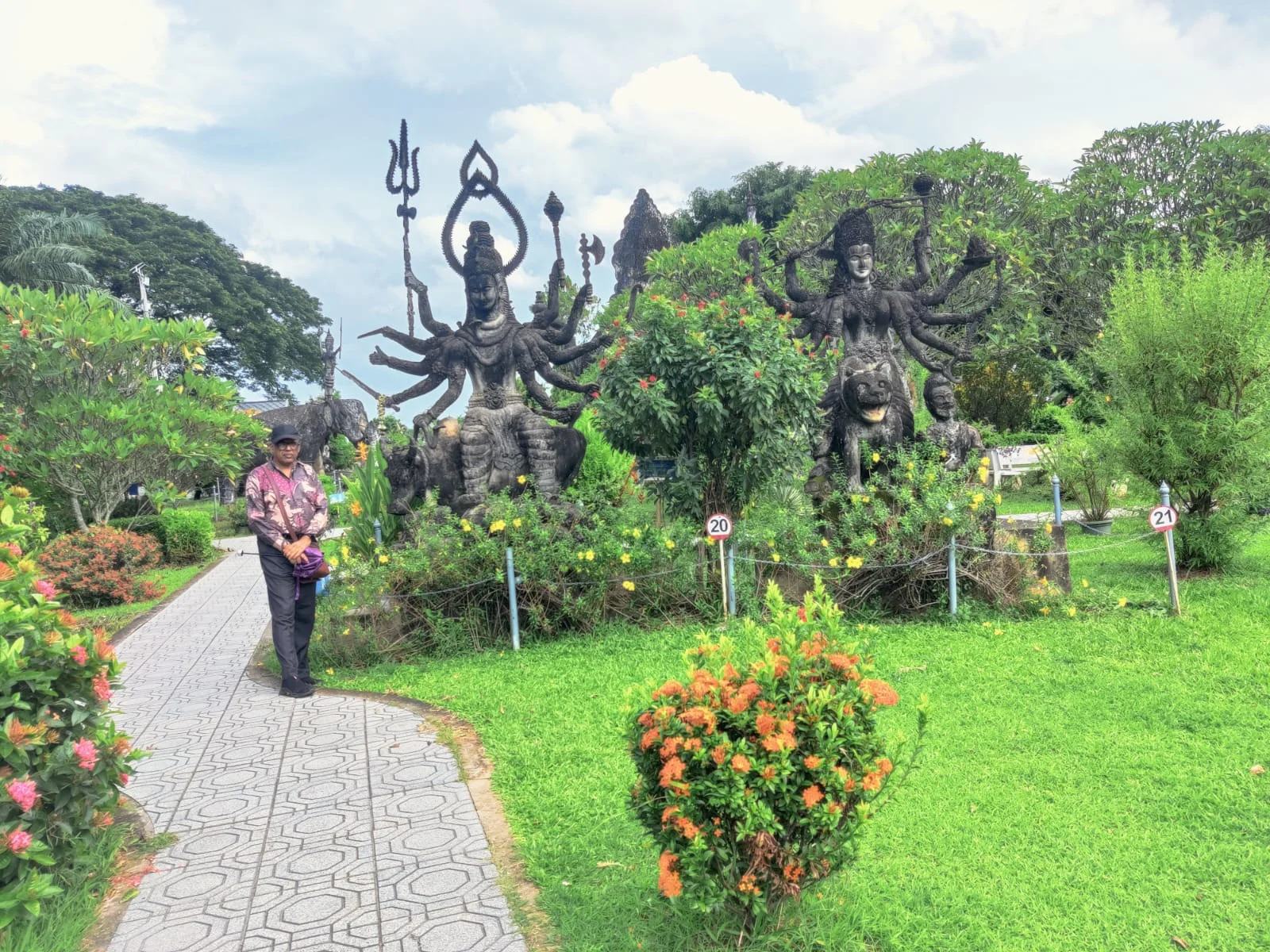
Shiva on Nandi & Durga Astride Her Lion: Shaivite and Shakta iconography rendered in monumental reinforced concrete on the tranquil banks of the Mekong
The sculptures were striking not only because of their enormous size but also because of their imaginative forms and symbolic details. Every corner seemed to reveal another mythological character or representation of a spiritual idea.
The entire experience felt imaginative, spiritual, and wonderfully different from any other religious site we had visited. For us, Buddha Park offered a fascinating glimpse into how religious ideas originating in India travelled across Southeast Asia and became part of the region’s diverse cultural landscape.
From the Coromandel coast and ancient Kalinga ports, Indian merchants, scholars, and ascetics sailed across the Bay of Bengal, traversing the Isthmus of Kra into the Gulf of Thailand and charting the Mekong river valley. In Laos, these philosophical streams coalesced into syncretic traditions where Vedic deities coexist in profound harmony with Theravada Buddhism.
Hindu Pantheon Park: A Symbolic Journey Through Hinduism and Buddhism
“The park felt like far more than a sculpture garden. It offered a symbolic journey through ideas of heaven, hell, karma, and rebirth—reminding us that Indian cultural influence lives in how later generations reimagined inherited traditions.”
— Reflections on Bunleua Sulilat's MasterworkCreated in 1958 by the mystic and sculptor Bunleua Sulilat, Buddha Park felt like far more than a sculpture garden. It seemed to offer a symbolic journey through ideas of heaven, hell, karma, and rebirth.
Among its most remarkable features was the giant reclining Buddha, whose peaceful form contrasted with the dramatic expressions and unusual shapes of the surrounding sculptures.
Another highlight was the enormous pumpkin-shaped structure, representing different realms of existence. Its interior passages and upper levels offered a distinctive way to experience the park’s imaginative interpretation of spiritual worlds.
Ascending the Three Realms: Hell, Earth & Heaven
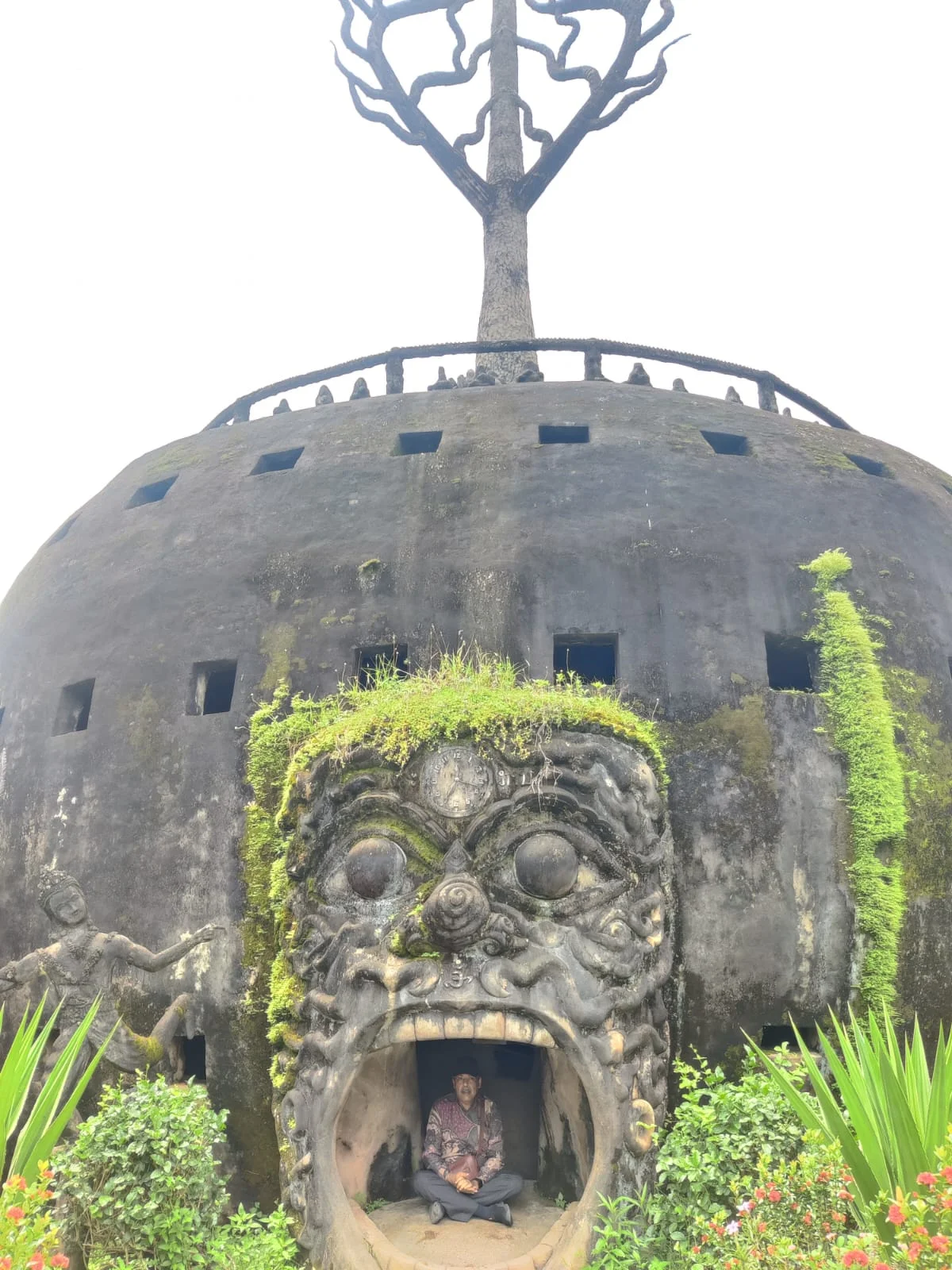
The Portal of Rahu: Entering the cosmic pumpkin through the gaping jaws of the demon representing time, karma, and passage into the underworld
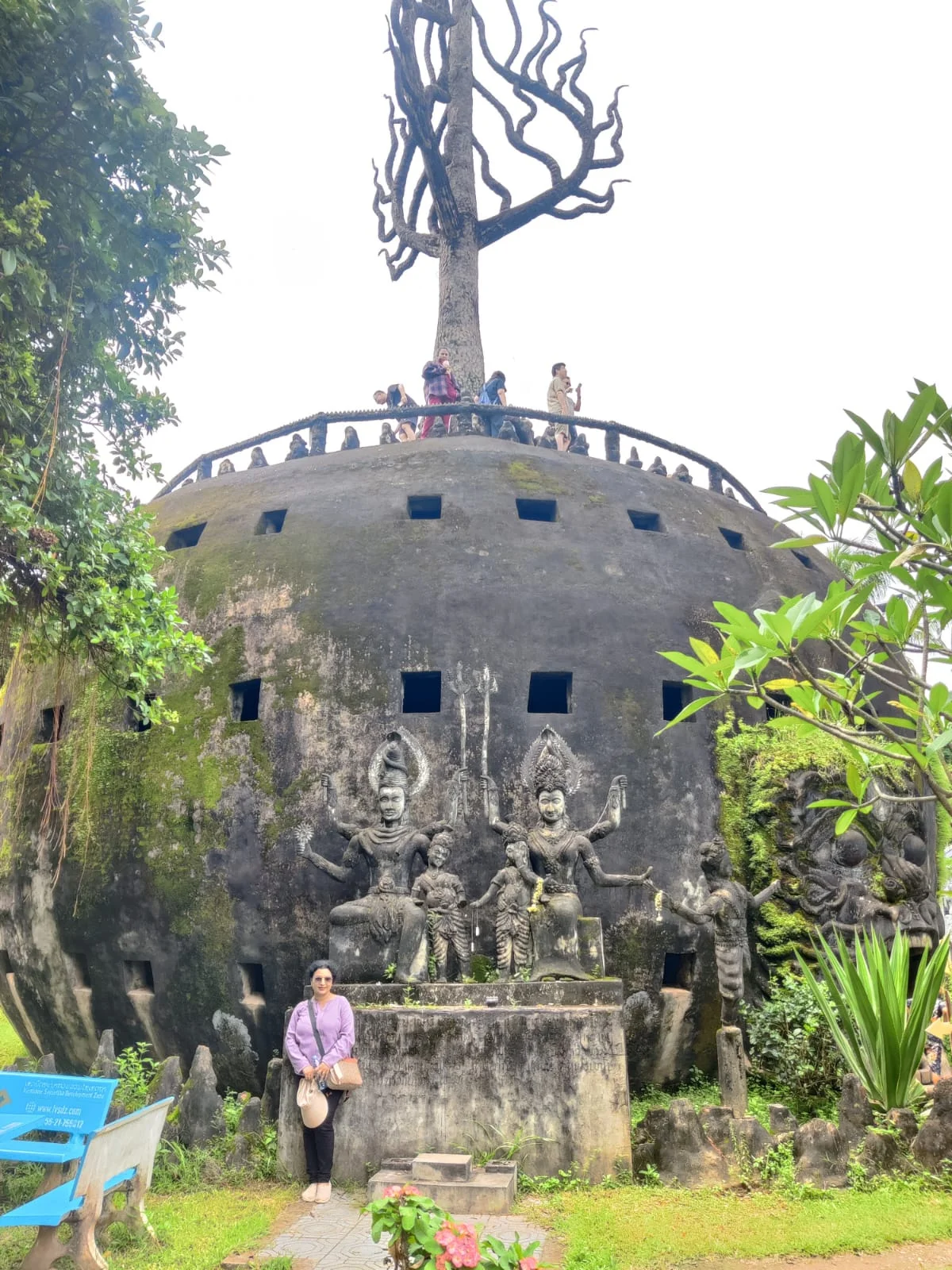
The Cosmic Pumpkin & Shiva-Parvati: Sulilat's three-tiered sphere representing Hell, Earth, and Heaven crowned by divine celestial figures
As we wandered among the strange yet fascinating sculptures, we could recognise familiar figures from Hindu mythology alongside Buddhist representations. The presence of Shiva, Vishnu, Indra, and other mythological figures demonstrated the continuing cultural significance of Hindu religious imagery in Laos.
However, the park is also a distinctive modern artistic creation rather than an ancient temple complex. Its unusual mixture of religious symbols reflects Sulilat’s own imaginative vision, drawing on Hindu and Buddhist traditions.
For us, the experience was spiritual, artistic, and deeply thought-provoking all at once. It reminded us that the cultural influence of India across Southeast Asia can be found not only in ancient monuments but also in the ways later generations interpreted and reimagined inherited traditions.
Sulilat's pumpkin represents the universe across three internal storeys: Hell (underworld suffering), Earth (karmic struggle of mortal existence), and Heaven (transcendent serenity). Visitors enter through the gaping mouth of a mythological demon (often interpreted as Rahu or Kala) and ascend narrow internal stone ladders to reach the open terrace crowned by a sacred spire.
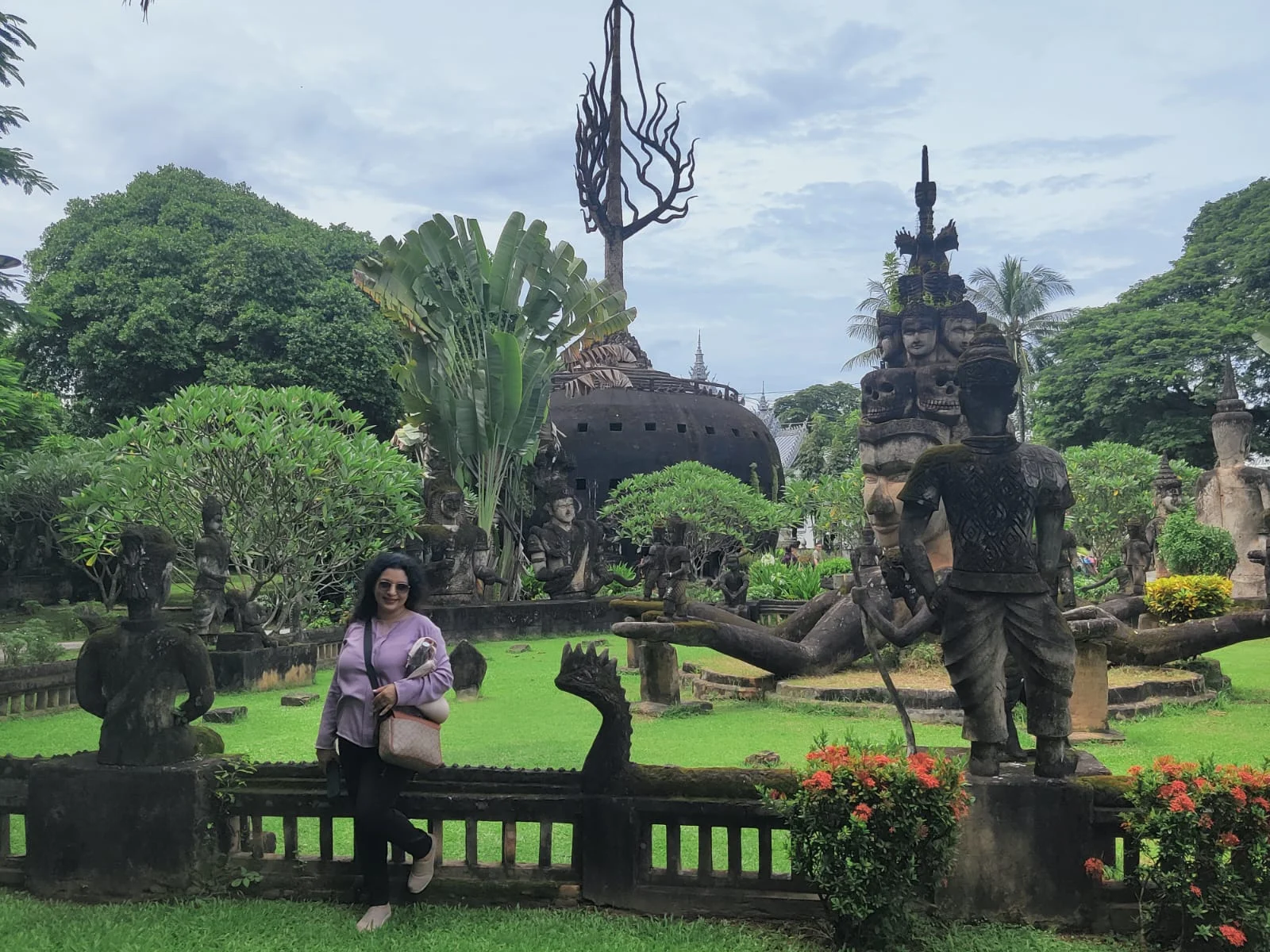
Courtyard of Mysticism: A stroll through Bunleua Sulilat's visionary landscape where dozens of mythological figures rise from the green lawn
Pantheon of Syncretism: Reclining Buddha, Krishna, & Cosmic Mount Meru
“Every corner revealed another mythological character—from Lord Krishna playing his divine flute to the serene 40-metre Reclining Buddha. The coexistence of deities here felt natural, vibrant, and alive.”
— Field Journal Entry · Wanderers At 50What makes Xieng Khuan utterly distinctive is the uninhibited coexistence of sacred figures from across the Indic spectrum. Resting serenely against the tropical tree canopy is the giant Reclining Buddha, measuring over 40 metres in length. Its reclining pose symbolizes the Buddha entering Parinirvana, offering a peaceful counterweight to the intense, dramatic postures of the nearby mythological entities.
Just steps away, the Vaishnavite tradition is lovingly rendered in a sculpture of Lord Krishna playing his divine bansuri flute beside the sacred Kamadhenu cow. The scene captures the pastoral tenderness of Vrindavan, transposed into mid-twentieth-century Lao concrete folk art.
In another corner of the grounds stands an imposing stepped pyramid stupa, evocative of cosmic Mount Meru—the mythological center of the universe shared by both Hindu cosmology and Buddhist metaphysics. Visitors can climb its narrow steps to view the panorama of statues scattered across the river meadow.
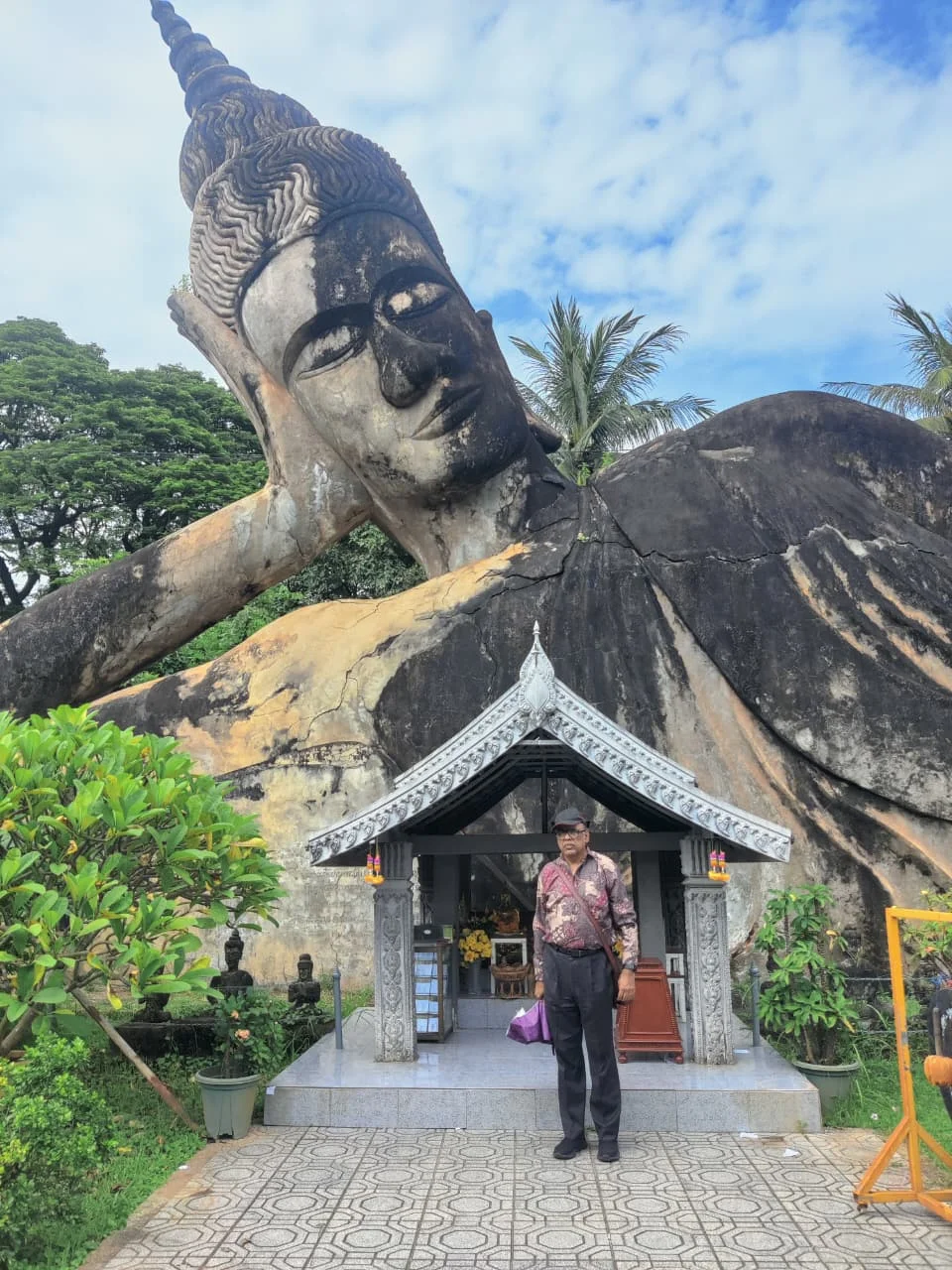
The 40-Metre Reclining Buddha: The peaceful centerpiece of Xieng Khuan, depicting the Buddha entering Parinirvana against the tropical sky
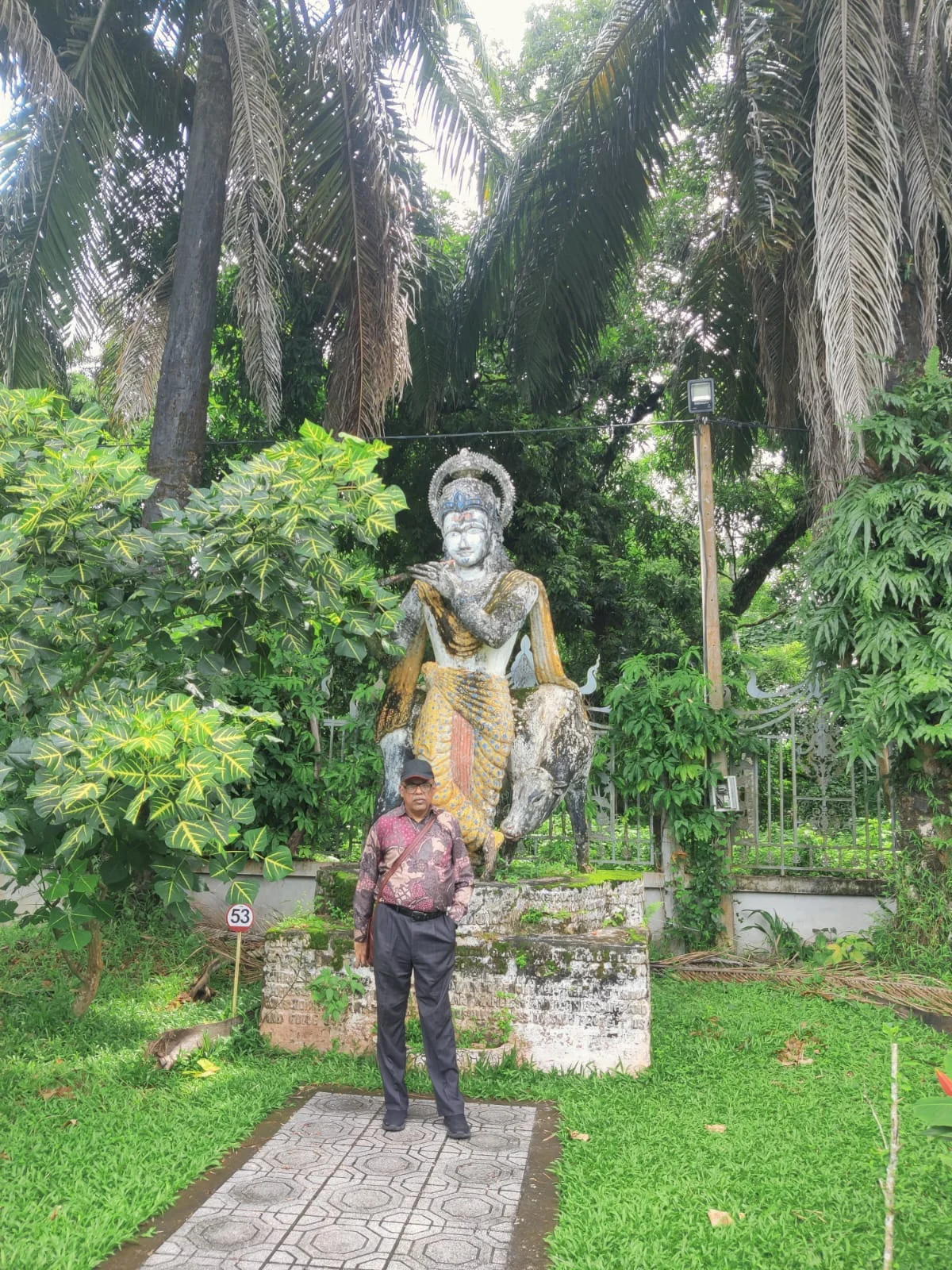
Lord Krishna & The Sacred Cow: The pastoral grace of Vaishnavite mythology expressed in folk-art concrete beside celestial attendants
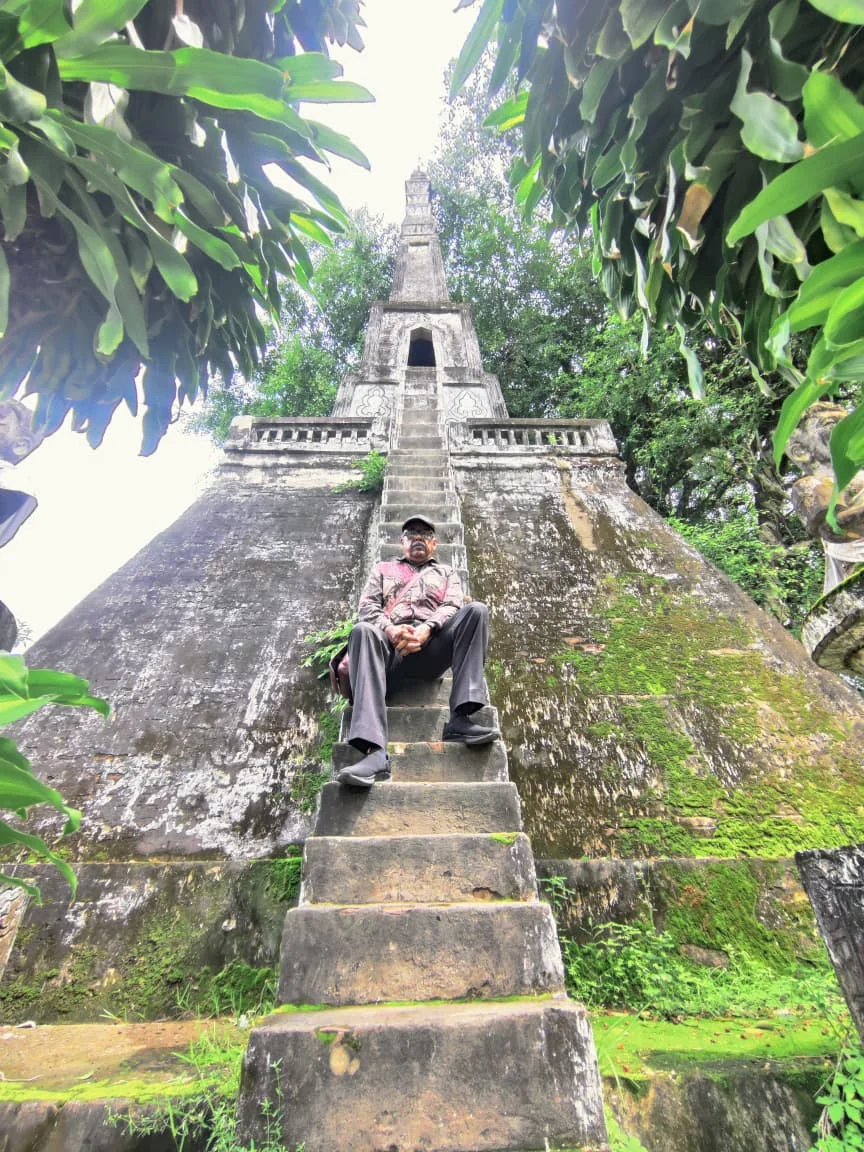
Cosmic Mount Meru Stupa: Ascending the multi-tiered stepped terrace designed as an architectural symbol of the universal cosmic axis
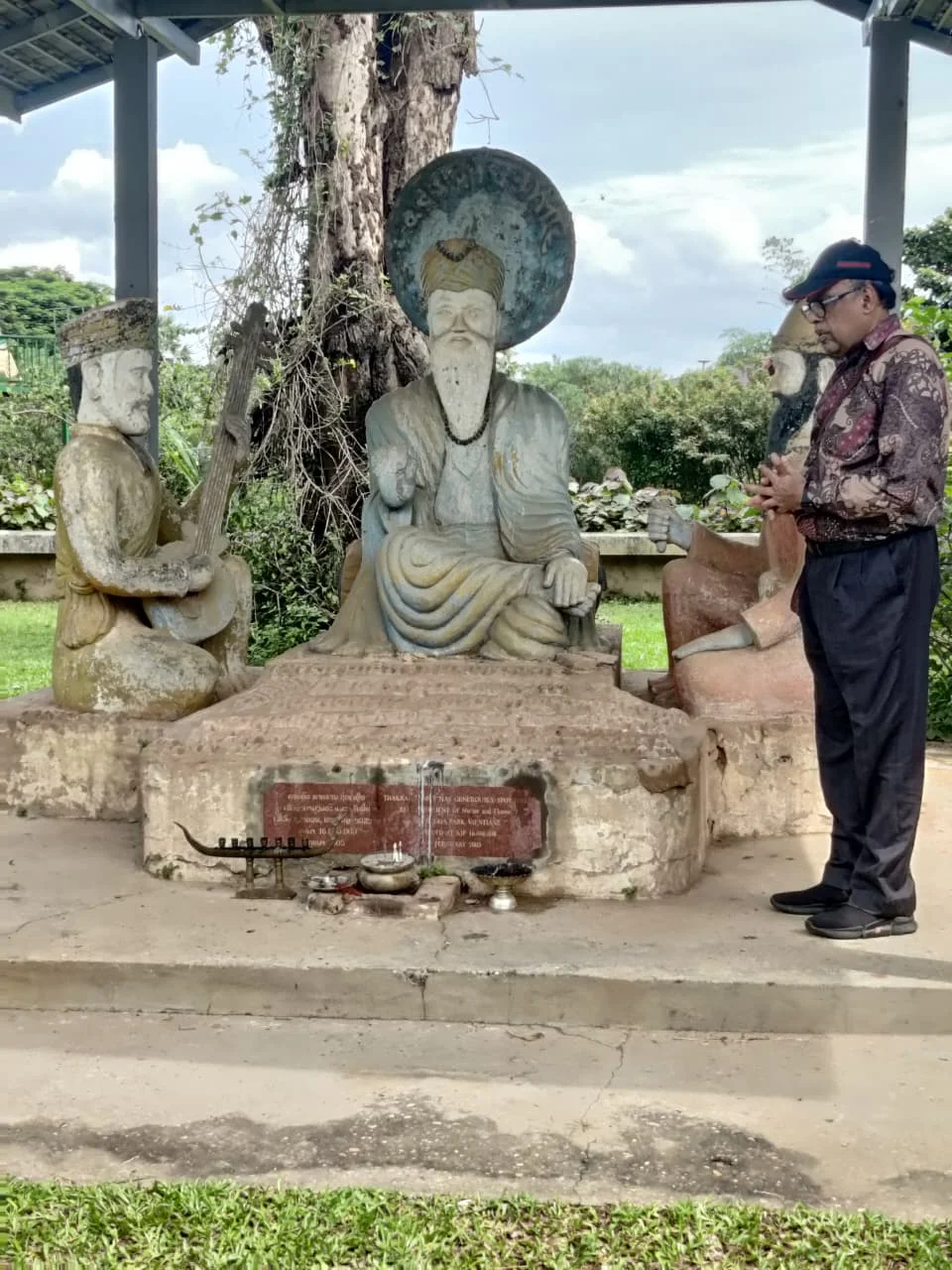
Guru Nanak Dev Ji Shrine: A testament to Sulilat's remarkably inclusive vision, incorporating the founder of Sikhism into the pantheon
Demonstrating Bunleua Sulilat's radical ecumenical vision, the park even includes a designated shrine honoring Guru Nanak Dev Ji, the founder of Sikhism, alongside walls carved with multi-armed guardian deities, celestial devas, and armed Yakshas standing sentry over the sacred precinct.
This sweeping assembly makes Buddha Park a living textbook of how religious motifs originating in the Indian subcontinent did not arrive as rigid dogma, but rather as fluid, imaginative narratives that local artisans embraced with joyous creative freedom.
Sulilat studied under a Vietnamese yogi and mystic named Keoku. Rather than maintaining sectarian boundaries between Shaivism, Vaishnavism, Theravada Buddhism, and other Indic traditions, Sulilat conceived Xieng Khuan as a universal spiritual sanctuary where all spiritual pathways converge under the open Lao sky.
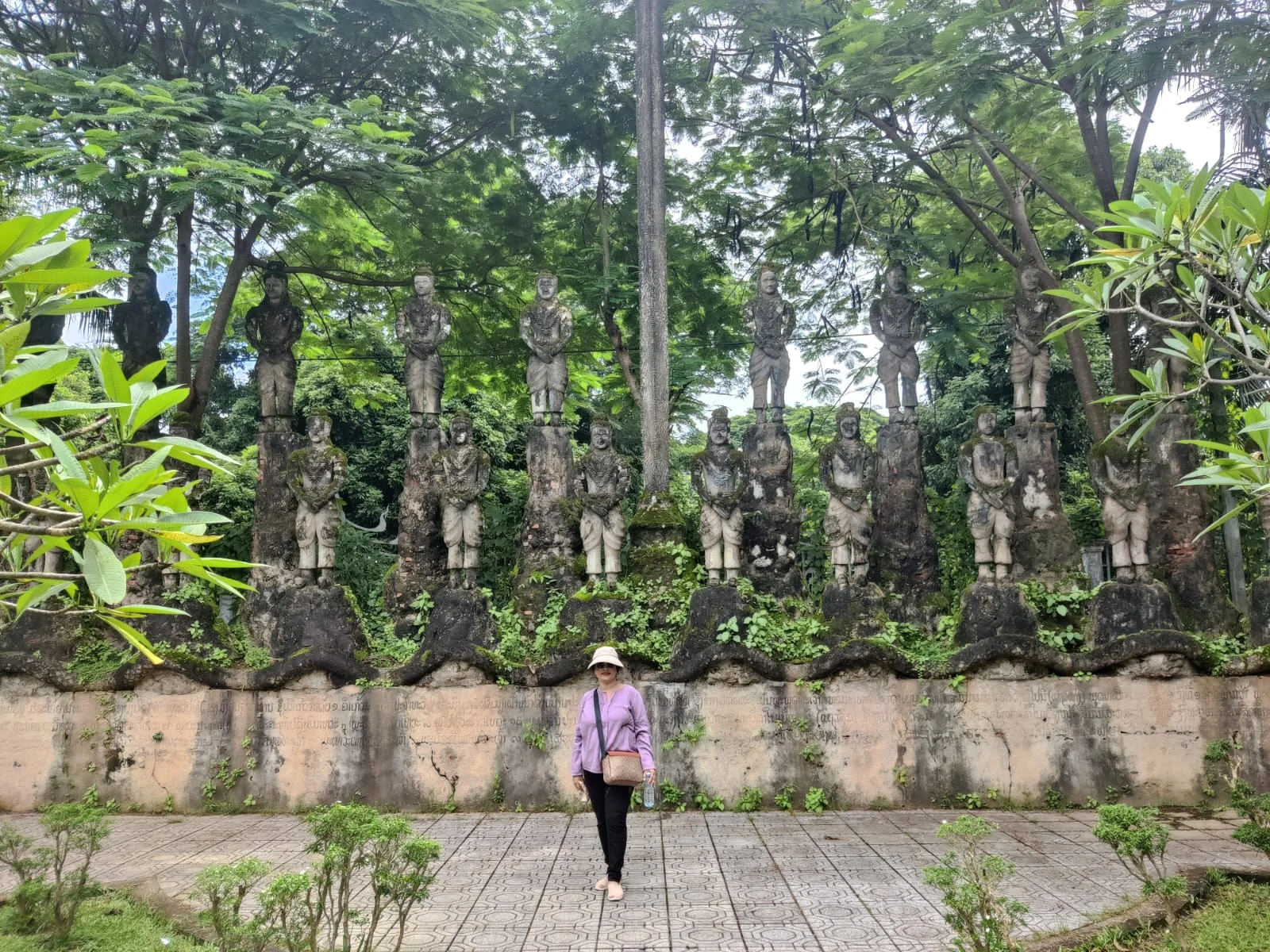
The Wall of Devas: A sweeping gallery of multi-armed guardian deities and celestial protectors keeping watch over Buddha Park
Patuxai: The Victory Gate of Vientiane
“Beneath its national symbolism, the monument reveals influences from wider artistic and religious traditions—mythological figures such as Indra reflecting the long history of Indian ideas incorporated into Lao art.”
— Field Journal Entry · Wanderers At 50Visiting Patuxai, the famous Victory Gate of Vientiane, was another fascinating experience during our journey through Laos.
Standing prominently along one of the city’s major avenues, this monumental structure commemorates those who fought for Laos’s independence. Its design combines elements of traditional Lao architecture with the monumental form of a triumphal arch.
Yet beneath its national symbolism, the monument also reveals influences from the wider artistic and religious traditions of Southeast Asia.
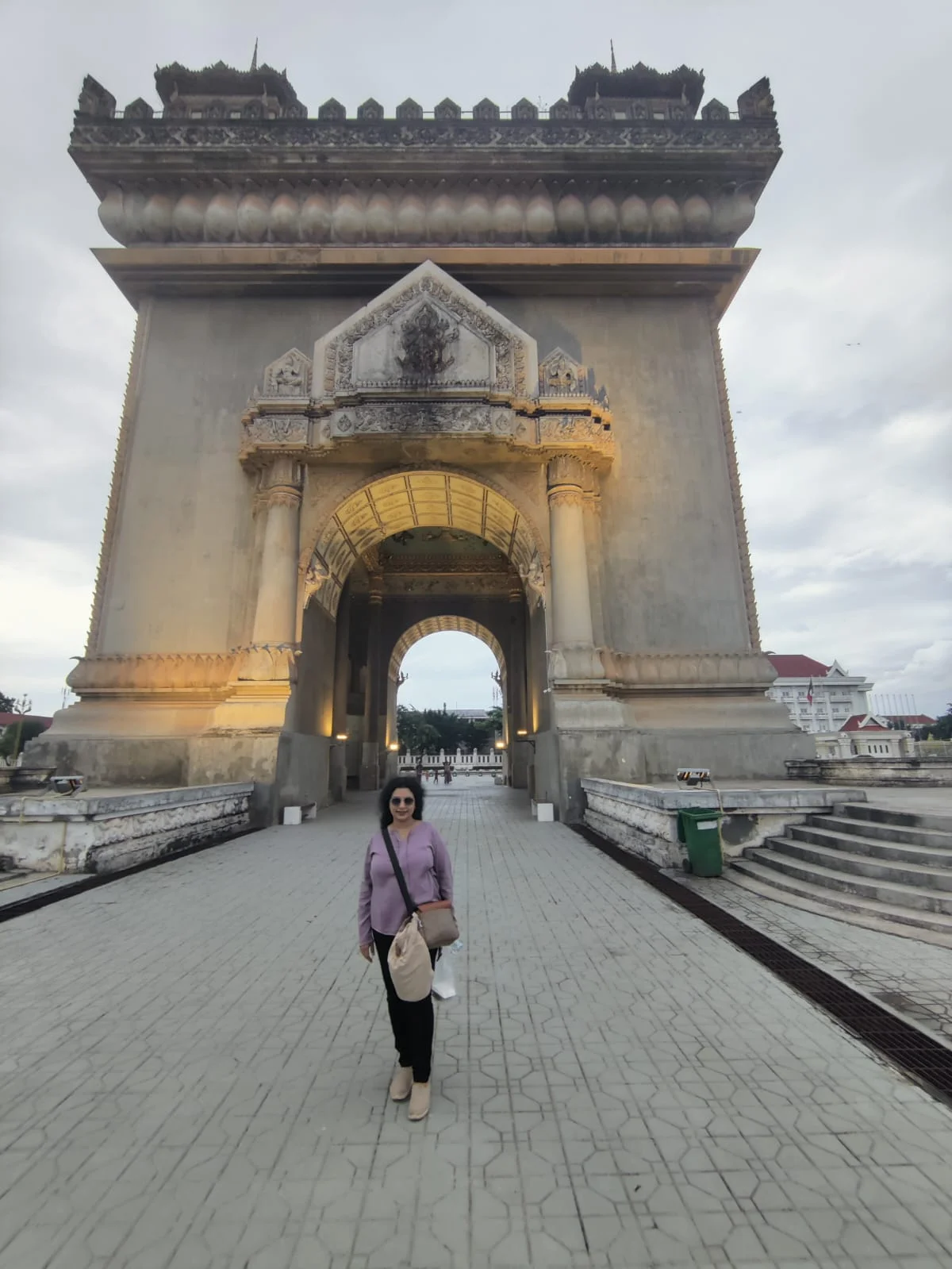
The Colossal Arch of Patuxai: Standing beneath the monumental victory gate combining classical French triumphal proportions with Lao spires
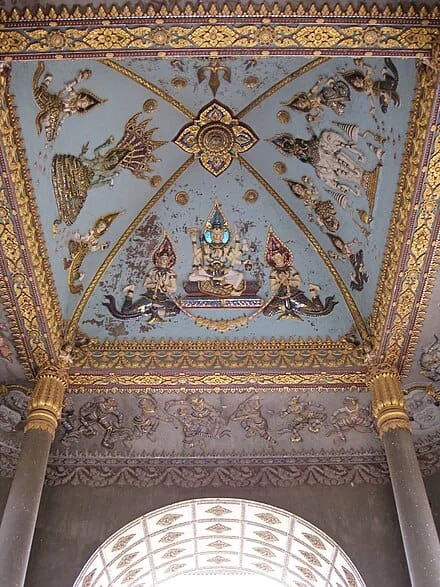
Vault of Indic Deities: The breathtaking painted relief ceiling of Patuxai depicting Lord Indra atop Airavata, Brahma, and celestial Kinnaris
The decorative details include mythological figures and intricate patterns associated with Hindu and Buddhist imagery. Representations of figures such as Indra and other celestial beings reflect the long history of Indian religious ideas being incorporated into Lao artistic traditions.
While Patuxai stands today as one of Laos’s most recognisable national monuments, its ornamentation illustrates how local artistic identity can incorporate cultural influences from beyond its geographical boundaries.
For us, visiting Patuxai offered another reminder that Indian mythology and religious symbolism travelled far beyond India, becoming part of the artistic vocabulary of societies across Southeast Asia.
Looking up into Patuxai's massive central portal reveals a vibrant vaulted ceiling painted in cobalt blue, lapis, and gold leaf. The high-relief stucco depicts Lord Indra mounted atop the three-headed celestial elephant Erawan (Airavata), flanked by Lord Brahma, Vishnu, and celestial half-bird half-human Kinnari maidens—showing that even modern national monuments in Laos continue to draw upon ancient Indic cosmological iconography.
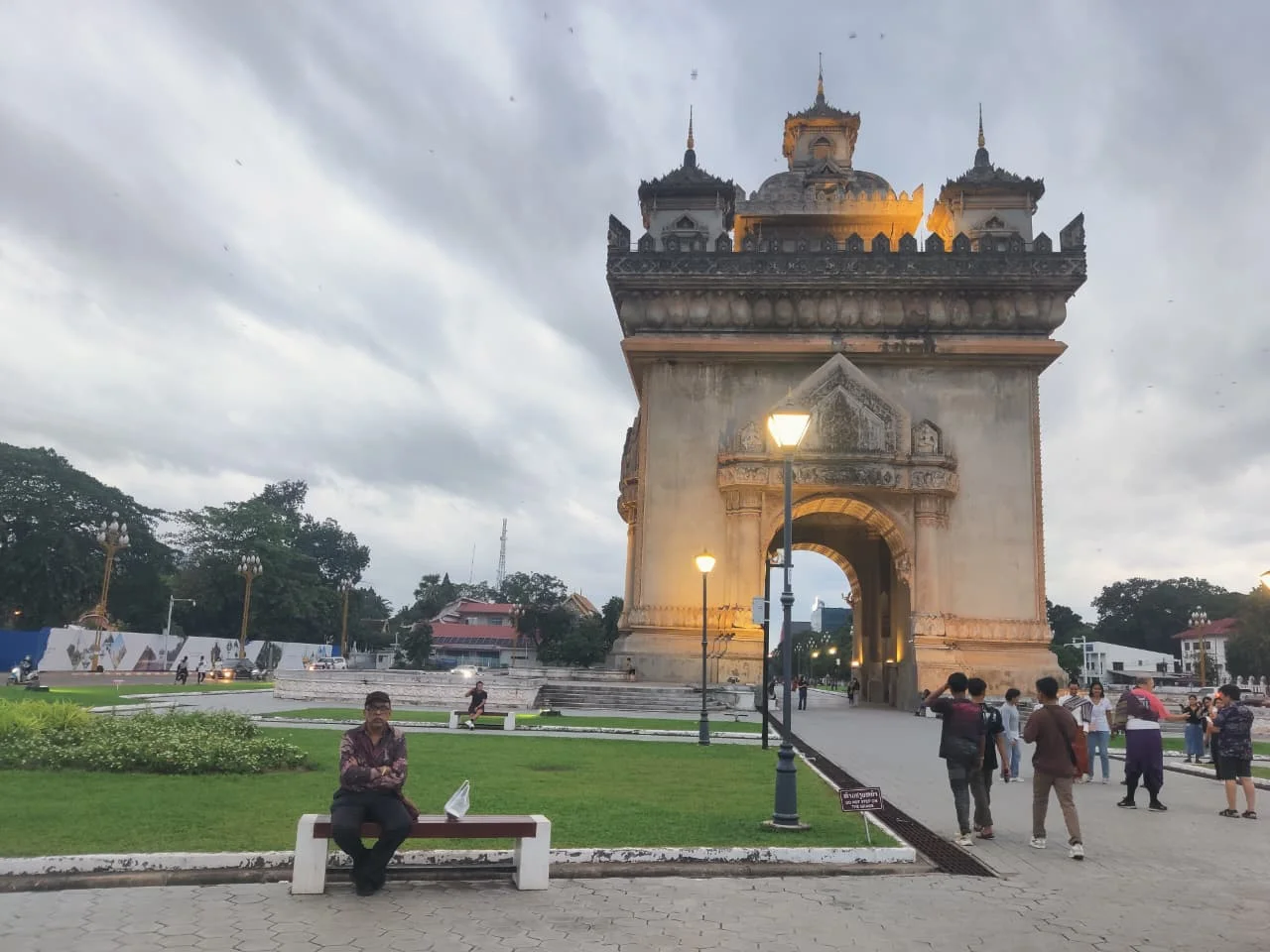
Twilight Radiance: Patuxai glowing in the evening twilight with landscaped musical fountains reflecting its traditional Lao finials
The Ramayana at the Royal Theatre of Luang Prabang
“For us, the performance was more than an evening of entertainment. It was a living demonstration of how an Indian epic travelled across geographical boundaries, entered the cultural life of another society, and developed into a cherished part of its artistic heritage.”
— Field Journal Entry · Royal Palace Theatre, Luang PrabangWatching a Ramayana-inspired performance at the Royal Theatre in Luang Prabang was one of the cultural highlights of our journey through Laos.
Through graceful classical dance, traditional music, expressive gestures, and elaborate costumes, the performance brought alive the deep Indian cultural influence that continues to resonate across Southeast Asia.
In Laos, the Ramayana is adapted as Phra Lak Phra Lam, a distinctive Lao literary and performing tradition that blends the story of Rama with Buddhist values, local beliefs, and Lao cultural identity.
The principal characters include Phra Lam (Rama), Phra Lak (Lakshmana), and Nang Sida (Sita), facing the ten-headed demon king Totsakan (Ravana) on the royal stage.
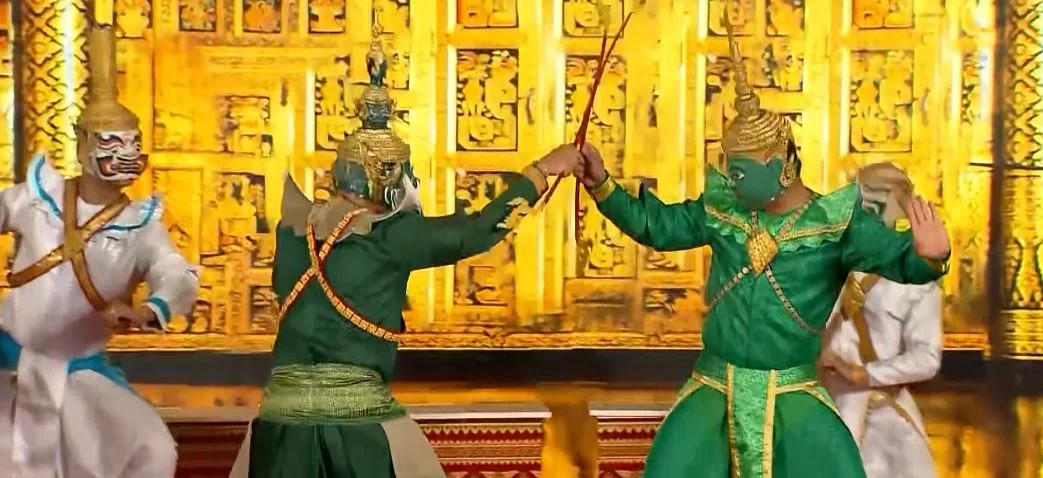
Phra Lak Phra Lam on Stage: The epic clash between Phra Lam (Rama) and the demon king Totsakan (Ravana) brought to life through classical court dance, gilded masks, and gamelan-like percussion
The principal characters include Phra Lam, the Lao counterpart of Rama; Phra Lak, corresponding to Lakshmana; and Nang Sida, corresponding to Sita. Although the narrative shares its foundations with the Indian epic, the Lao version incorporates its own interpretations, cultural details, and religious perspectives.
Sitting in Luang Prabang, the former royal capital of Laos, and watching familiar elements of the epic unfold through traditional performance was both fascinating and deeply enjoyable. The dancers’ movements, the intricate costumes, and the accompanying music gave the ancient story a distinctly Lao character.
The experience reminded us that the Ramayana is not simply a story preserved in books. Across Asia, it continues to live through dance, theatre, music, sculpture, and the traditions of communities that have made it their own.
Unlike Valmiki's Sanskrit epic, the Lao Phra Lak Phra Lam is framed as a Jataka tale—a previous life story of Gautama Buddha, where Phra Lam is the Bodhisattva embodying consummate righteousness, and the ten-headed demon king Totsakan (Ravana) represents delusion and attachment. Accompanied by the resonant tones of the Lanat (traditional Lao xylophone) and Kong (drums), each gesture traces centuries of living court tradition.
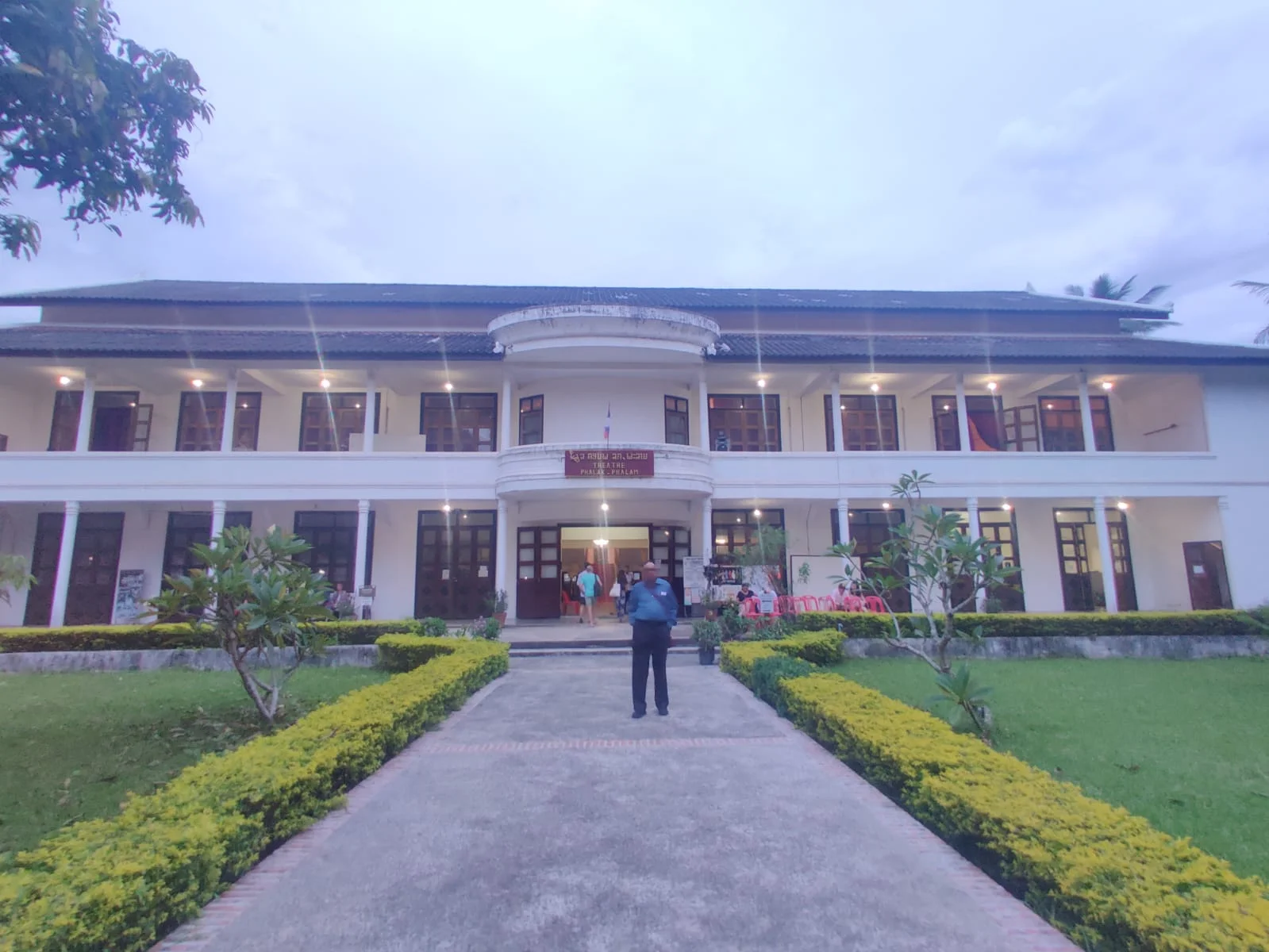
Arriving at the Royal Theatre: Situated within the historic palace grounds in the heart of Luang Prabang, where the royal troupe preserves centuries of classical dance
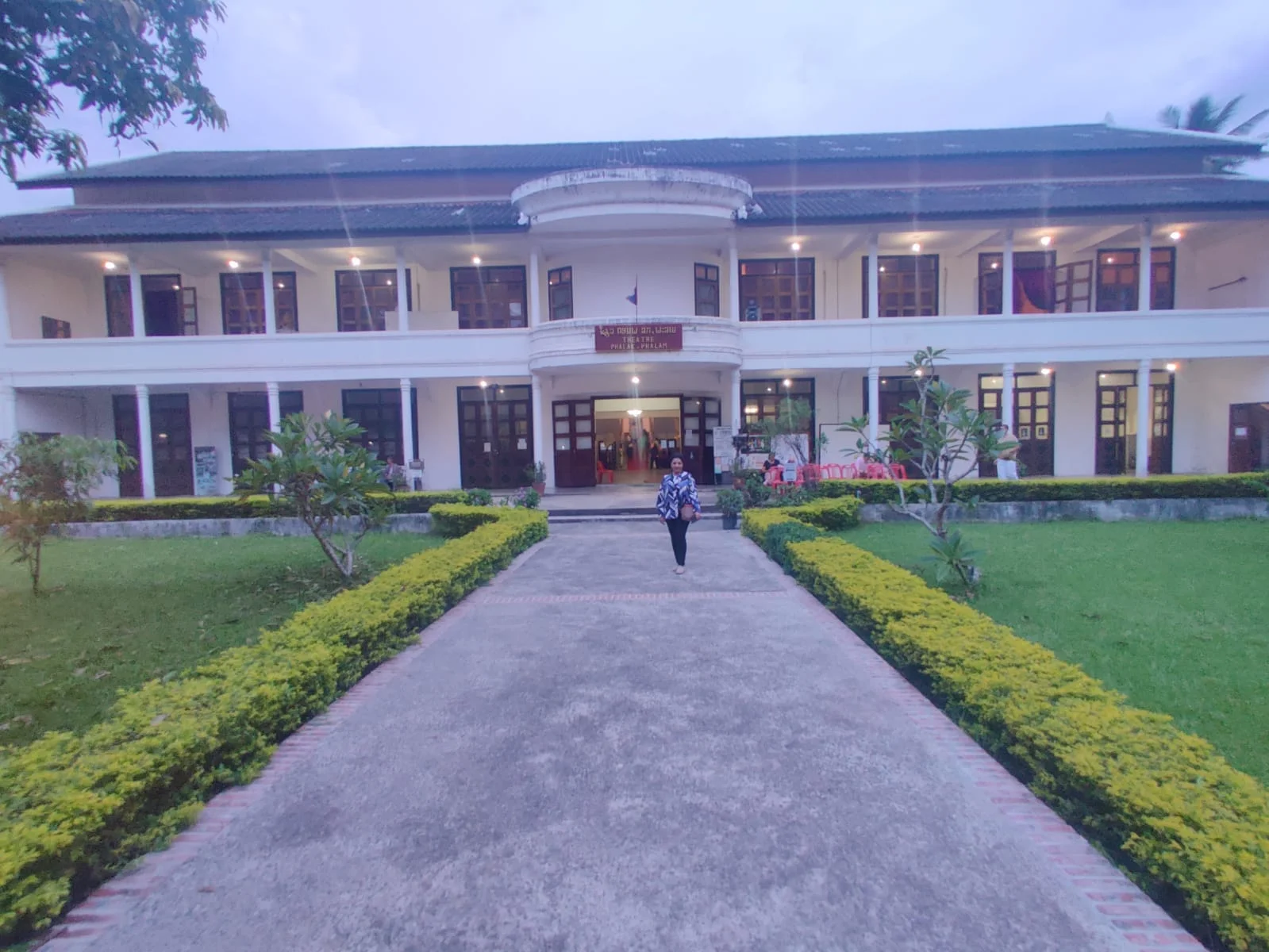
Garden of the Royal Palace: The tranquil grounds between Haw Pha Bang and the Royal Theatre where classical Lao culture remains preserved and celebrated
Practical Traveler Notes: Vientiane & Luang Prabang
Tips for Visiting Buddha Park from Vientiane
1Getting There
Buddha Park is approximately 25 km southeast of central Vientiane. A taxi or tuk-tuk arranged for a round trip offers a convenient option. Public buses, including services associated with Route 14 from the Central Bus Station (Talat Sao), have also traditionally served the area, but check current routes and schedules before travelling.
2Best Time to Visit
Arrive early in the morning (around 8:00 AM) to avoid the midday tropical heat and enjoy the best natural lighting for photography across the open meadows.
3Time Required
Allow approximately 1–2 hours to explore the sculptures, climb the cosmic pumpkin, and stroll along the Mekong river embankment at a relaxed pace.
4What to See
Look for the giant 40-metre reclining Buddha, sculptures of Hindu deities such as Shiva, Durga, and Vishnu, the stepped pyramid stupa, and the enormous pumpkin-shaped structure representing different realms of existence.
5Climbing the Pumpkin Structure
The interior passages and stairs leading from Hell up through Heaven are narrow, steep, and dark. Watch your step carefully and skip the climb if you are uncomfortable with confined spaces or uneven stairs.
6What to Carry
Bring plenty of drinking water, a wide-brimmed hat, sunscreen, insect repellent, and local Lao Kip cash for the modest entry fee and refreshing drinks at the riverside café.
7Dress Comfortably & Respectfully
Wear comfortable walking shoes with good grip, as the lawn paths can be dusty or muddy after rain. Although it is an open-air sculpture garden, treat the religious statues with respect.
8Respect the Grounds
Avoid climbing on delicate statues or sitting on sacred heads. Keep speech calm and do not leave any litter behind.
9Combine with Local Sights
Pair your Buddha Park morning excursion with the First Lao-Thai Friendship Bridge nearby, and visit Patuxai and Pha That Luang on your return drive into central Vientiane.
Tips for Visiting the Royal Theatre, Luang Prabang
1Location
The Royal Theatre (Phra Lak Phra Lam Theatre) is located within the grounds of the Royal Palace Museum (Haw Kham) in the center of Luang Prabang along Sisavangvong Road.
2Performance Schedule
Shows typically run on selected evenings during the week (often Monday, Wednesday, Friday, and Saturday at 6:00 PM). Always check the latest seasonal schedule in advance, especially during the low season when performances may be less frequent.
3Booking Tickets
Purchase tickets at the theatre box office earlier in the day or book through local tour desks to secure good seats in the lower or VIP tiers.
4Seating & Timing
Arrive about 15–20 minutes before the performance to find your seat, admire the regal wooden hall, and read the program notes explaining the episode being enacted.
5Dress Code
Smart-casual attire is recommended. Avoid beachwear or sleeveless tops out of respect for the royal venue, classical performers, and local cultural sensibilities.
6Photography Etiquette
Flash photography and video recording with bright lights are prohibited during the performance. Non-flash photos are usually permitted, but verify house rules upon entry.
7Learn the Story
Familiarise yourself briefly with the Lao adaptation of the Ramayana (Phra Lak Phra Lam) to better appreciate the character masks, specific combat choreography, and spiritual allegories.
8Combine with Royal Palace Visit
Plan to visit the Royal Palace Museum and the gilded Haw Pha Bang chapel during the afternoon before attending the evening dance performance, then cap the night with the nearby night market.
Echoes of India Along the Mekong
“Seeing familiar Hindu gods sculpted along the banks of the Mekong and watching the story of Rama retold through classical Lao dance showed us how deeply ideas can travel—and how beautifully they can take root in new soil.”
— Closing Reflections · Wanderers At 50From the imaginative sculptures of Buddha Park in Vientiane to the graceful movements of the Ramayana at Luang Prabang’s Royal Theatre, our journey through Laos revealed the quiet, enduring presence of Indian cultural influence.
Rather than merely copying ancient traditions, Laos welcomed these stories, symbols, and spiritual ideas, weaving them seamlessly into its own Buddhist heritage and artistic expression.
Seeing familiar Hindu gods sculpted along the banks of the Mekong and watching the story of Rama retold through classical Lao dance showed us how deeply ideas can travel—and how beautifully they can take root in new soil.
Dok Champa & The Indic Legacy
Echoes of the Ramayana & Indic Pantheon across Laos
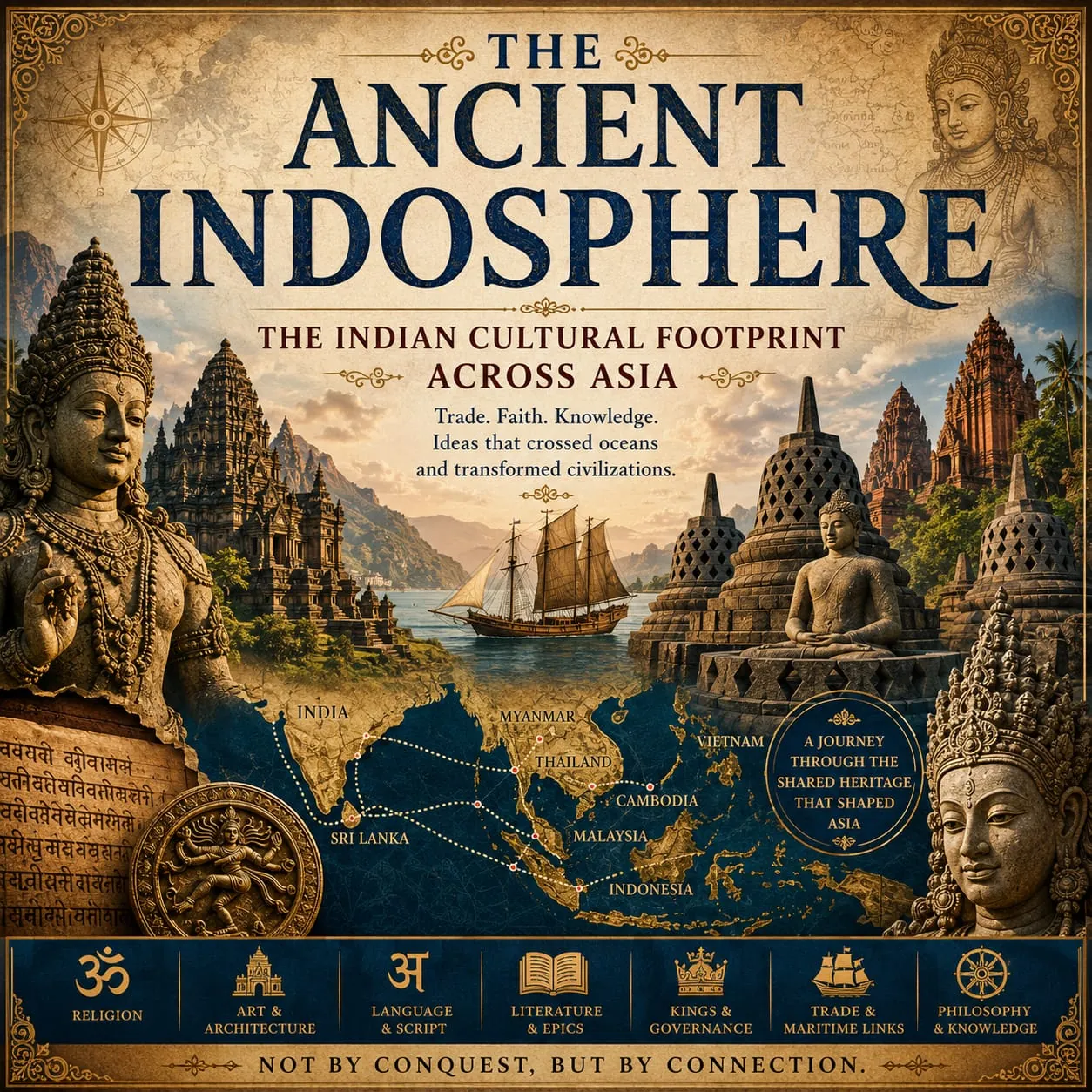
TRAVELLING THROUGH THE TIMELESS LEGACY OF INDIAN CIVILIZATION ACROSS ASIA AND BEYOND
“Not by conquest, but by connection.”
Across ancient temples, sacred stupas, and living cultural landscapes, the timeless traditions born in India continue to illuminate Asia with philosophy, art, and civilizational communion carried not by sword, but through dialogue and spiritual devotion.
CONTINUE THE LAOS JOURNEY
Journey Through the Sacred Monuments of Laos