
KANDY, SRI LANKA — ESALA PERAHERA
Where Sri Lanka’s Buddhist Heritage Meets India’s Cultural Legacy
“The annual Esala Perahera in Kandy is far more than a festival. It feels like the heartbeat of Sri Lanka itself, bringing together faith, history, music, dance, and centuries-old traditions in one extraordinary celebration.”
Staying close to the procession route gave us a rare opportunity to witness how the city transformed each evening into a sea of lights, traditional drums, decorated elephants, dancers, monks, and pilgrims. As sunset approached, Kandy seemed to overflow with humanity. Roads were packed shoulder to shoulder, balconies were crowded with spectators, and even the smallest lanes buzzed with anticipation.
At times, the city felt completely overwhelmed by the crowds, and navigating the streets became exhausting. Route changes and road closures also created confusion for visitors and locals alike. Yet, beneath the chaos was an unmistakable sense that people from across the country had gathered for something sacred, deeply emotional, and profoundly connected to their cultural identity.
Experiencing the Esala Perahera firsthand allowed us to witness one of Sri Lanka’s most treasured religious traditions, where devotion and spectacle come together in a celebration unlike any other.
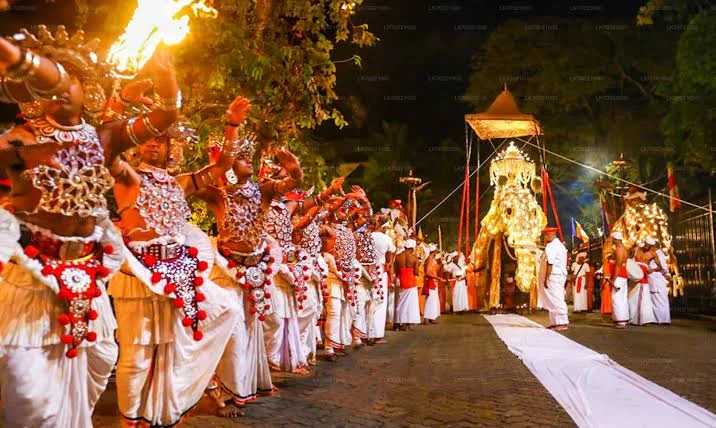
The Grand Nocturnal Pageantry
Ves dancers with blazing torches accompanying the Maligawa Tusker upon the sacred white linen path
Esala Perahera: A Sacred Celebration Connecting Sri Lanka and India
Where Buddhist Sacred Relics Harmonize with Hindu Devale Devotion
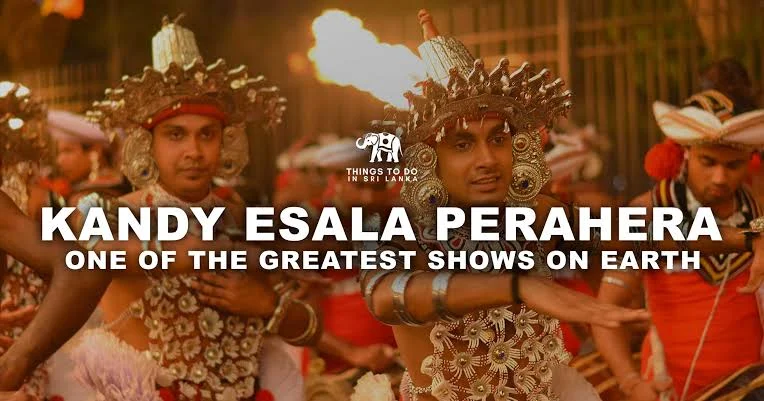
One of the Greatest Shows on Earth
The traditional Kandyan dancers and fire performers leading the grand annual pageant
The origins of the Esala Perahera stretch back centuries and are closely associated with the Sacred Tooth Relic of the Buddha, preserved at the revered Temple of the Sacred Tooth Relic in Kandy.
The relic holds immense spiritual and historical significance in Sri Lanka. Over the centuries, it also became a powerful symbol of kingship and political authority, linking the protection of the relic with the legitimacy of rulers. The grand procession developed into a public expression of devotion, seeking blessings for the nation, its people, and their prosperity.
What fascinated us most was how strongly the festival reflected the deep cultural connections between Sri Lanka and India.
Although the Perahera is centred on Sri Lanka’s Buddhist heritage, its celebrations also incorporate processions associated with Hindu devales dedicated to deities including Vishnu, Kataragama, Natha, and Pattini. These traditions reveal centuries of religious interaction across the island and the wider Indian Ocean region.
The rhythmic drumming, fire dancers, whip crackers, elaborately decorated elephants, and ceremonial rituals reminded us of the magnificent temple festivals of South India. The similarities in music, movement, ceremonial pageantry, and religious devotion offered a vivid reminder of how neighbouring cultures have influenced one another while preserving their own distinctive identities.
For us, the Esala Perahera became more than a spectacular event. It was a living expression of the historical and spiritual connections linking Sri Lanka with the wider cultural world of South Asia.
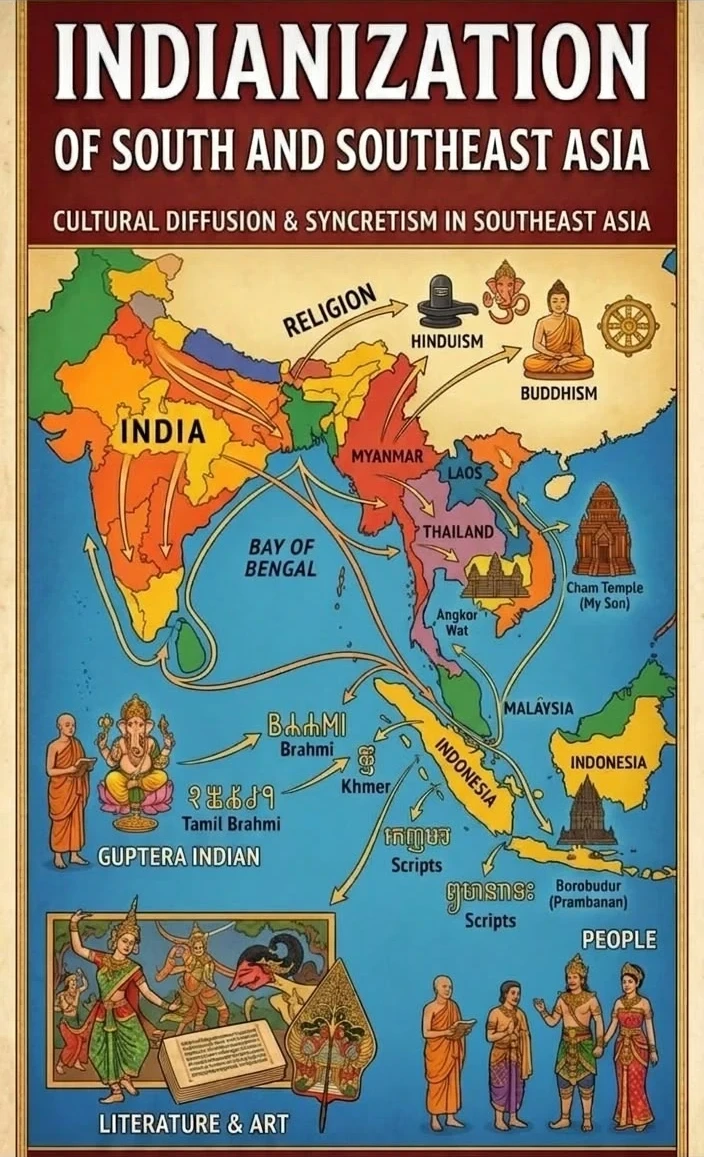
Indianization Across South & Southeast Asia
The maritime and overland diffusion of religion, literature, script, and ceremonial customs across the Indian Ocean
The Five Intertwined Processions of Esala Perahera
Although centred on Buddhist heritage, the Perahera incorporates four Hindu shrines revealing centuries of shared Indic devotion.
Sri Dalada Maligawa
Leads the sacred procession. The grand Maligawa Tusker carries the illuminated golden casket beneath an ornate silk canopy upon consecrated white cloth.
The Sacred Tooth Relic, Kandy: A Symbol of Faith, Kingship, and Sri Lankan Identity
Enshrined within the Historic Octagonal Pavilion and Golden Inner Sanctum
At the heart of the Esala Perahera lies the Sacred Tooth Relic of the Buddha, one of the most revered objects in Sri Lankan Buddhism.
According to Buddhist tradition, a tooth relic survived the Buddha’s cremation and was preserved by devotees. Over time, it became a powerful symbol of religious devotion and royal authority in Sri Lanka. Historical accounts describe how the relic travelled between different centres of power, with rulers attaching great importance to its protection and possession.
Throughout the island’s history, the relic became closely associated with the legitimacy of kings and the protection of the kingdom. Its preservation was therefore not only a religious responsibility but also a matter of profound political and cultural significance.
Today, the relic is enshrined at the Temple of the Sacred Tooth Relic in Kandy, where it continues to attract pilgrims and visitors from around the world.
During the Esala Perahera, a sacred casket associated with the relic is carried in the magnificent procession. It is important to note that the actual Tooth Relic remains enshrined within the temple; the ceremonial casket carried through the streets is not the relic itself.
Watching the procession pass through Kandy, we could sense the reverence with which this tradition is maintained. The elaborate ceremonies, the devotion of the spectators, and the extraordinary care given to every detail reflected the relic’s enduring place in Sri Lanka’s spiritual and cultural identity.
The Golden Casket vs. The Enshrined Relic
The sacred Tooth Relic itself remains permanently safeguarded inside seven nested golden caskets in the innermost chamber of Dalada Maligawa. What journeys through the streets during Esala Perahera is the magnificent ceremonial replica casket (Ransivige), allowing the public to receive blessings without endangering the holy relic.
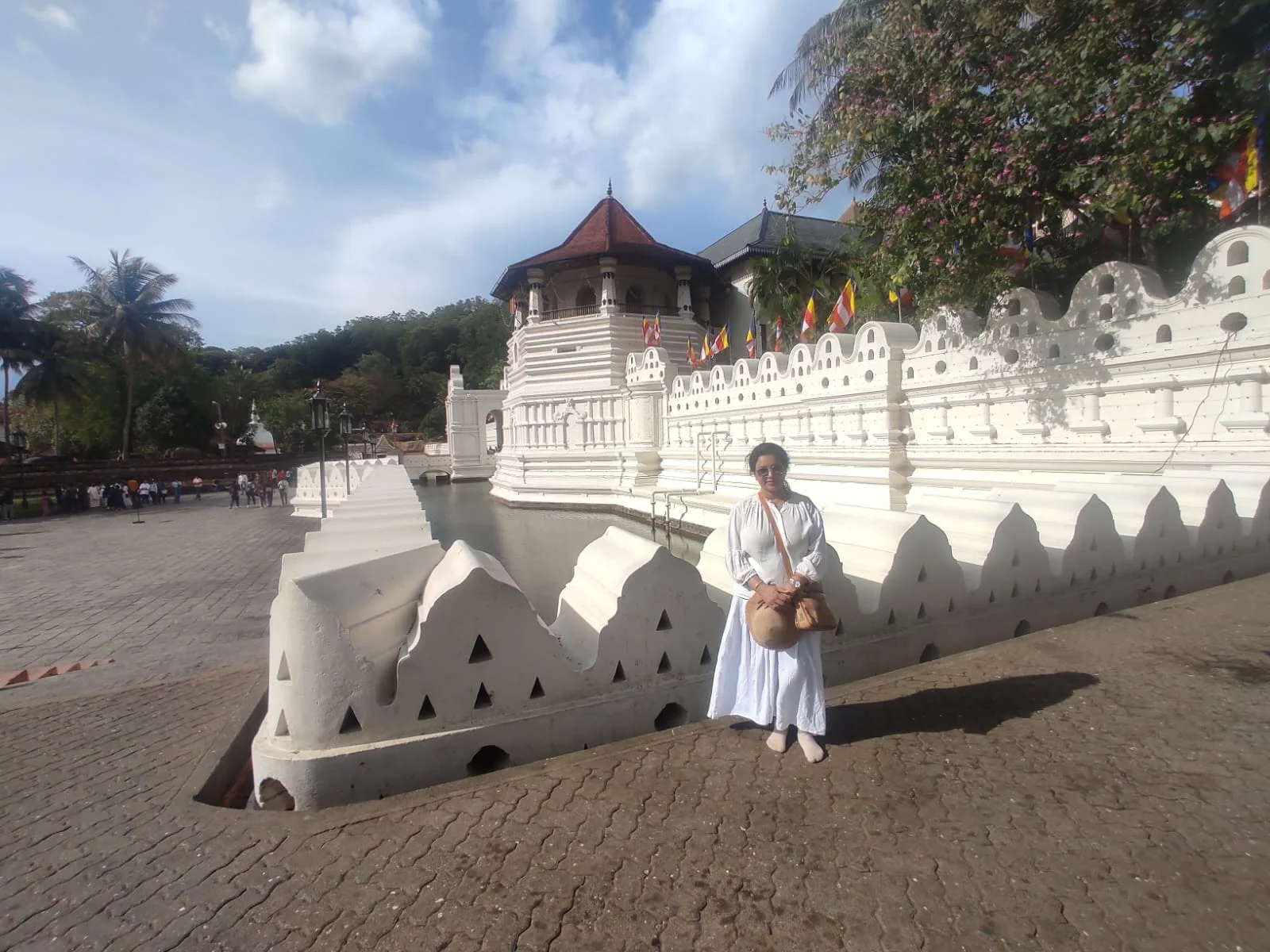
The Octagonal Tower & Cloud Wall
The famous Walakulu Bamma (cloud wall) and Paththirippuwa octagonal pavilion in daylight
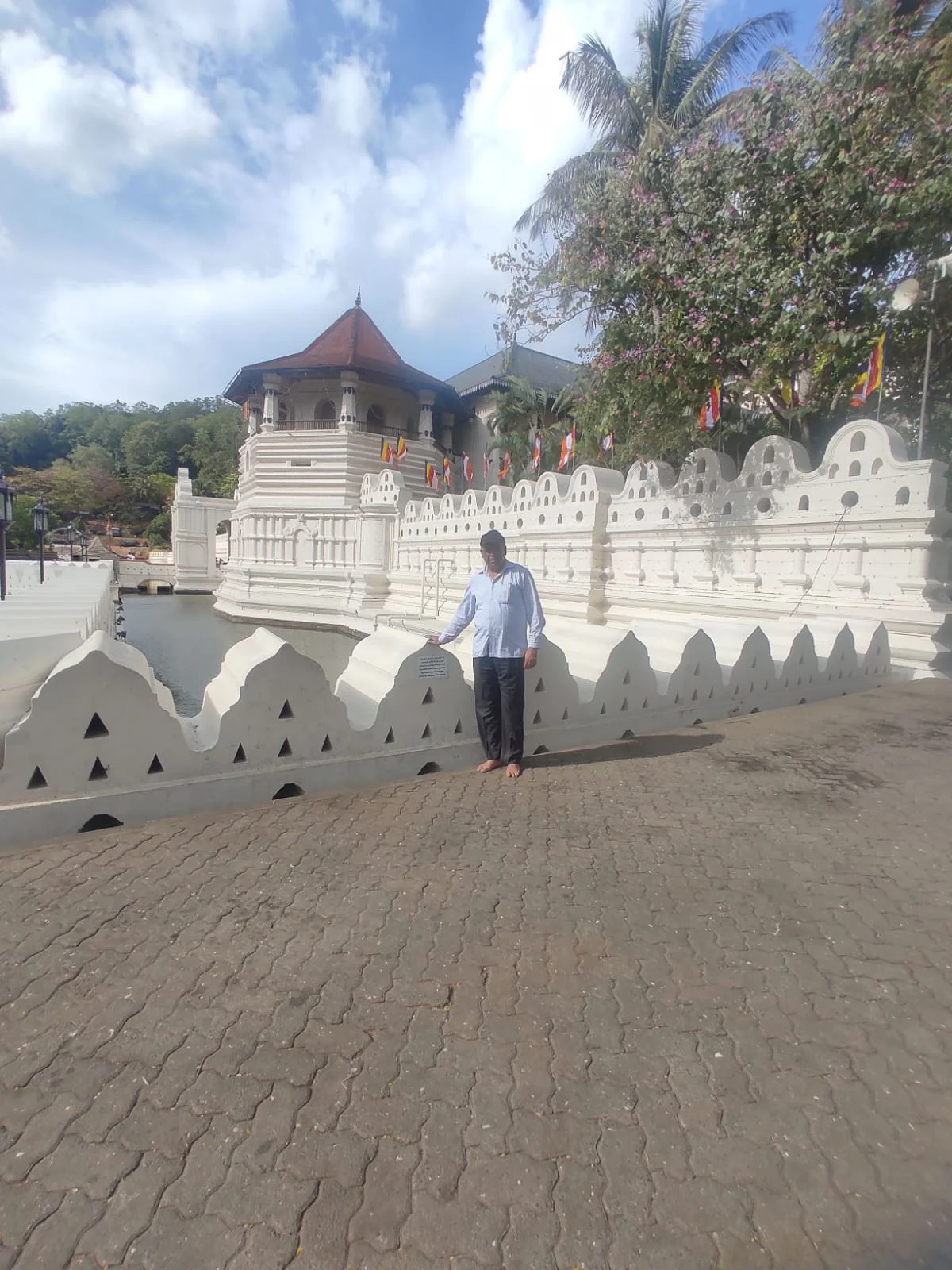
By the Sacred Waters
The perimeter of the royal palace complex and moat overlooking the tranquil Kandy Lake
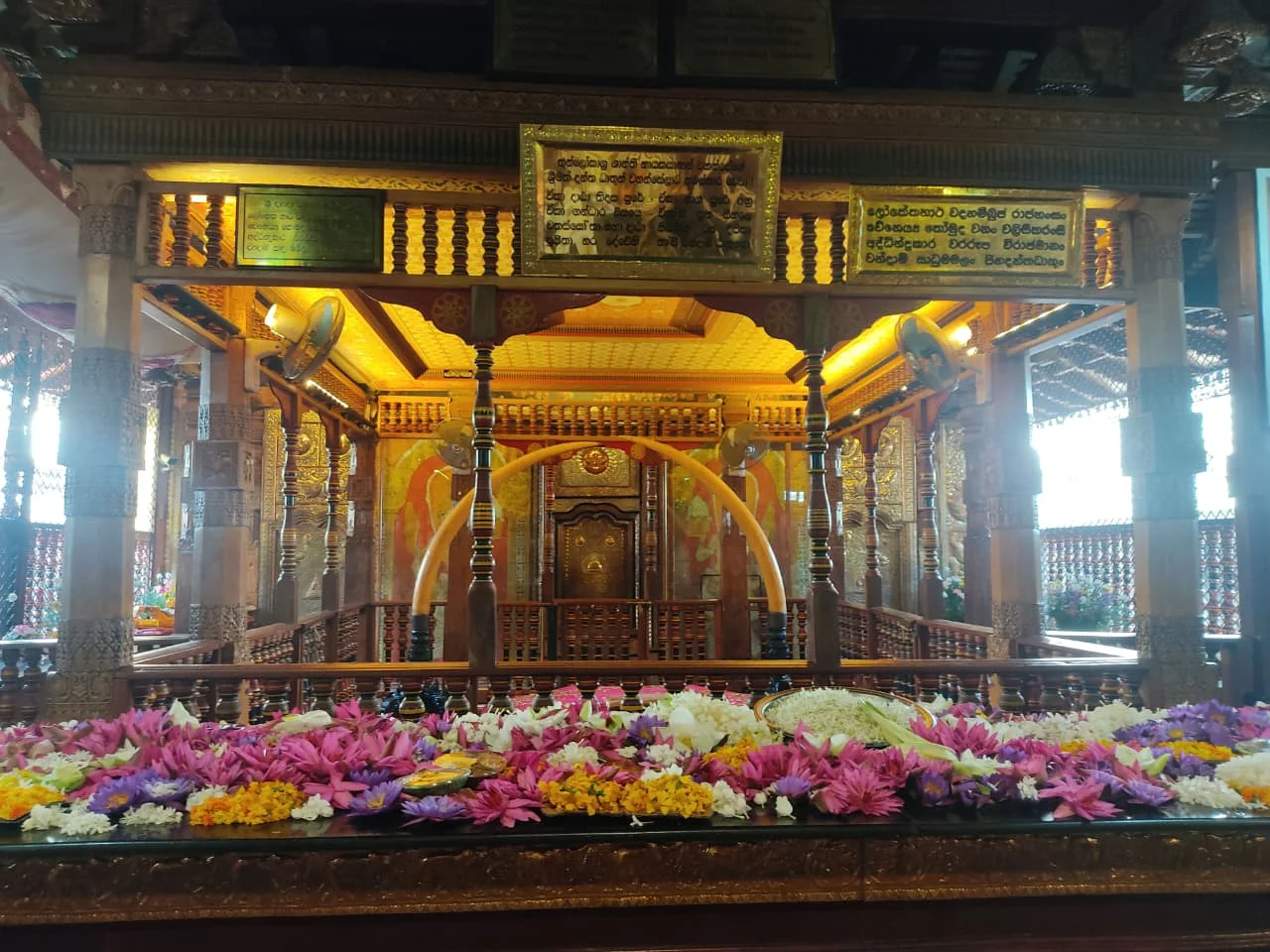
A Sea of Lotus Offerings
Devotees place thousands of freshly bloomed lotus blossoms before the carved ivory tusks and golden shrine
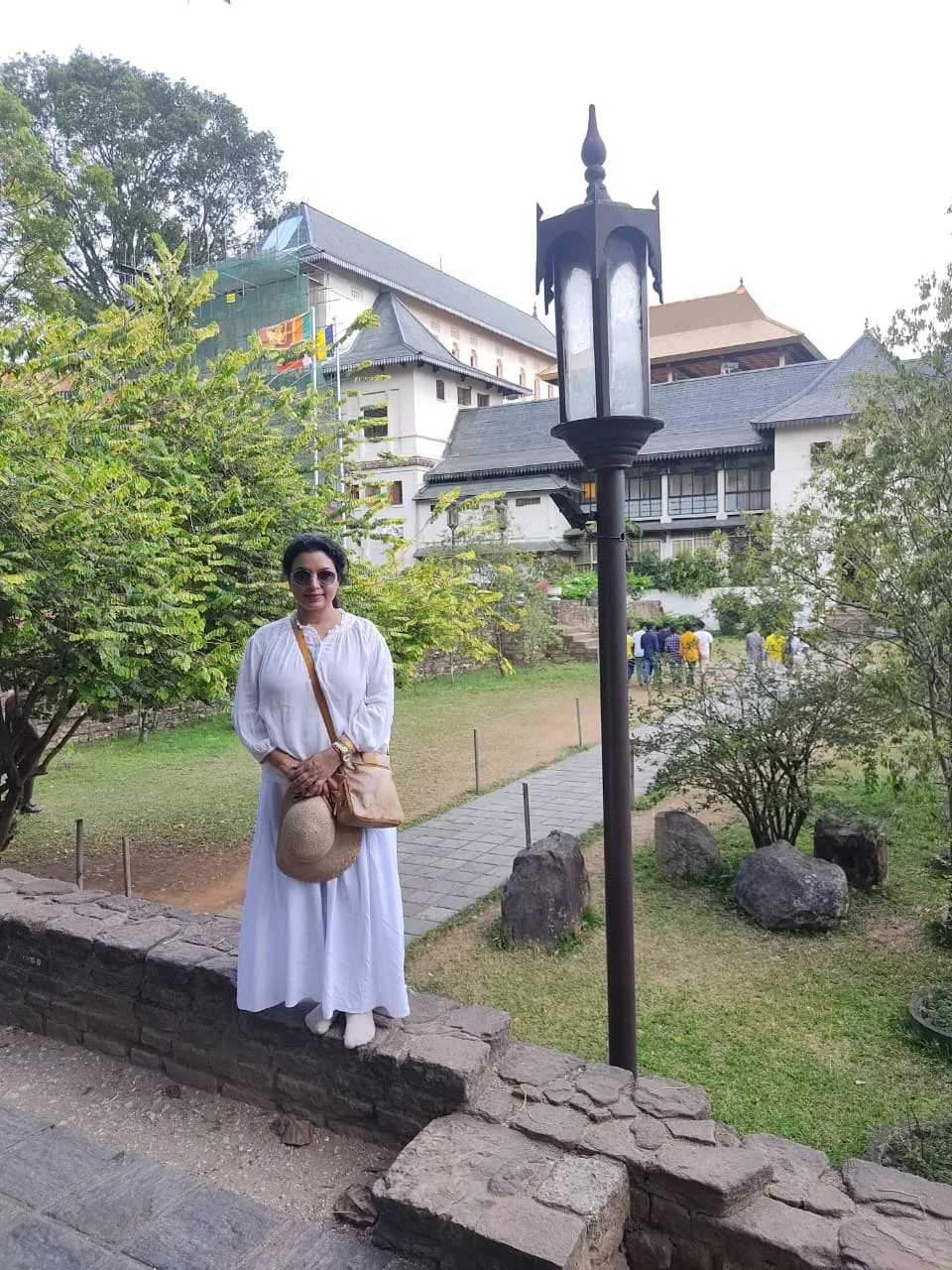
Gardens of Tranquility
Historic stone foundations, ceremonial lanterns, and serene garden walkways surrounding Dalada Maligawa
Kandy Esala Perahera: A Living Expression of Faith
Thunder of Drums, Flaming Torches, and Caparisoned Tuskers Under the Night Sky
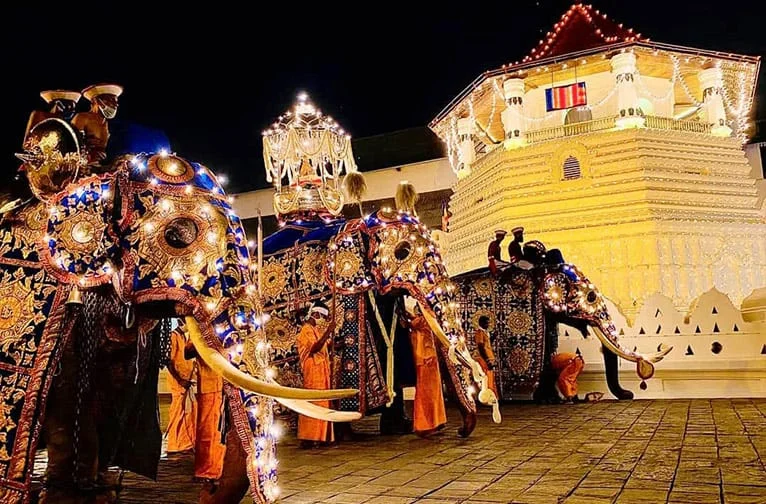
The Golden Gathering of Tuskers
Caparisoned elephants bathed in thousands of electric bulbs outside the glowing octagonal pavilion
Watching the Perahera at night was mesmerising.
One moment, the streets would seem to pause in anticipation. Then, suddenly, the silence would give way to the thunder of traditional drums and the glow of flaming torches. The procession would emerge, bringing with it a dazzling display of movement, colour, and sound.
The elephants moved majestically through the crowded streets, adorned in glittering ceremonial garments. Traditional dancers performed intricate movements beneath the lights, while drummers maintained powerful rhythms that seemed to echo through the entire city. Fire performers and whip crackers added to the intensity of the spectacle.
Everywhere, we could see devotion. People sat patiently for hours, families gathered together, and pilgrims waited for a glimpse of the sacred procession. For many, this was not simply entertainment but an opportunity to participate in a cherished religious tradition.
Despite the crowds, road closures, and occasional confusion, the experience carried an energy that was impossible to forget. The combination of spiritual reverence and extraordinary pageantry created an atmosphere that remained with us long after the procession had passed.
The Esala Perahera is not merely a parade. It is a living expression of faith, history, artistic tradition, and the cultural connections that have linked Sri Lanka with India and the wider Asian world for centuries.
The Sacred Order of the Nocturnal Procession
Kasakkarayo (Whip Crackers)
Clearing the Sacred CorridorCrackers with giant bullwhips whose echoing cracks warn the crowd and announce the holy procession's arrival.
Ginikeli Karayo (Fire Acrobats)
Sanctifying the AtmosphereAcrobats spinning twin fireball poles, breathing flame, and illuminating the nocturnal darkness with sacred fire.
Hewisi & Geta Bera Drummers
The Pulse of LankaOver a hundred traditional Kandyan percussionists beating thunderous, complex polyrhythms on double-ended drums.
Ves Dancers (Kandyan Dancers)
Sacred Invocation to the DeitiesPerformers in elaborate silver headgear, beadwork breastplates, and jingling anklets executing ancient ceremonial leaps.
The Maligawa Tusker (Ransivige)
The Apex of DevotionThe majestic tusker bearing the illuminated golden reliquary casket under a silk canopy, walking upon pure white pawada cloth.
Witnessing Sri Lanka’s Grandest Cultural Spectacle: Two Evenings at the Kandy Esala Perahera
Balcony Seats at an Indian Restaurant, White Clothes of Reverence, and the Kindness of Tourist Police
We were fortunate to witness the magnificent Kandy Esala Perahera on two different evenings, watching the grand procession pass from an Indian restaurant overlooking the route.
Because the procession follows different routes on different days during the festival, each evening offered a distinct atmosphere and perspective. Experiencing it twice allowed us to appreciate the scale of the celebrations and the dedication involved in organising such an enormous cultural event.
By around 4 PM, large sections of Kandy were already being closed to traffic as the city prepared for the procession. Roads were barricaded, crowds gathered along the route, and spectators began securing their places hours before the festivities reached them.
Finding a comfortable viewing position during the festival can be extremely difficult. We were fortunate to secure seats at the restaurant with assistance from the tourist police, who were available to help visitors navigate the crowded streets.
We also purchased white clothes for the occasion, as white is widely associated with purity and is commonly worn for Buddhist religious observances in Sri Lanka. Dressing respectfully helped us feel more connected to the solemnity and cultural significance of the occasion.
From our seats, we watched the extraordinary spectacle unfold late into the night. Illuminated elephants, traditional drummers, dancers, whip crackers, and torch bearers moved through the packed streets in a seemingly endless procession.
The experience offered us the best of both worlds: the comfort of a place to sit and the opportunity to witness the festival’s full magnificence.
Looking back, those two evenings remain among the most unforgettable moments of our Sri Lankan journey. The Esala Perahera allowed us to experience the country’s spiritual traditions not from a distance, but from within the living rhythm of its people.
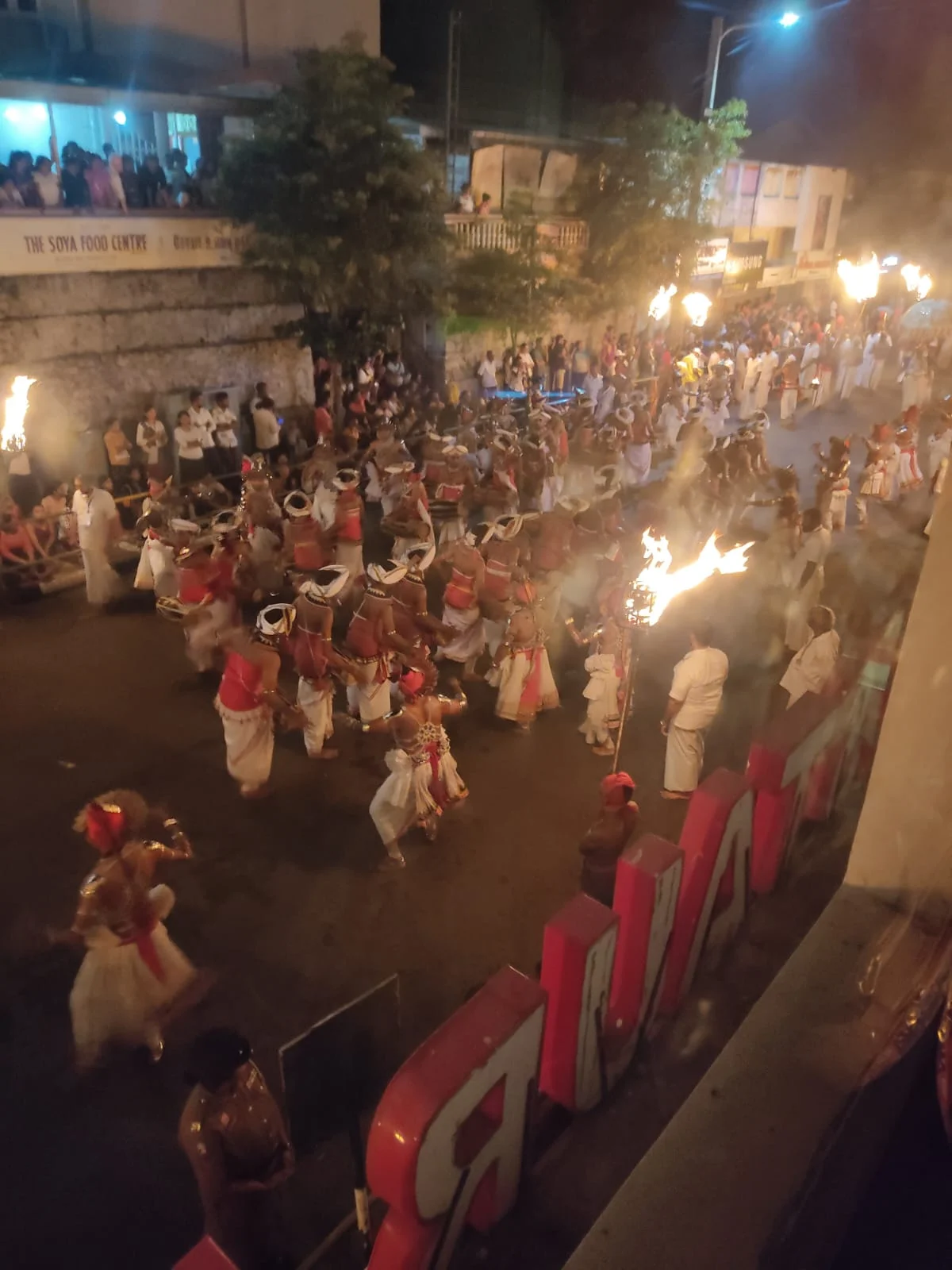
A Sea of Torches and Devotion
Looking down upon the surging procession route framed by the red lettering of the restaurant balcony
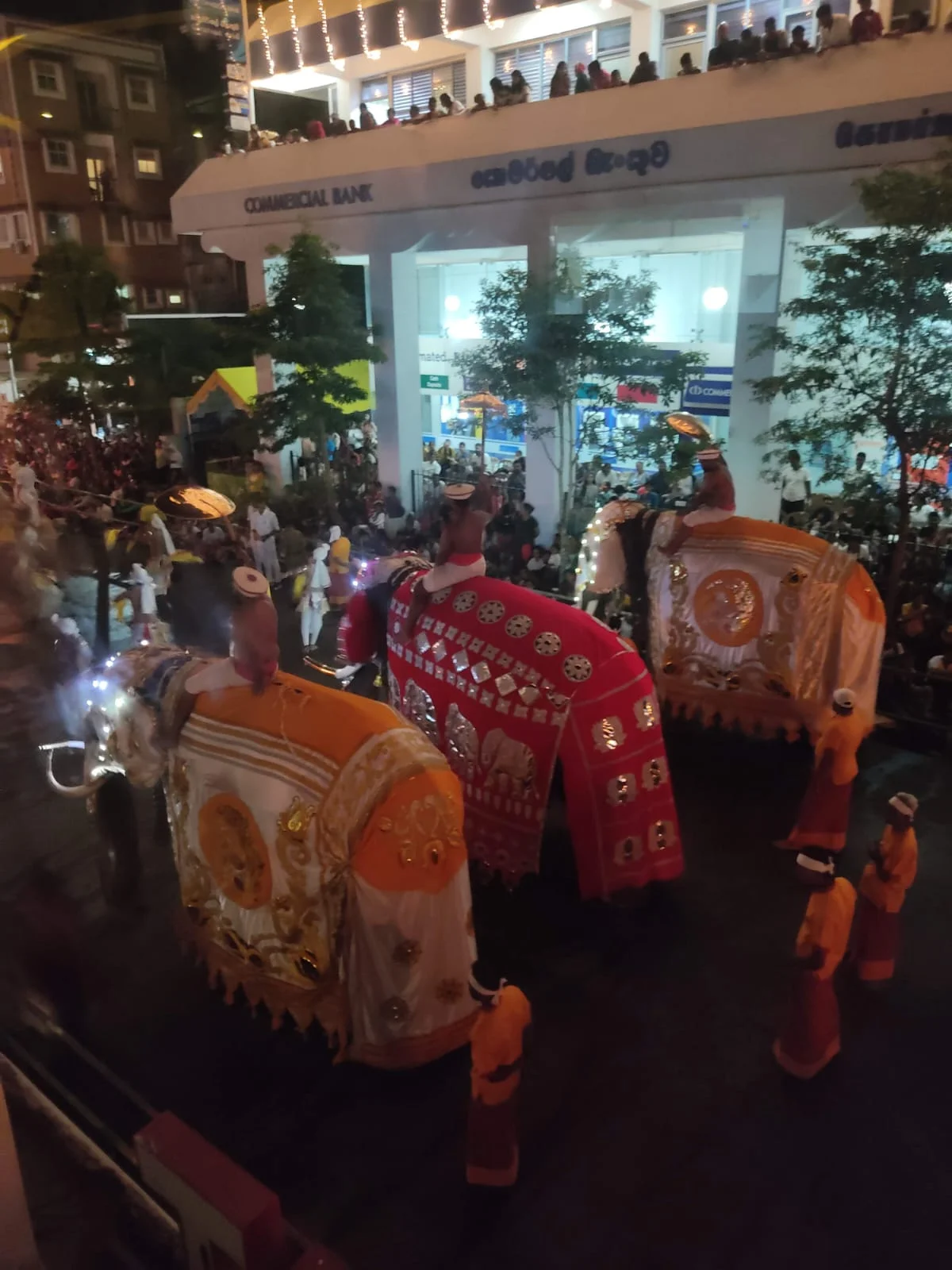
Three Royal Elephants in Formation
Adorned in intricate embroidered robes sparkling with thousands of electric bulbs in the Kandy night
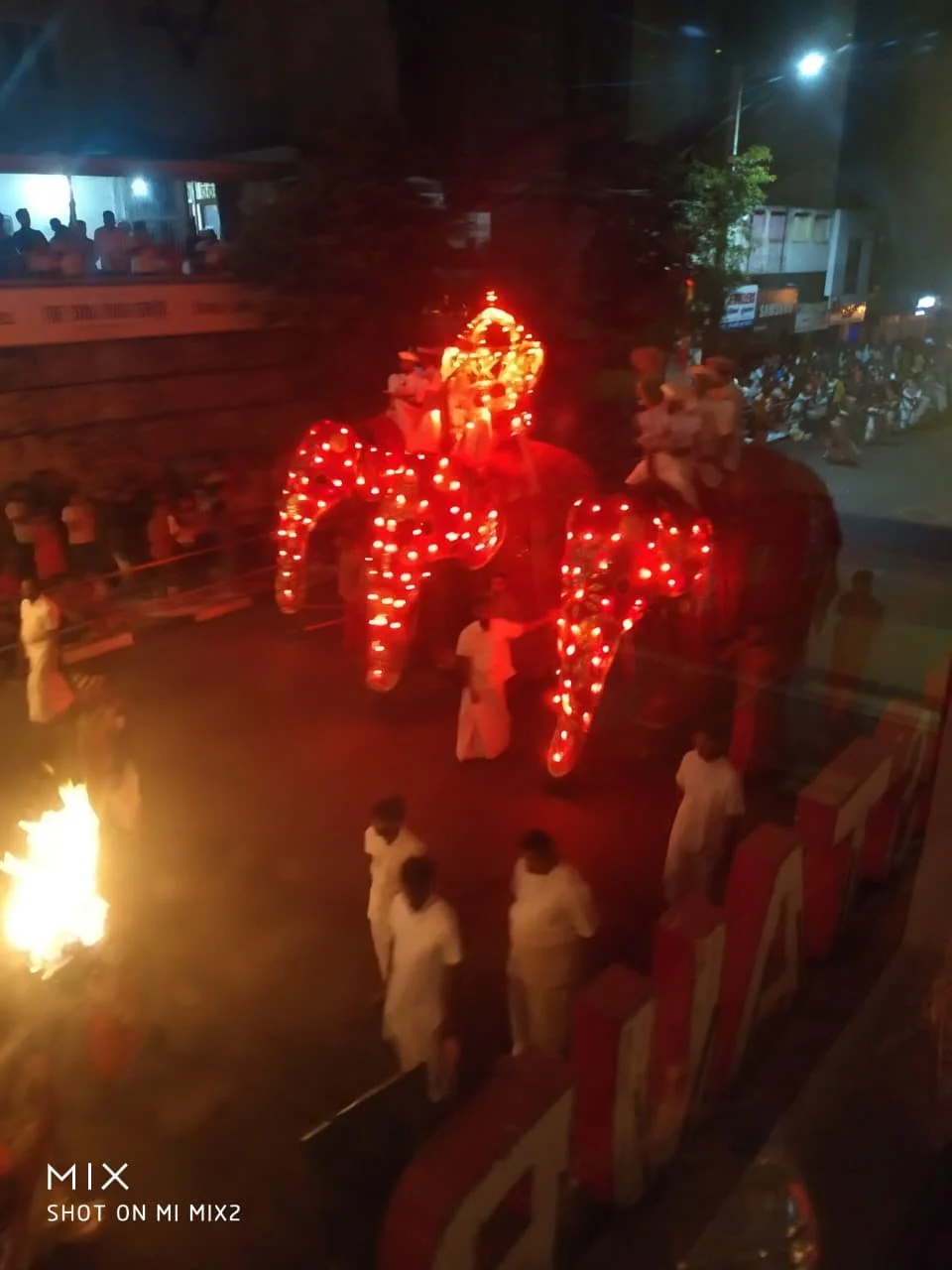
The Crimson Glow of the Devales
Elephants draped in vibrant ruby-red lights illuminating the enthusiastic faces of thousands of spectators
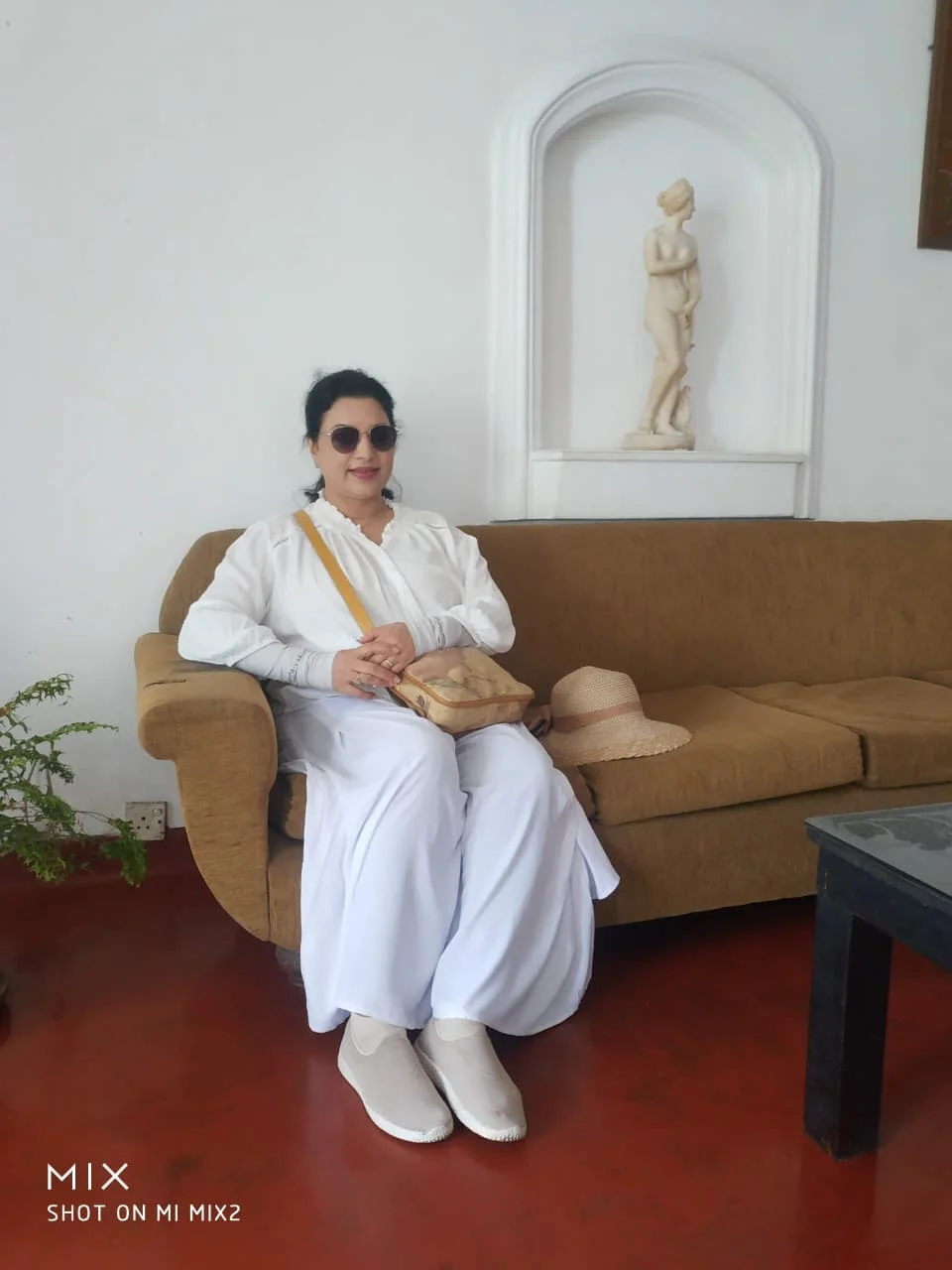
Wearing White for the Occasion
Purchased traditional white attire honoring Buddhist custom and shared spiritual reverence
Peradeniya: When Even the Trees Seemed to Dance After Kandy’s Divine Carnival
Serenity at the Royal Botanical Gardens Where the Magic of the Perahera Lingered
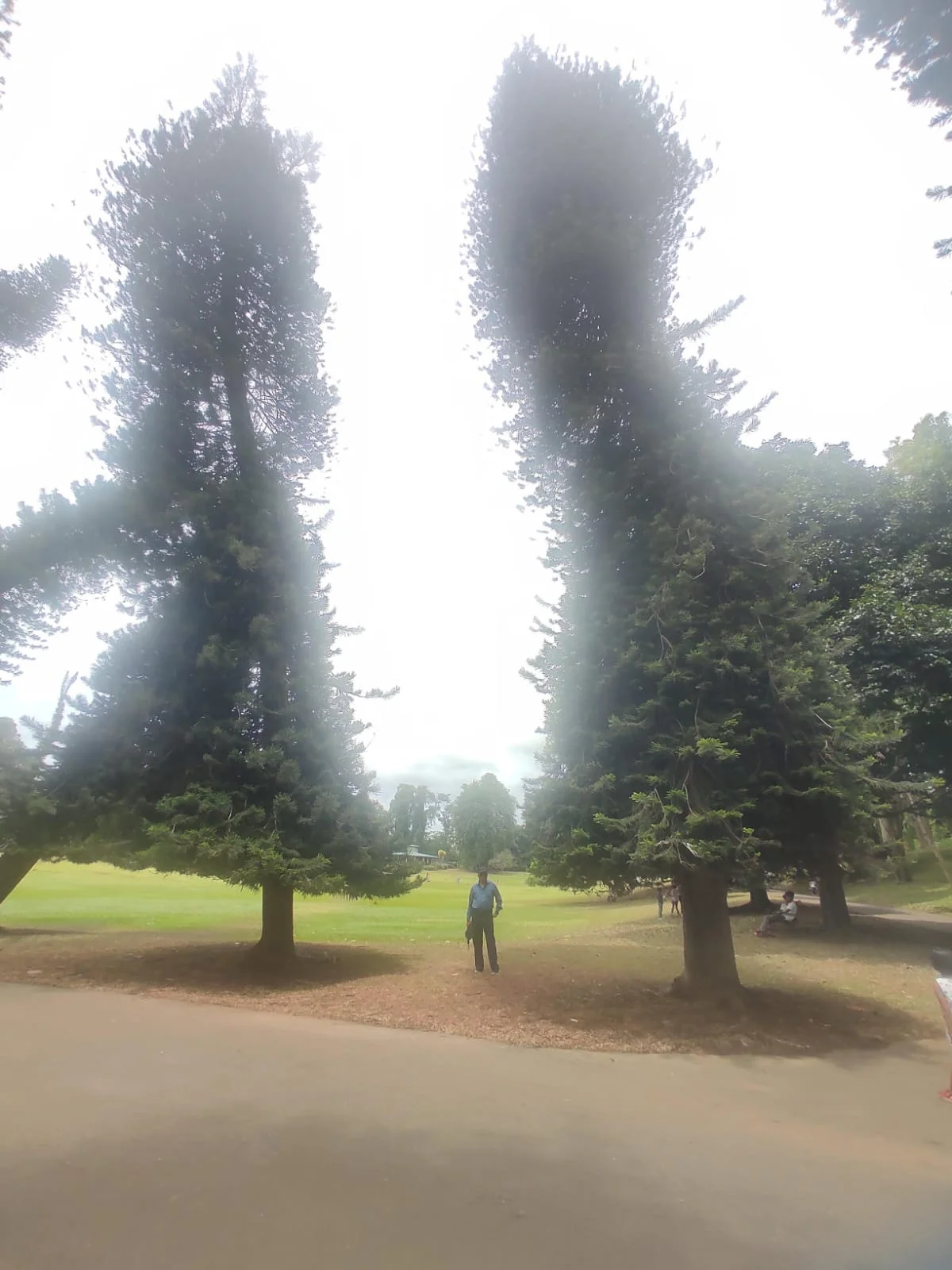
Between the Dancing Pines
Towering Cook pines swaying gently against the mountain breeze, echoing the joyful rhythms of the festival
“As I stood between two towering trees in the botanical garden for a photograph, I suddenly felt that the trees themselves were gently dancing. Their branches seemed to sway in silent joy, as if they too were celebrating the divine carnival of the Perahera.”
After two hectic days at the magnificent Kandy Esala Perahera, spending a quiet day in the serene Royal Botanical Gardens at Peradeniya felt almost surreal.
The atmosphere was completely different. The thunder of drums had given way to the gentle sounds of nature, the crowds had disappeared, and the dazzling procession seemed like a beautiful dream from the previous night.
Yet, something about the experience of the Perahera had changed the way I saw the world around me. Ordinary sights appeared brighter, more colourful, and strangely alive, as though the festival’s music, lights, dancers, and elephants had left their magic behind.
As I stood between two towering trees in the botanical garden for a photograph, I suddenly felt that the trees themselves were gently dancing. Their branches seemed to sway in silent joy, as if they too were celebrating the divine carnival of the Perahera.
For a moment, nature itself seemed to have become part of the celebration.
It was an unexpected and deeply personal feeling, difficult to explain but impossible to forget. After witnessing one of Sri Lanka’s grandest expressions of devotion, even the stillness of a garden seemed filled with movement, rhythm, and life.
Perhaps that is the lasting magic of travel. Sometimes, an experience does more than show us a place. It changes how we see everything that comes afterwards.
Tips for Experiencing the Kandy Esala Perahera
Essential practical advice gathered firsthand for attending Sri Lanka’s grandest annual religious pageant
Book accommodation early
The festival attracts large crowds, so reserve your accommodation well in advance, particularly if you want to stay near the procession route.
Arrive early
Road closures and security arrangements can begin well before the procession. Reach your viewing area early to avoid unnecessary stress and secure a comfortable position.
Consider a restaurant overlooking the route
Reserved seating can provide an excellent view without requiring you to stand in crowded streets for hours. Check the exact location, viewing arrangements, and reservation terms before booking.
Check the procession route
The route and road closures can vary between evenings. Ask your accommodation provider or local authorities for the latest information before heading out.
Dress respectfully
White is a popular choice for religious occasions in Sri Lanka. Comfortable, modest clothing is advisable, particularly when visiting temples or participating in religious activities.
Carry water and essential items
The crowds, warm weather, and long waiting periods can be tiring. Carry drinking water, keep essential belongings secure, and wear comfortable footwear.
Follow local advice
Tourist police and local officials can help visitors understand road closures, locate viewing areas, and navigate the crowds.
Be patient and respectful
The Esala Perahera is a deeply meaningful religious event for many Sri Lankans. Follow local instructions, respect ceremonial spaces, and be considerate of worshippers and fellow spectators.
Kandy, Sri Lanka: Where Faith, History, and Cultural Heritage Come Alive
A living celebration of shared history, enduring devotion, and the sacred echoes of India across the ocean
Our experience of the Kandy Esala Perahera revealed a side of Sri Lanka that cannot be fully understood through photographs or travel guides alone.
We witnessed a city transformed by devotion, where ancient rituals unfolded beneath the night sky and thousands of people gathered to honour a sacred tradition. The illuminated elephants, powerful drumming, graceful dancers, and ceremonial procession created a spectacle of extraordinary beauty.
Yet, beyond the grandeur, it was the devotion of the people that touched us most deeply. Their patience, faith, and emotional connection to the festival revealed how profoundly the Esala Perahera remains woven into Sri Lanka’s cultural identity.
The festival also reminded us of the historical connections between Sri Lanka and India. Through Buddhism, Hindu traditions, artistic exchanges, pilgrimage, and centuries of movement across the Indian Ocean, the two lands have influenced one another in ways that continue to be visible today.
From the sacred Tooth Relic in Kandy to the unforgettable procession through the city’s crowded streets, our journey became a celebration of living heritage, shared history, and the enduring power of faith.
And even after the drums faded and the crowds dispersed, the spirit of the Perahera seemed to follow us, lingering in our memories and transforming an ordinary afternoon among the trees of Peradeniya into something extraordinary.
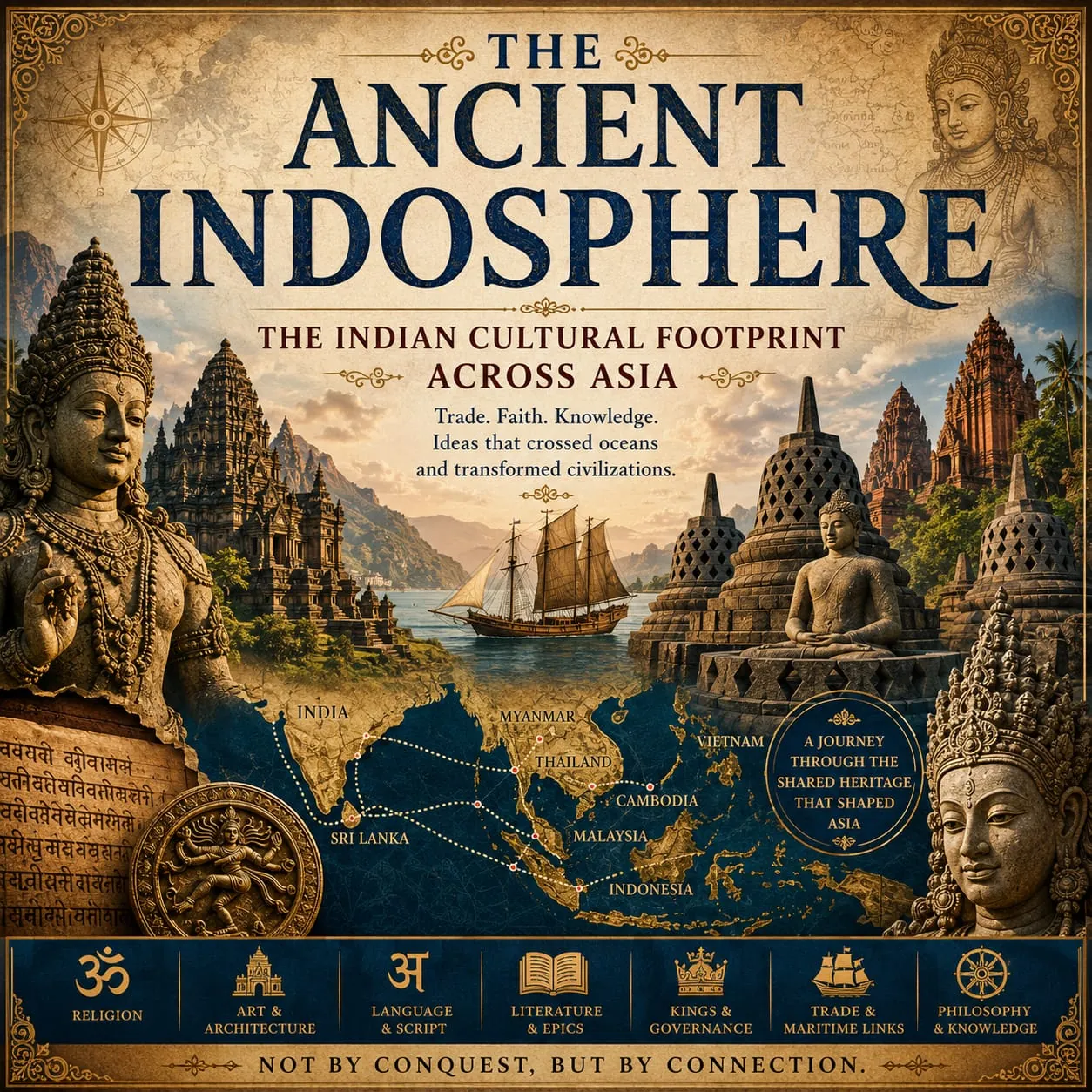
TRAVELLING THROUGH THE TIMELESS LEGACY OF INDIAN CIVILIZATION ACROSS ASIA AND BEYOND
“Not by conquest, but by connection.”
Across ancient temples, sacred stupas, and living cultural landscapes, the timeless traditions born in India continue to illuminate Asia with philosophy, art, and civilizational communion carried not by sword, but through dialogue and spiritual devotion.
CONTINUE THE SRI LANKA JOURNEY
Journey Through the Sacred Monuments of Sri Lanka