
THE SAFFRON PATH
Following the Ancient Journey of Buddha’s Wisdom Across the Indian Ocean
“Buddhism travelled across Asia not through conquest, but through cultural exchange, religious missions, and royal patronage.”
Buddhism, founded on the teachings of Gautama Buddha in ancient India around the fifth century BCE, gradually spread beyond its homeland through the efforts of monks, merchants, pilgrims, and royal patrons. Rather than relying primarily on conquest, its teachings travelled through cultural exchange, religious missions, and the movement of people across Asia.
During the reign of Emperor Ashoka in the third century BCE, Buddhism received significant royal support and began reaching new regions beyond the Indian subcontinent. According to Sri Lankan Buddhist chronicles, Ashoka supported a mission led by his son Mahinda to introduce Buddhist teachings to Sri Lanka during the reign of King Devanampiya Tissa. His daughter Sanghamitta is traditionally credited with bringing a branch of the sacred Bodhi tree to the island.
These events became foundational to Sri Lanka’s Buddhist heritage. Over the centuries, the island developed a rich tradition of Theravada Buddhism, expressed through magnificent temples, sacred relics, ancient murals, meditation centres, and vibrant religious ceremonies.
Our journey through Sri Lanka offered us an opportunity to experience this living heritage firsthand, from the remarkable cave sanctuaries of Dambulla to the peaceful temples of the southern coast, the Sacred Tooth Relic in Kandy, and the vibrant Buddhist complex of Colombo.
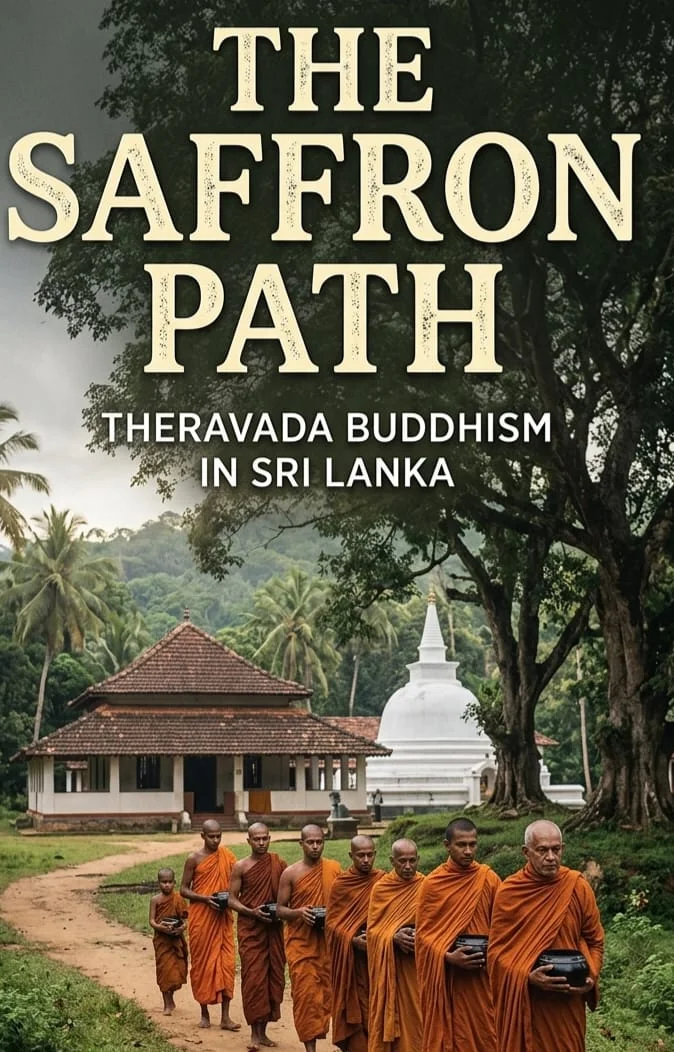
The Saffron Path
Theravada Buddhism in Sri Lanka: tracing the timeless journey of Buddha's wisdom and Emperor Ashoka's royal missions across the ocean.
Dambulla Cave Temple
Preserving Centuries of Buddhist Devotion Carved into Living Granite
We visited the magnificent Dambulla Cave Temple on a day trip from Kandy, and it turned out to be one of the most memorable spiritual destinations of our journey through Sri Lanka.
Recognised as a UNESCO World Heritage Site, the temple complex is among the island’s most remarkable and best-preserved examples of Buddhist cave art. Its religious history stretches back more than two thousand years, while the caves and their artistic treasures developed through successive periods of royal patronage and religious devotion.
Built into a massive rock overlooking the surrounding countryside, the complex contains five principal shrine caves adorned with Buddha statues, painted ceilings, and colourful murals depicting episodes from Buddhist tradition.
As we entered the caves, we were struck by the extraordinary combination of art, architecture, and spirituality. Rows of Buddha images occupied the sacred interiors, while intricate paintings covered the walls and ceilings in rich shades of red, gold, ochre, and other earthy colours.
The atmosphere felt calm and timeless. Standing inside these ancient sanctuaries, we found ourselves admiring not only the artistry but also the generations of devotion that had preserved this sacred place.
Dambulla offered us a powerful glimpse into how Buddhism flourished in Sri Lanka and how religious communities transformed natural landscapes into enduring centres of worship and artistic expression.
“Dambulla offered us a powerful glimpse into how Buddhism flourished in Sri Lanka and how religious communities transformed natural landscapes into enduring centres of worship and artistic expression.”
— Spiritual Sanctuary at Dambulla Cave Temple
Devaraja Viharaya, Maharaja Viharaya, Maha Alut Viharaya, Pachima Viharaya, and Devana Alut Viharaya carved under the sheer overhang of rock.
A magnificent assembly of seated, standing, and colossal reclining Buddha sculptures carved with profound elegance.
Ceilings and stone vaults painted in natural mineral ochres, cinnabar, and gold depicting the Temptation of Mara and the Dhammacakkappavattana Sutta.
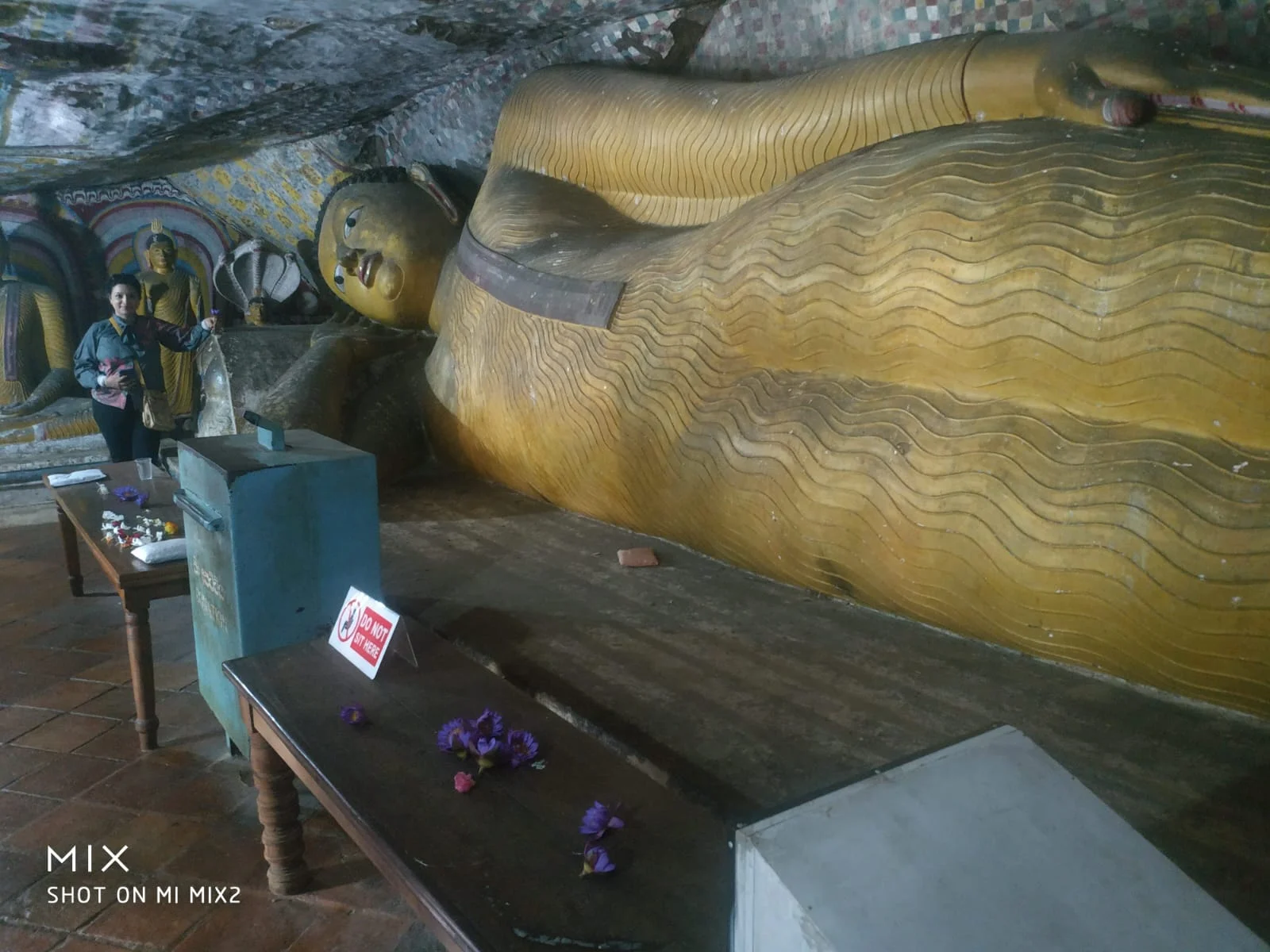
The Reclining Buddha at Dambulla
Carved directly from living rock, the 14-metre Parinirvana Buddha lies peacefully with exquisite pillow detailing and gilded feet.
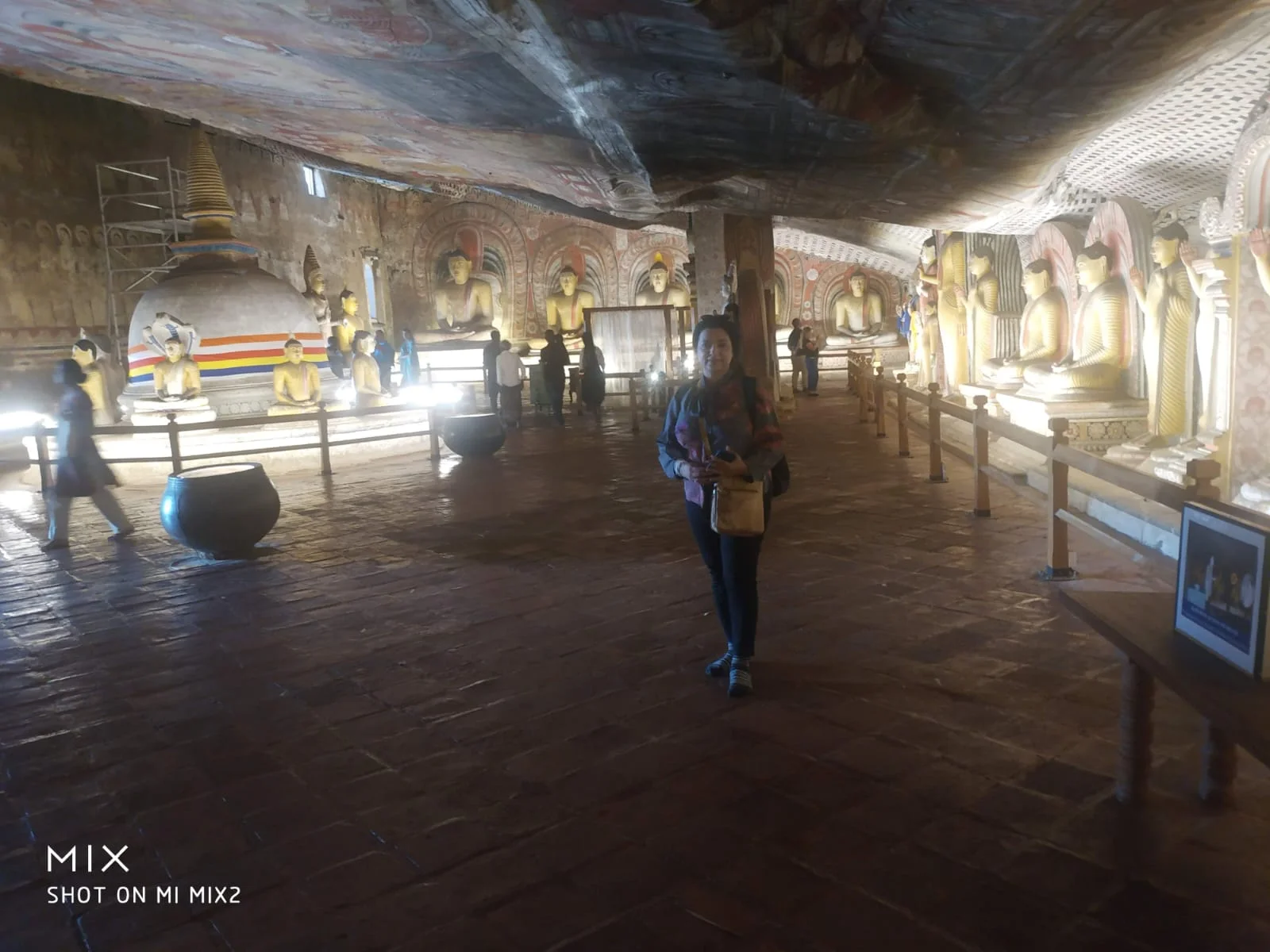
Temple of the Great Kings
Featuring an interior dagoba, natural rock drip-ledge, and statues of King Valagamba and King Nissanka Malla among illuminated Buddhas.
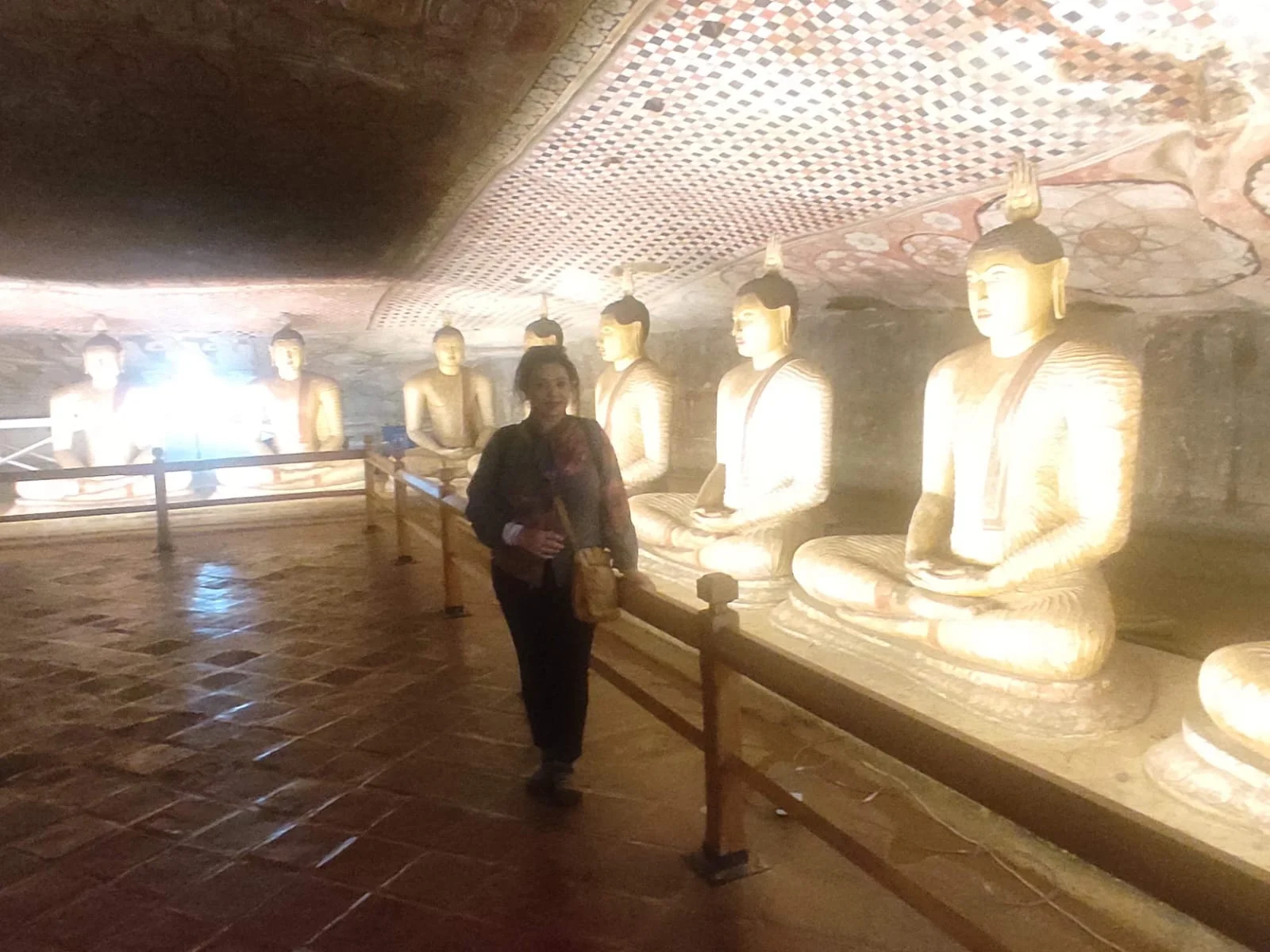
Vibrant Ochre & Gold Frescoes
Centuries of sacred rock art covering natural contoured stone vaults with rhythmic patterns of meditation Buddhas.
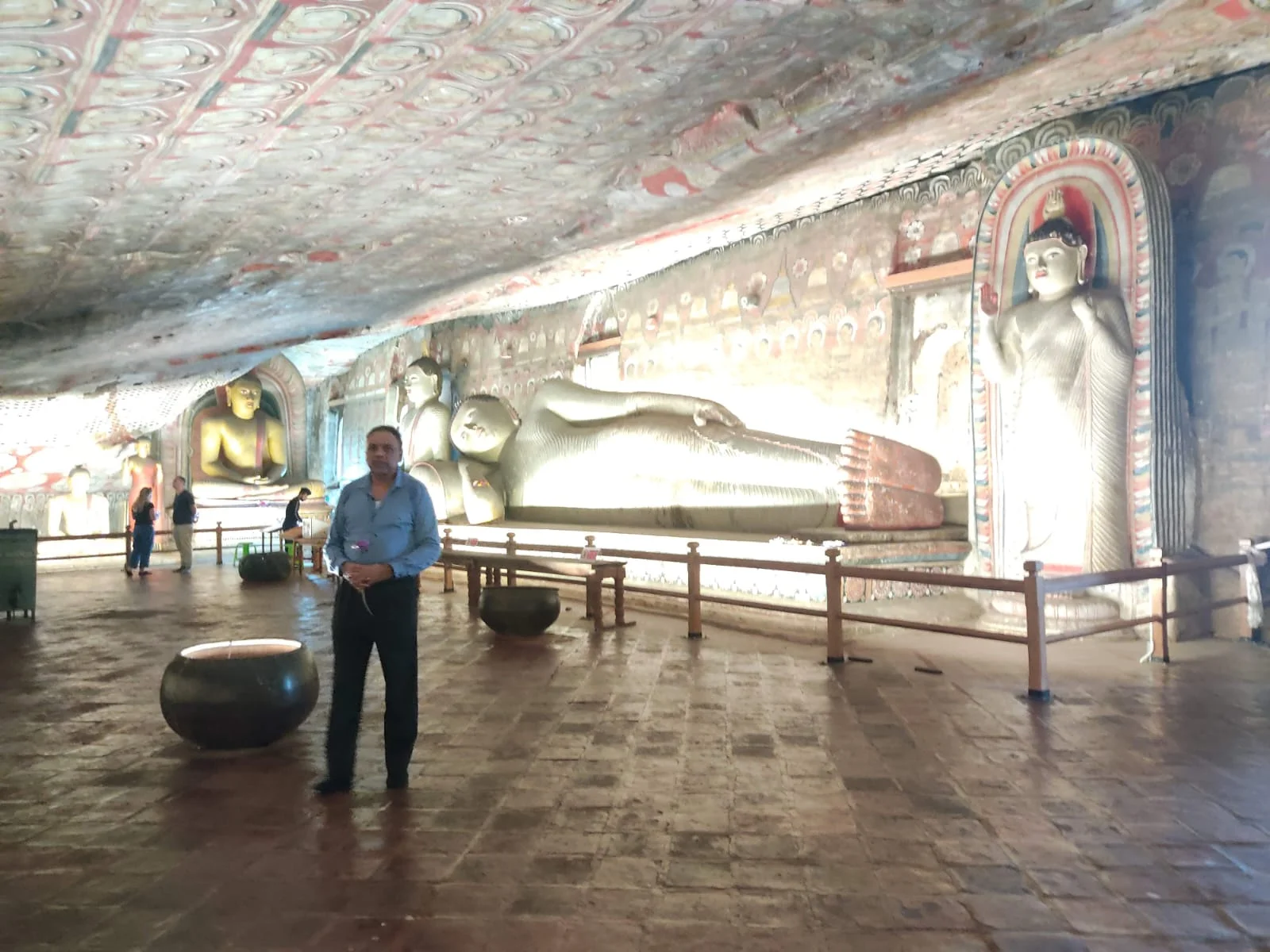
Paying Respects in the Granite Sanctum
A moment of devotion with fresh lotus blossoms placed before ancient rock sculptures amidst silent reverence.
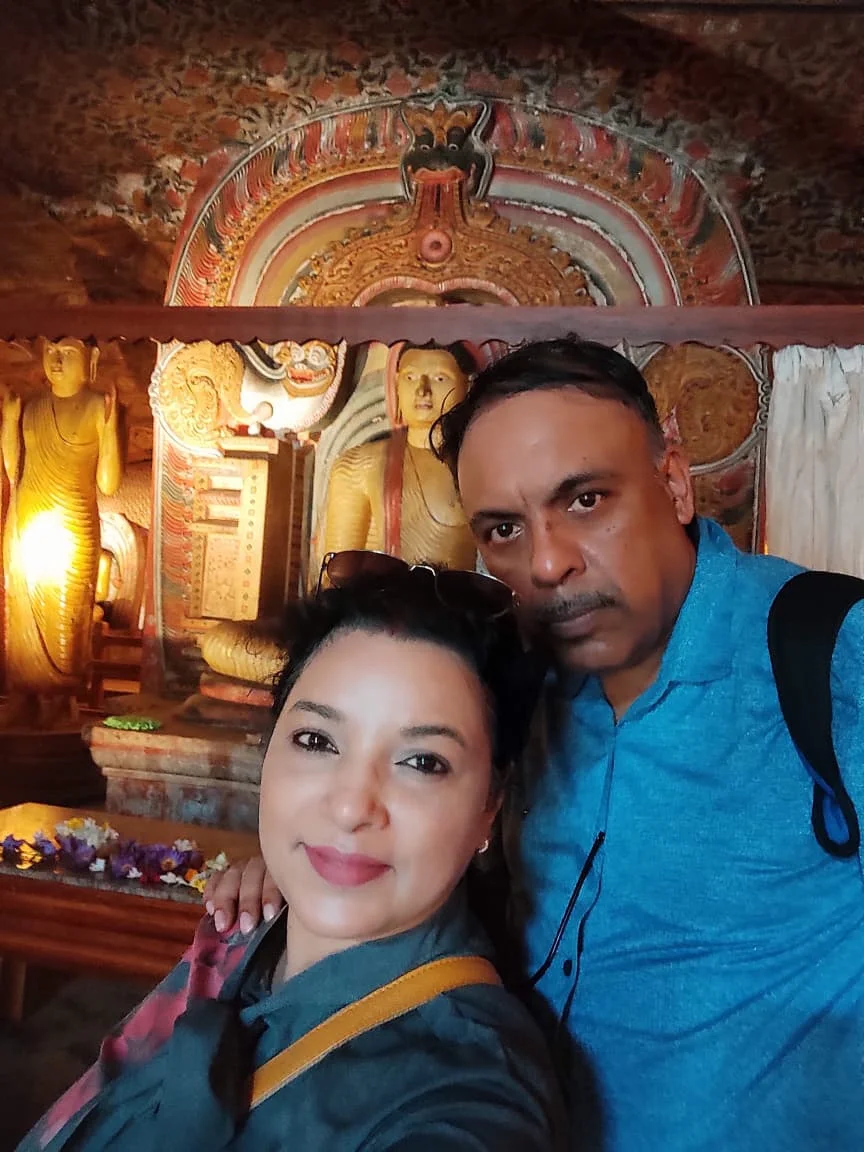
Dragon Archway of Transcendence
Intricate mythical Makara arch framing a seated Buddha statue, showing traditional Indian-Sinhalese decorative synergy.
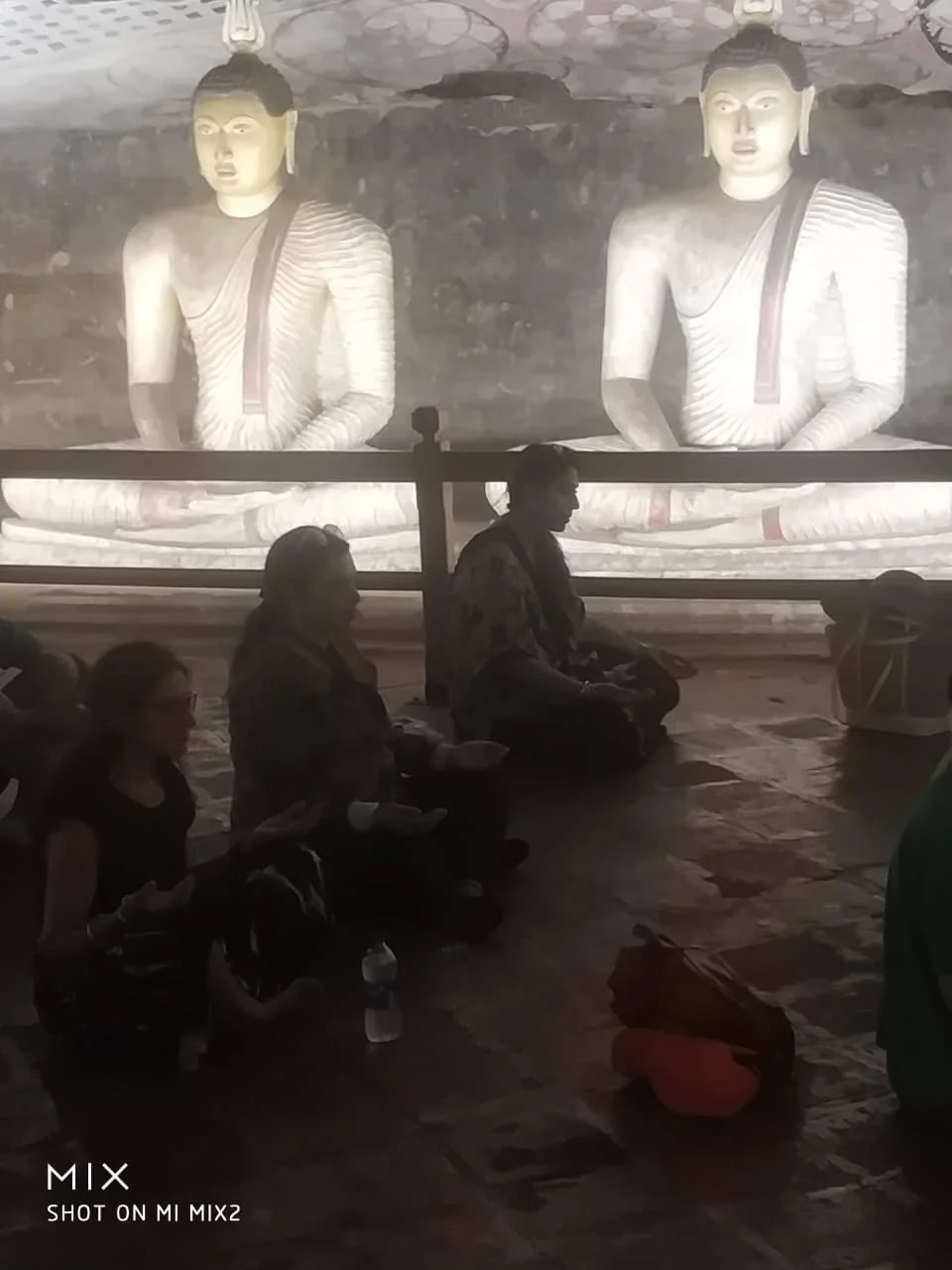
Quiet Stillness in the Cavern
Sitting on cool stone floors before illuminated Buddha statues, absorbing the sacred energy and stillness of millennia.
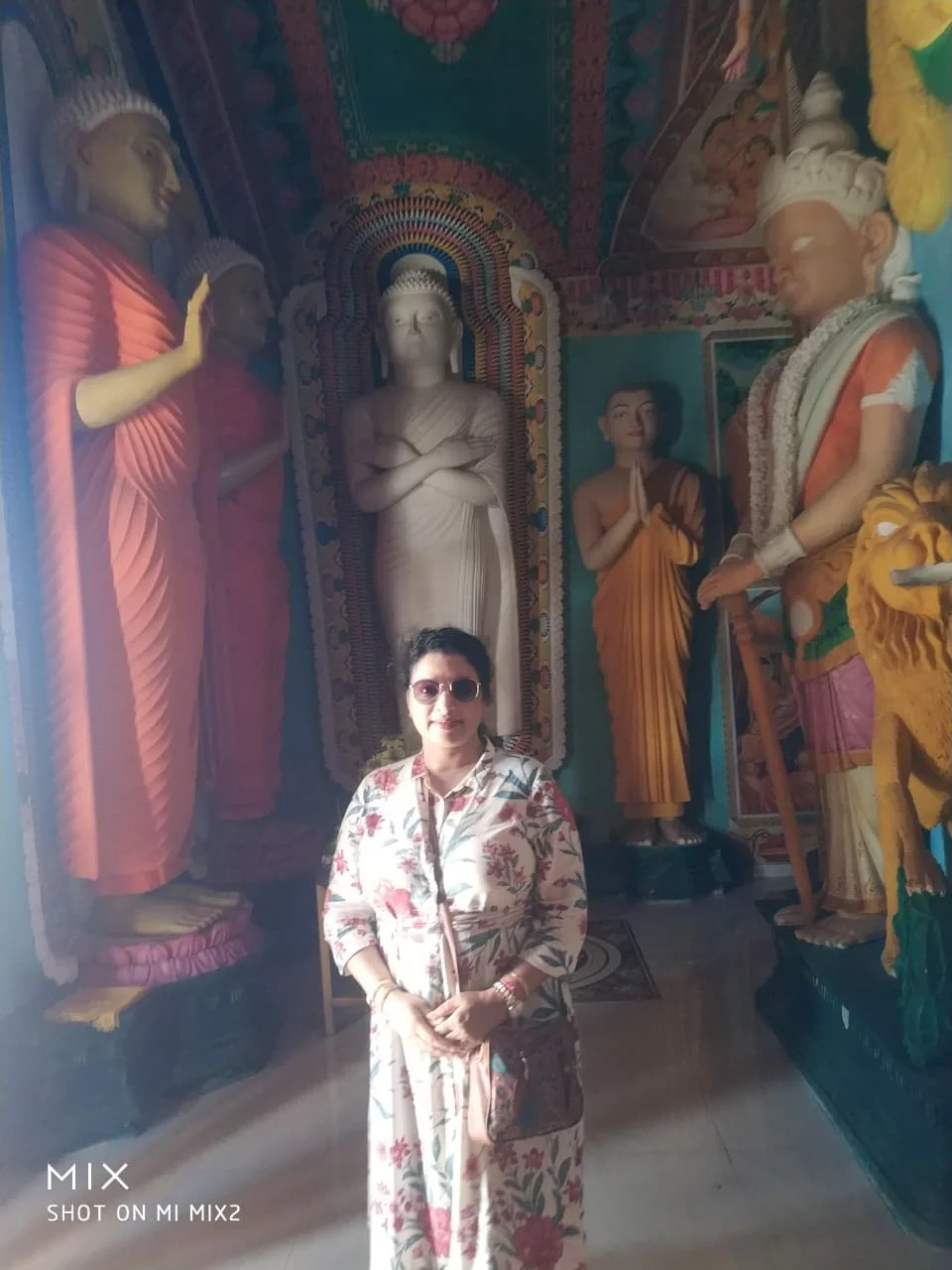
Abhaya Mudra of Fearlessness
The standing Buddha offering protection with raised right hand, flanked by attendant disciples and protective celestial devas.
A Rewarding Ascent to Sacred Caves
Climbing the Granite Rock and Unveiling Panoramic Plains
The weather was quite warm during our visit, and reaching the caves required climbing a long series of stone steps. Although the ascent was tiring, the experience was absolutely worthwhile.
Along the way, we encountered beautiful views of the surrounding countryside. The higher we climbed, the more expansive the landscape became, with green plains stretching towards the distant hills.
We also visited another beautiful Buddhist temple nearby, adding further depth to our day’s spiritual exploration.
Once we reached the cave complex, the peaceful surroundings offered a welcome contrast to the heat and effort of the climb. Exploring the shrines at a relaxed pace allowed us to appreciate the Buddha statues, colourful murals, and distinctive atmosphere of each cave.
The combination of physical effort, breathtaking scenery, and spiritual tranquillity made Dambulla one of the most rewarding stops on our journey through Sri Lanka.
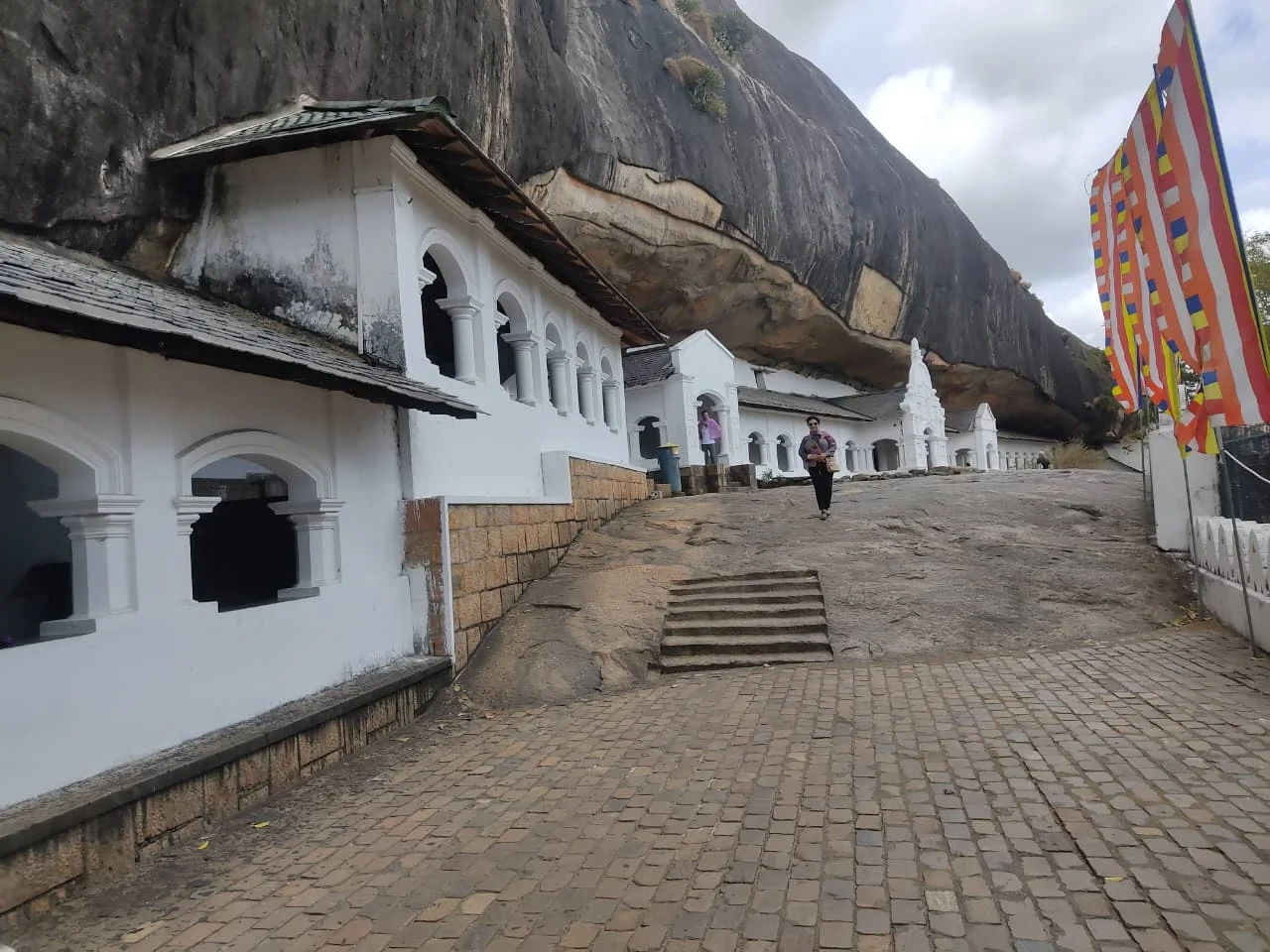
Colonnaded Veranda Beneath Massive Overhang
The elegant whitewashed entrance corridor constructed under the colossal black granite cliff with colourful Buddhist flags.
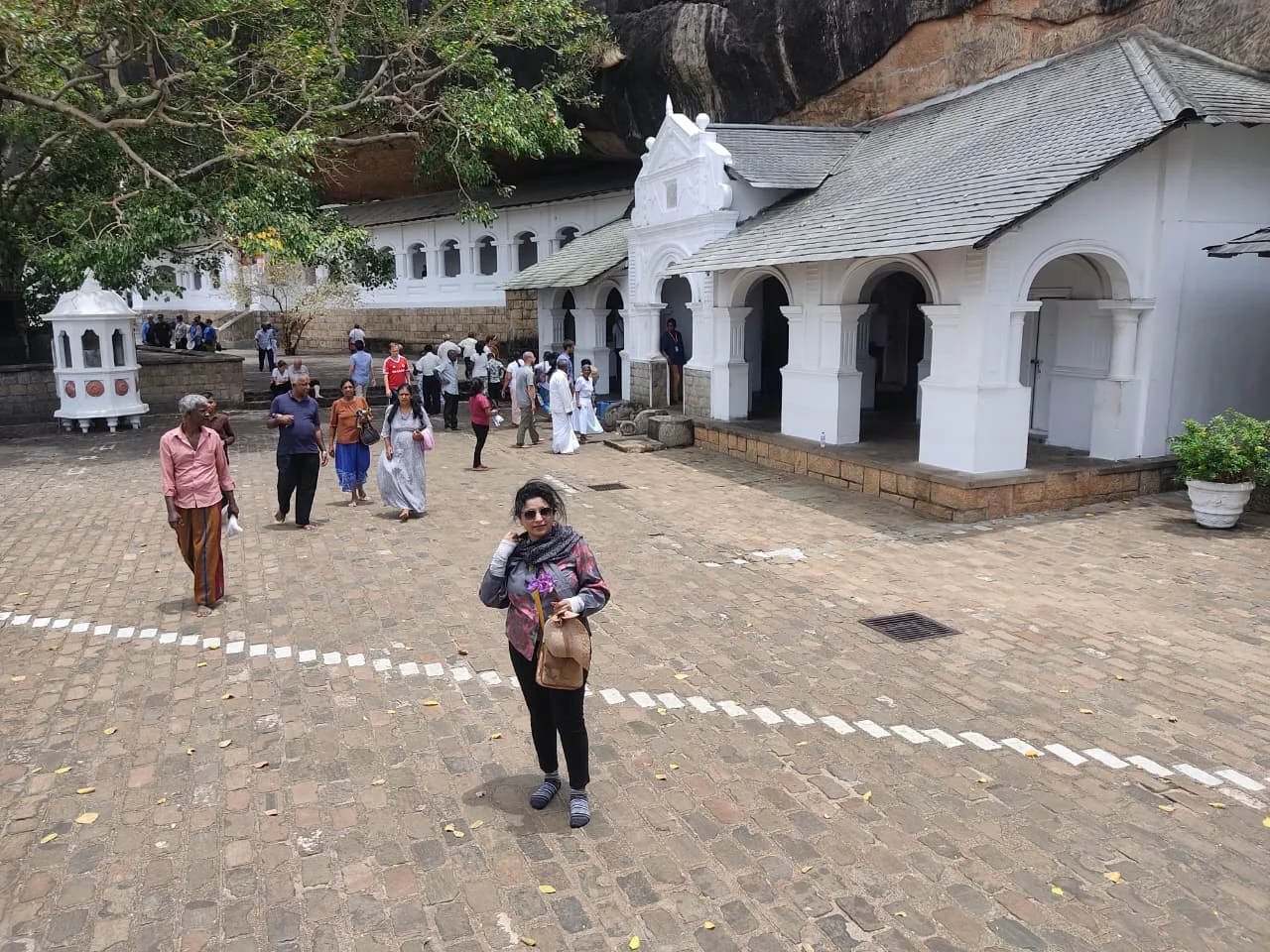
Walkway Along the Great Rock
Pilgrims journeying across stone-paved terraces overlooking the lush Sri Lankan plains, leading directly into the cave entrances.
The Sacred Harmony of Dambulla
Why Hindu Deities Appear Within a Buddhist Sanctuary
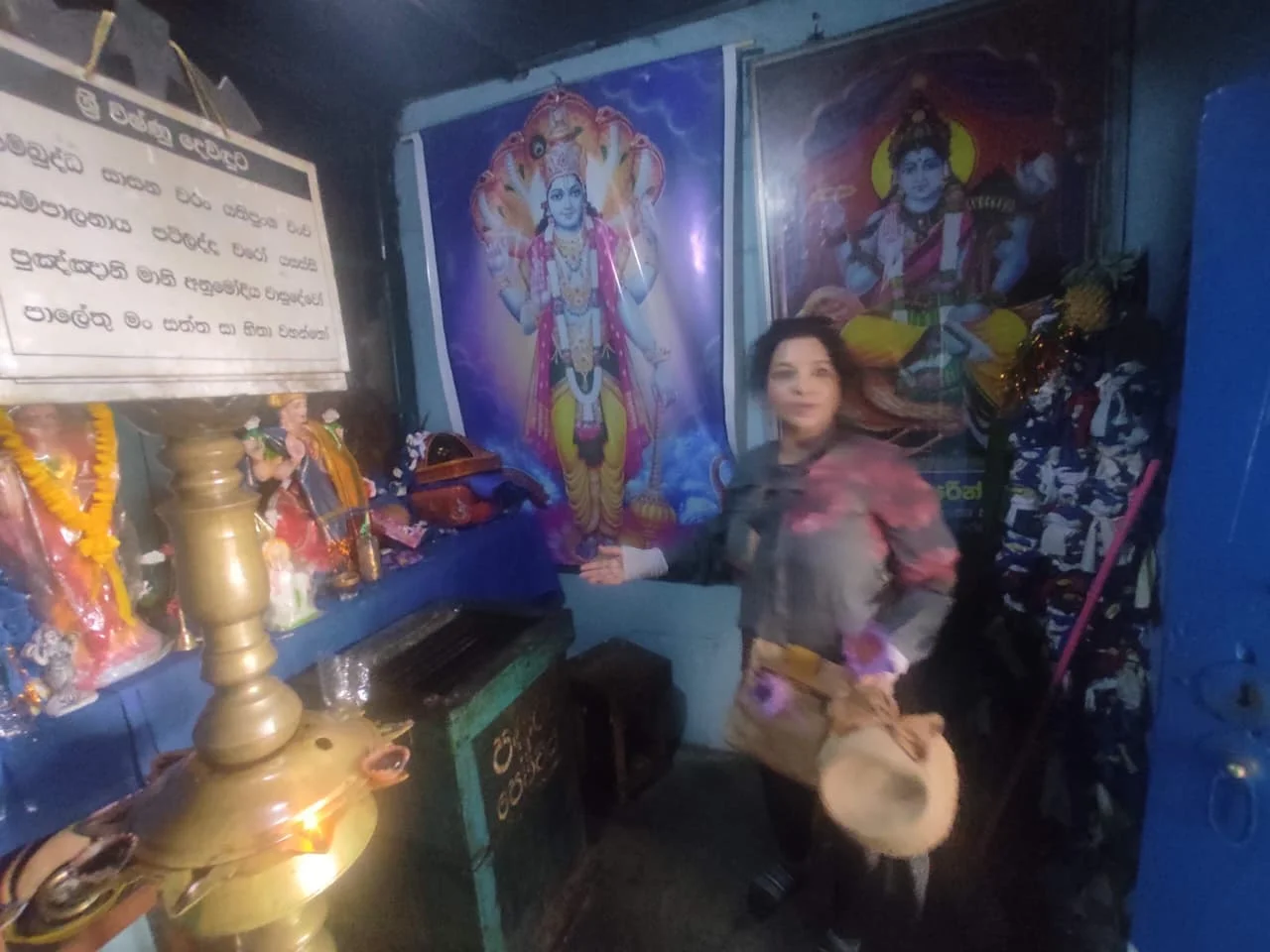
The Guardian Deva Shrine
A traveler standing with folded hands before the painted image of Lord Vishnu / Upulvan within the Dambulla cave complex, illuminated by a traditional oil lamp.
One of the fascinating aspects of Sri Lanka’s religious landscape is the historical relationship between Buddhism and Hindu traditions.
At Dambulla and other Buddhist sites across the island, Hindu deities such as Vishnu appear within religious settings associated with Buddhist worship. This reflects centuries of interaction between religious traditions, royal patronage, and local devotional practices.
Within Sri Lankan Buddhist traditions, certain Hindu deities are revered as protective figures or devas. Vishnu, also associated in Sri Lanka with the name Upulvan, has a particularly important place in traditions concerning the protection of the island and the Buddhist faith.
For many devotees, Buddhist worship and reverence for protective deities are not necessarily contradictory. The Buddha is honoured as the enlightened teacher who reveals the path to liberation, while protective deities may be approached for blessings, guidance, and assistance in everyday life.
These traditions developed through complex historical interactions involving Buddhist institutions, Hindu communities, royal courts, and regional cultural exchanges. Connections with South India contributed to this shared religious landscape, although its development cannot be explained solely through royal marriages or a single historical event.
For us, encountering Hindu deities within a Buddhist setting was a powerful reminder that the religious history of South Asia and Sri Lanka is not a story of isolated traditions. It is also a story of dialogue, adaptation, shared symbolism, and communities finding ways to honour different expressions of the sacred.
At Dambulla, this coexistence adds another dimension to the temple’s significance, revealing the richness and complexity of Sri Lanka’s spiritual heritage.
“Encountering Hindu deities within a Buddhist setting was a powerful reminder that South Asian religious history is not a story of isolated traditions. It is a story of dialogue, adaptation, shared symbolism, and communities finding ways to honour different expressions of the sacred.”
— Religious Syncretism & Shared Devotion in Sri Lanka
Lord Vishnu / Upulvan Devale
Revered in Sri Lankan chronicles as the guardian deity appointed by the Buddha to protect Sri Lanka and the Buddha Sasana.
Dual Devotional Dimensions
The Buddha as the supreme guide to enlightenment (Lokuttara), complemented by devas providing everyday worldly protection (Lokiya).
Centuries of Cross-Strait Exchange
Constant interaction with South Indian artisans, scholars, and royal dynasties shaping a shared spiritual tapestry across the Indian Ocean.
Weherahena Poorwarama Rajamaha Viharaya
A Hidden World of Buddhist Murals, Sacred Tunnels, and Serenity
During our journey through southern Sri Lanka, we visited Weherahena Poorwarama Rajamaha Viharaya near Matara, and the experience left a deep impression on us.
The enormous seated Buddha statue was visible from a distance, rising peacefully above the surrounding landscape and drawing our attention towards the temple.
Inside, we discovered a fascinating world of tunnels, chambers, vivid murals, and intricate paintings depicting scenes from Buddhist teachings. The colourful passageways created an unusual setting in which religious art and architecture became part of the visitor’s journey through the temple.
As we walked slowly through the underground passages, the painted walls seemed to tell spiritual stories at every turn. The artwork offered a visual introduction to Buddhist teachings, while the enclosed spaces created a distinctive atmosphere of reflection.
Unlike some of the more crowded religious destinations, the temple felt calm and deeply serene during our visit. We could take our time, observe the details, and quietly absorb the artistic richness of the surroundings.
The experience revealed another dimension of Sri Lanka’s Buddhist heritage, demonstrating how temples use monumental sculpture, painted narratives, and carefully designed spaces to communicate religious ideas.
For us, Weherahena was a memorable discovery: a place where art, devotion, and architecture came together to create an immersive spiritual experience.
“As we walked slowly through the underground passages, the painted walls seemed to tell spiritual stories at every turn, creating a distinctive atmosphere of reflection.”
— The Underground Murals of Weherahena
One of the largest seated Buddha statues in Sri Lanka, constructed in the 20th century inside an open-air stone enclosure.
Subterranean passages excavated beneath the statue, winding through extensive corridors designed for quiet pilgrimage.
Every inch of tunnel wall is painted with vivid multi-panel visual chronicles illustrating the previous lives of the Buddha.
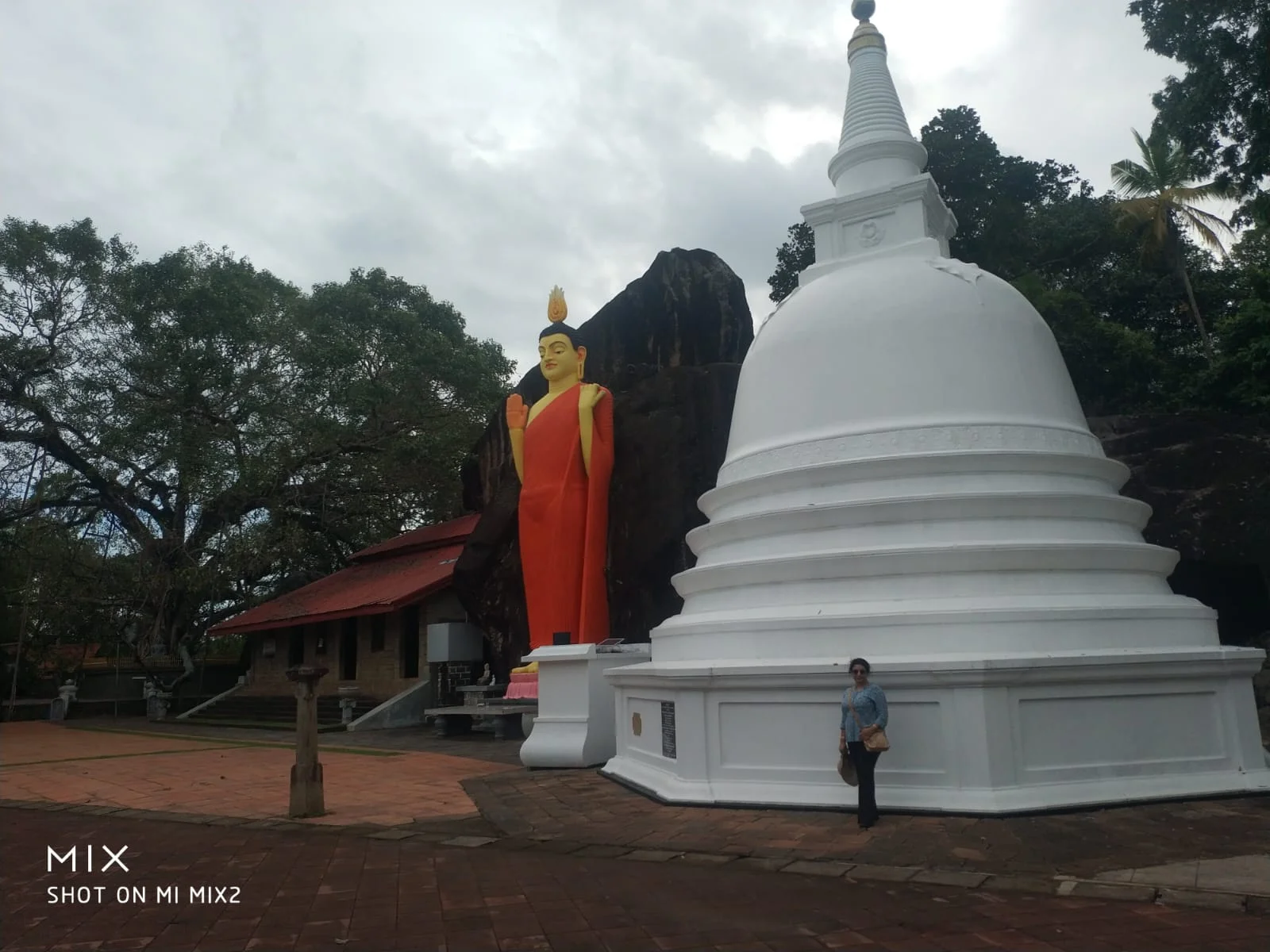
The Great Buddha of Matara
The colossal seated Buddha of Weherahena rising majestically against the open sky, visible from kilometres across the palm canopies.
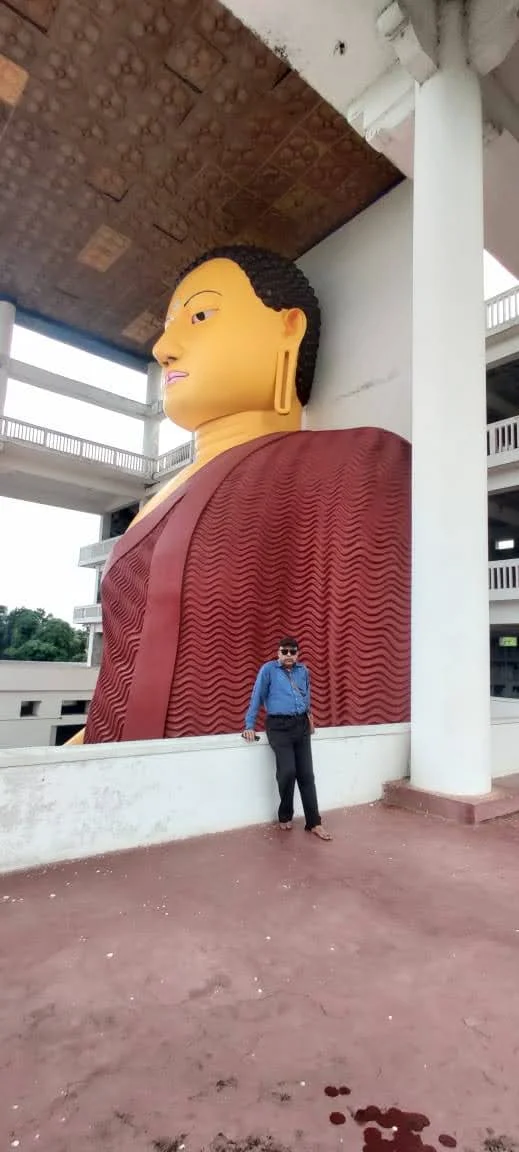
The Temple Balcony
Overlooking the peaceful countenance of the giant Buddha statue from the multi-tiered pilgrim galleries.
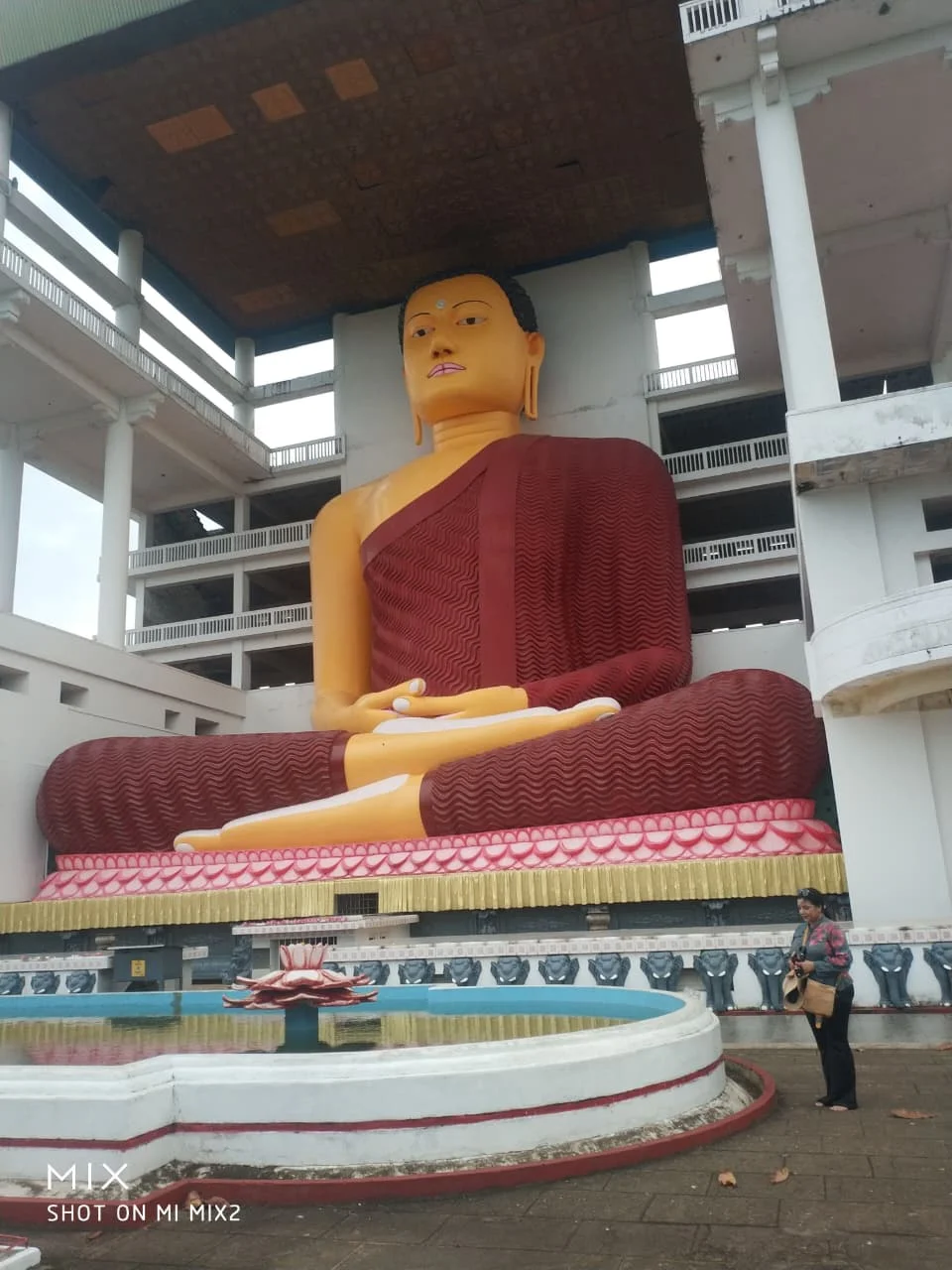
The Monumental Courtyard
High surrounding balustrades and viewing tiers framing the massive central sculpture in serene architectural harmony.
The Underground Labyrinth of Jataka Story Murals
Carved directly beneath the monumental Buddha, kilometres of subterranean corridors guide pilgrims through a visual chronicle of the Bodhisattva’s path across lifetimes.
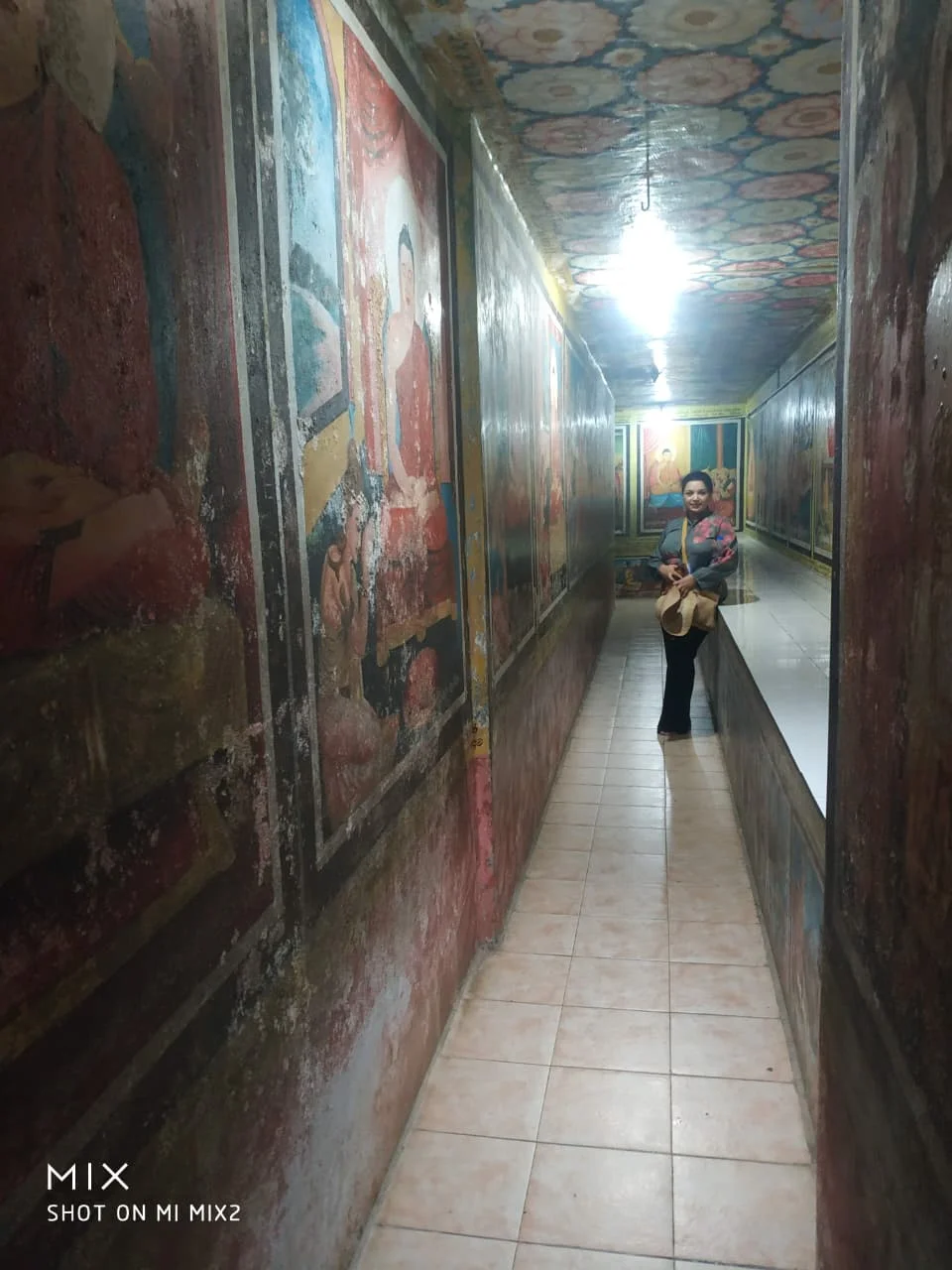
Walking Through Sacred Stories
A contemplative walk through cool subterranean halls, surrounded by vivid folk-art depictions of Sri Lankan Buddhist tradition.
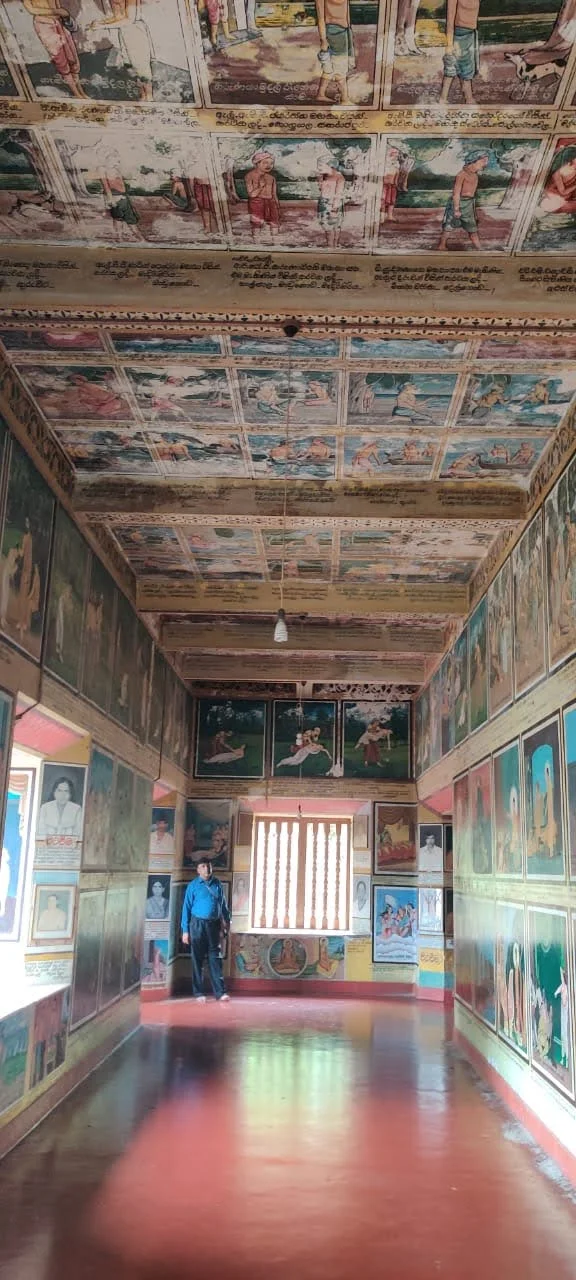
Narrative Jataka Chronicles
Endless subterranean tunnel walls painted in rich narrative panels recounting the virtues and moral teachings of the Bodhisattva.
Yatagala Raja Maha Viharaya
Finding Spiritual Stillness Among Ancient Rocks and Lush Greenery
Tucked among massive granite boulders and lush greenery near Unawatuna, Yatagala Raja Maha Viharaya was one of the quietest and most peaceful places we visited in southern Sri Lanka.
The temple’s large Buddha statue creates a deeply serene atmosphere, surrounded by tropical vegetation, ancient rock formations, and meditation spaces associated with the site’s long religious history.
Unlike the more crowded religious destinations, Yatagala felt wonderfully calm and undisturbed. The natural surroundings were as memorable as the temple itself, with enormous granite boulders rising above the grounds and trees providing welcome shade.
We spent some quiet time there, listening to the birds and the gentle rustling of leaves. Away from busy roads and crowded attractions, the stillness allowed us to slow down and appreciate the peaceful character of the place.
The experience reminded us that Buddhist heritage is not preserved only in monumental stupas or grand temple complexes. It also survives in modest sanctuaries where the surrounding landscape becomes part of the spiritual experience.
At Yatagala, the combination of rock, greenery, and Buddhist devotion gave us a rare sense of tranquillity during our travels through southern Sri Lanka.
“Buddhist heritage is not preserved only in monumental stupas or grand temple complexes. It also survives in modest sanctuaries where the surrounding landscape becomes part of the spiritual experience.”
— Forest Monasticism at Yatagala
Founded during the reign of King Devanampiya Tissa as one of the earliest monastic retreats following the arrival of the sacred Bodhi tree.
Sheltering one of the first 32 saplings (Dethispala Ruha Bodhi) grown from the sacred Jaya Sri Maha Bodhi in Anuradhapura.
Gigantic balancing granite monoliths creating natural sheltered chambers and meditative cliff-side shrines.
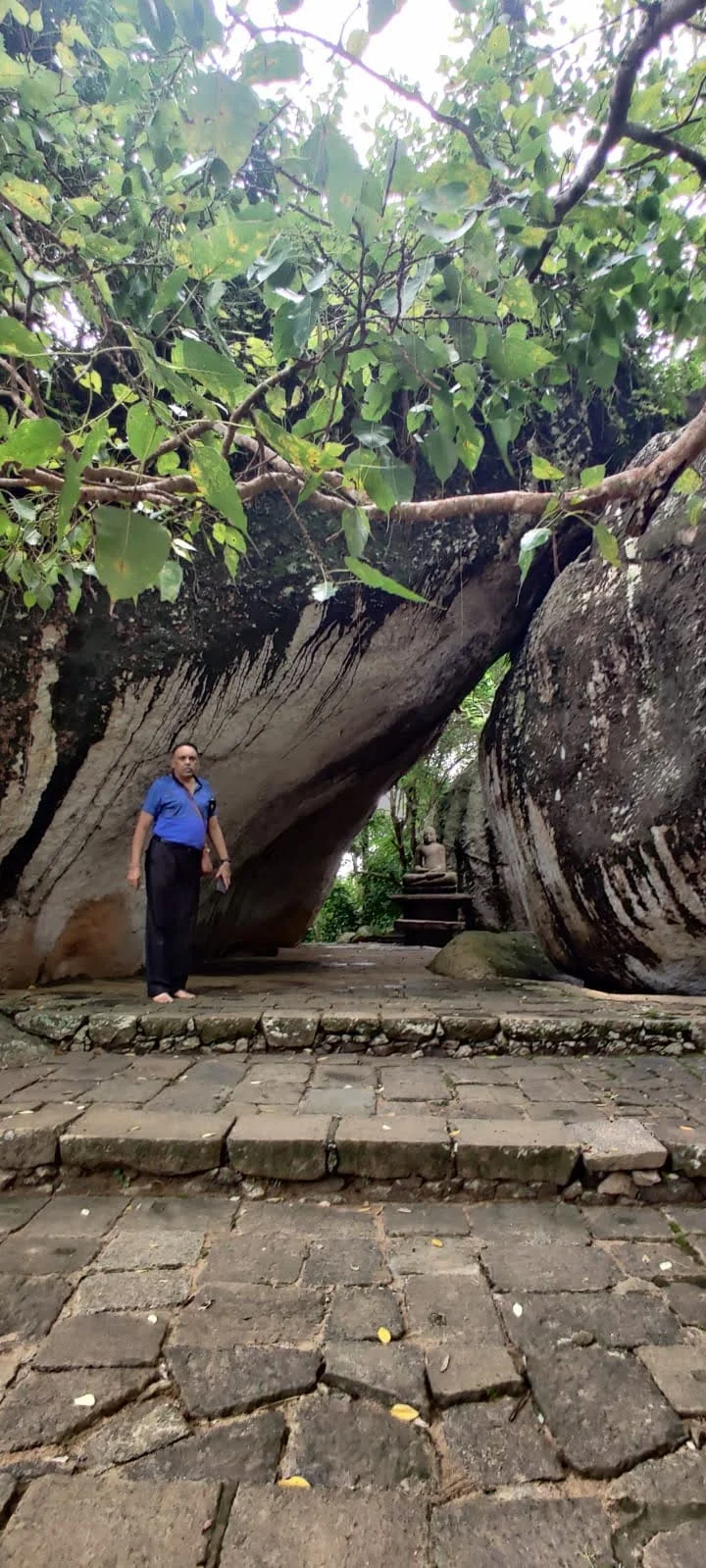
Path Through the Forest Canopy
Stone steps shaded by towering tropical palms and forest giants, winding gently upwards to the secluded boulder monastery.
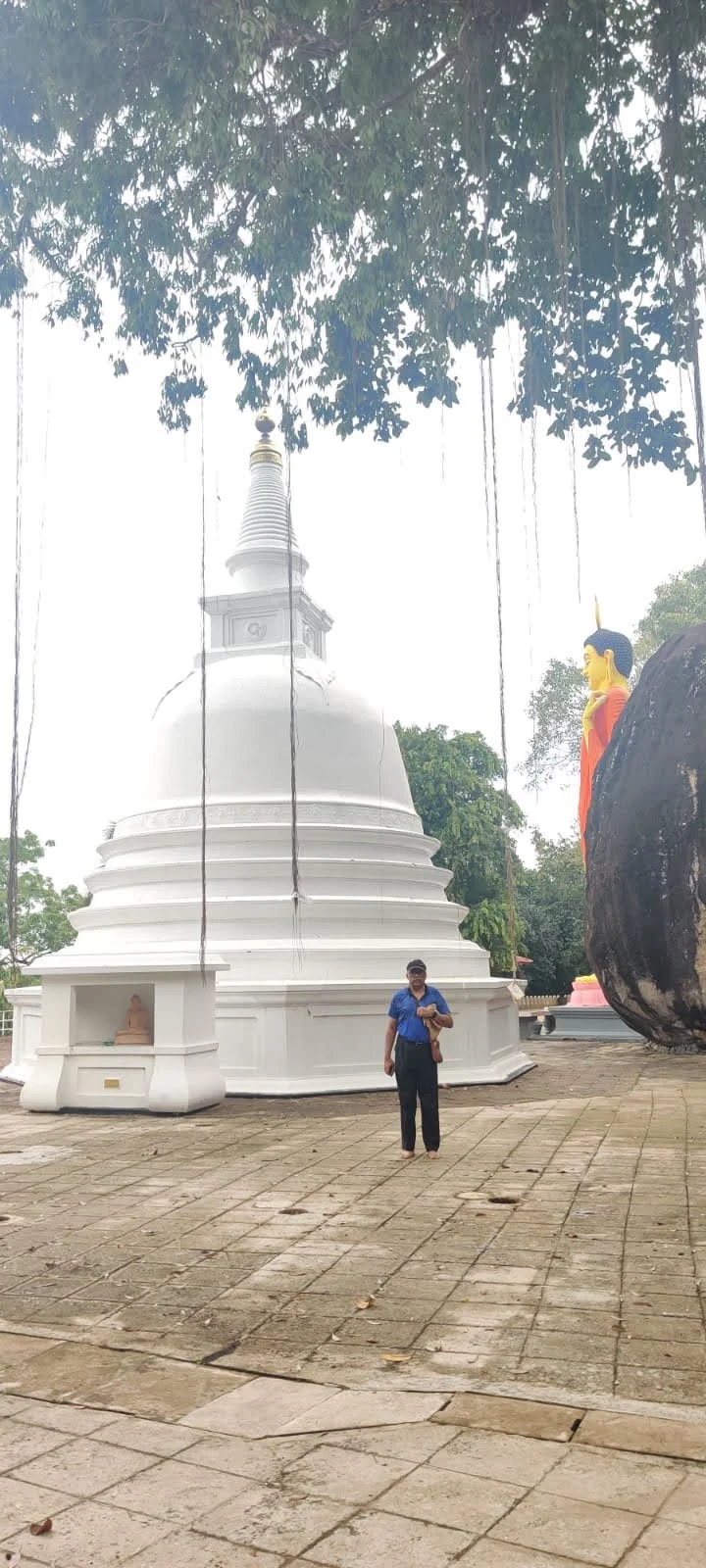
Steps to the Rock Temple
Worn stone steps carved by centuries of pilgrims climbing to the ancient rock-sheltered meditation caves.
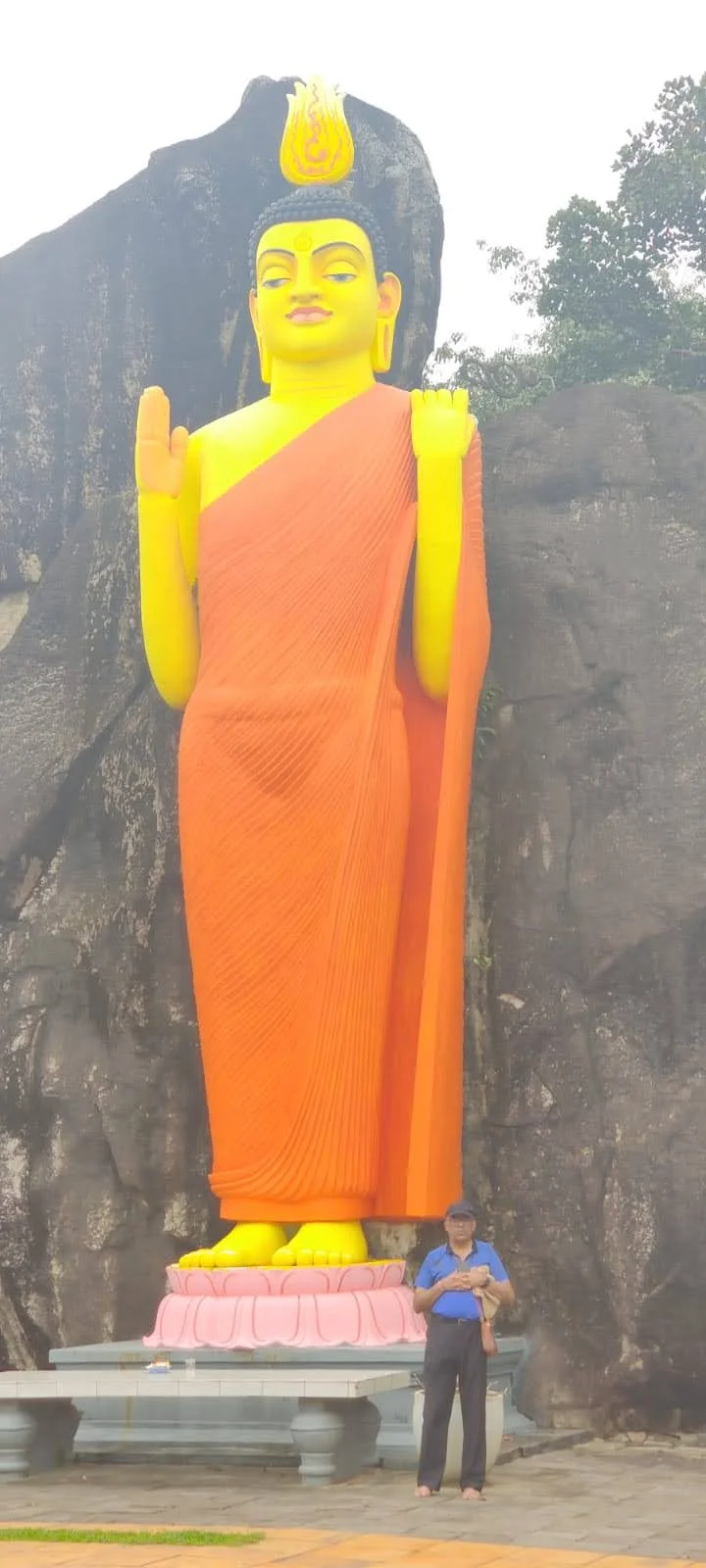
Buddha Beneath the Boulders
A serene Buddha statue carved against towering natural granite boulders that have guarded this spiritual refuge for over two millennia.
The Sacred Heart & Contemporary Life
The Tooth Relic in Royal Kandy & Gangaramaya Temple in Vibrant Colombo
Visiting the Temple of the Sacred Tooth Relic in Kandy was a deeply moving experience.
Surrounded by the peaceful waters of Kandy Lake and historic royal buildings, the temple occupies a special place in Sri Lanka’s religious and cultural life. Its importance is closely connected with the Sacred Tooth Relic of the Buddha, one of the most revered objects in Sri Lankan Buddhism.
Over the centuries, the relic became a powerful symbol of spiritual authority and kingship. Its association with Sri Lanka’s rulers helped establish Kandy as an important centre of Buddhist devotion, and the temple continues to attract pilgrims from across the island and beyond.
During our visit, we watched worshippers dressed in white offering flowers and prayers. The sound of traditional temple drums, the fragrance of incense, and the quiet movement of devotees created an atmosphere filled with reverence.
We were particularly touched by the sincerity of the people who had come to pay their respects. For them, the temple was not simply a historic attraction but a living sanctuary connected to faith, family traditions, and national identity.
Our visit to Gangaramaya Temple in Colombo offered a fascinating glimpse into the spiritual and cultural life of modern Sri Lanka. Located near the waters of Beira Lake, Gangaramaya stands out for its distinctive combination of architectural styles, decorative elements, Buddhist images, and cultural artefacts.
Walking through its richly decorated halls, we encountered Buddha statues, religious objects, colourful artwork, and intricate ornamental details. Despite being situated in the middle of busy Colombo, the temple offered moments of calm and reflection.
The visit showed how a tradition that travelled from India more than two thousand years ago continues to find expression in a modern urban environment.
“A tradition that travelled from India more than two thousand years ago continues to find profound expression in modern urban life, preserving a community’s spiritual memory across generations.”
— From Royal Kandy to Contemporary Colombo
The royal palace complex safeguarding the Sacred Tooth Relic, the spiritual palladium of Sri Lankan kings and national sovereignty.
A vibrant urban sanctuary encompassing a Buddhist museum, monastic university, and extraordinary collection of sacred antiques.
The serene floating assembly hall designed by legendary architect Geoffrey Bawa, surrounded by bronze meditative Buddhas.
Temple of the Sacred Tooth Relic • Kandy
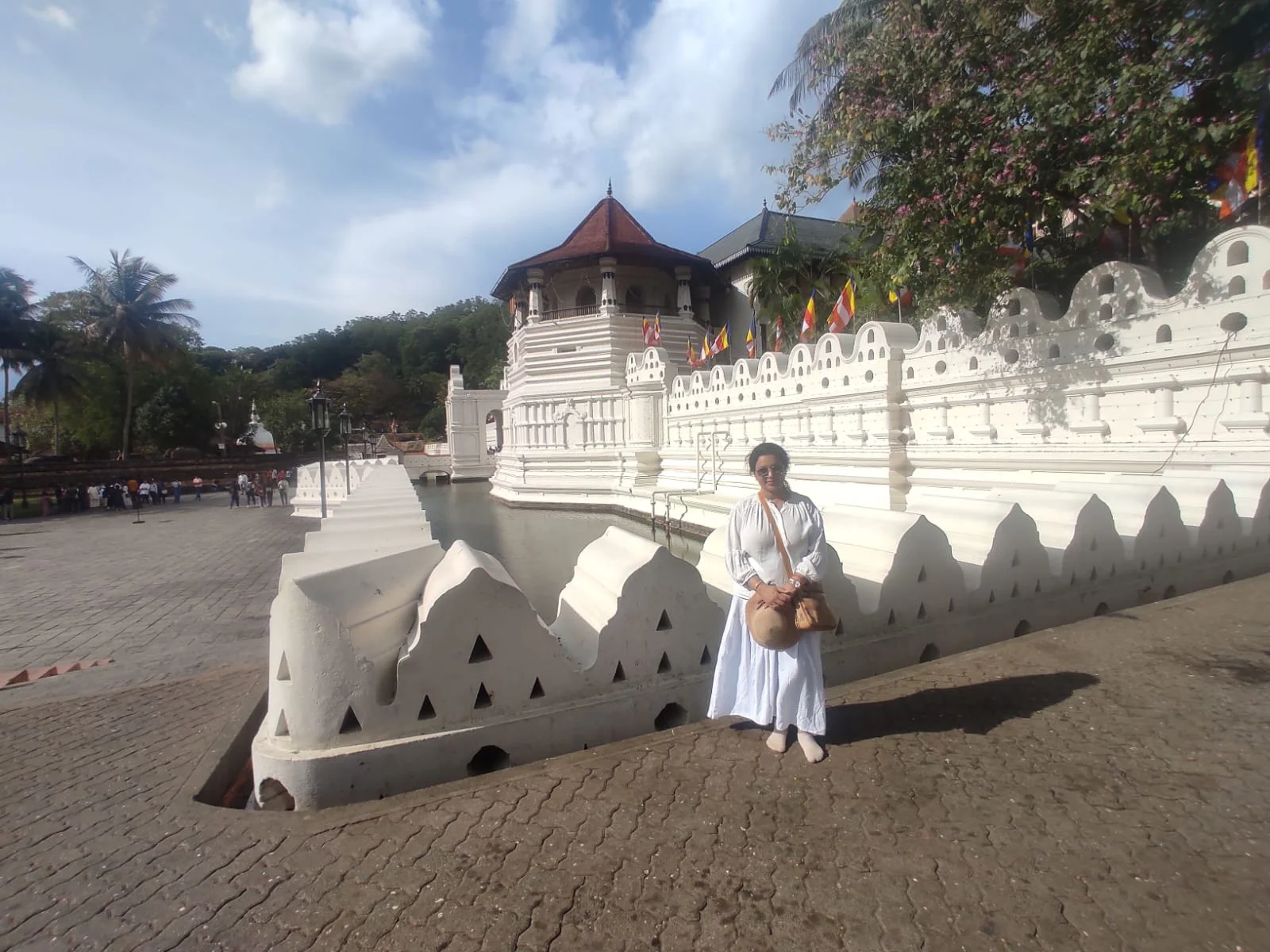
The Temple of the Sacred Tooth Relic
The sacred temple complex beside Kandy Lake, encircled by the iconic cloud-wall (Walakulu Bamma) and royal moats.
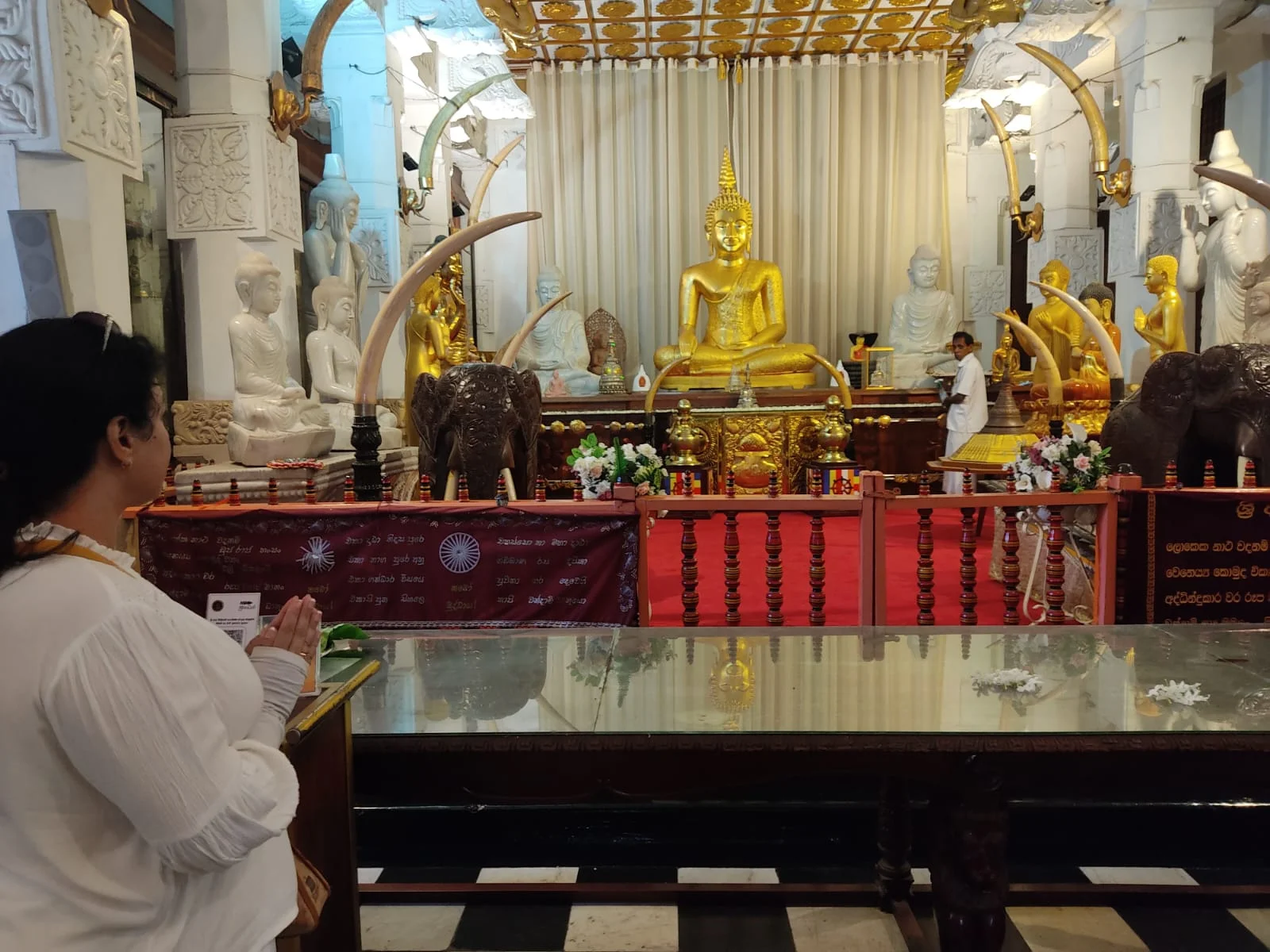
Inner Chamber of the Tooth Relic
Gilded doorways and fragrant tables overflowing with white lotus blossoms, as drums resound for the daily Tevava rituals.
Gangaramaya Sanctuary & Seema Malaka • Colombo
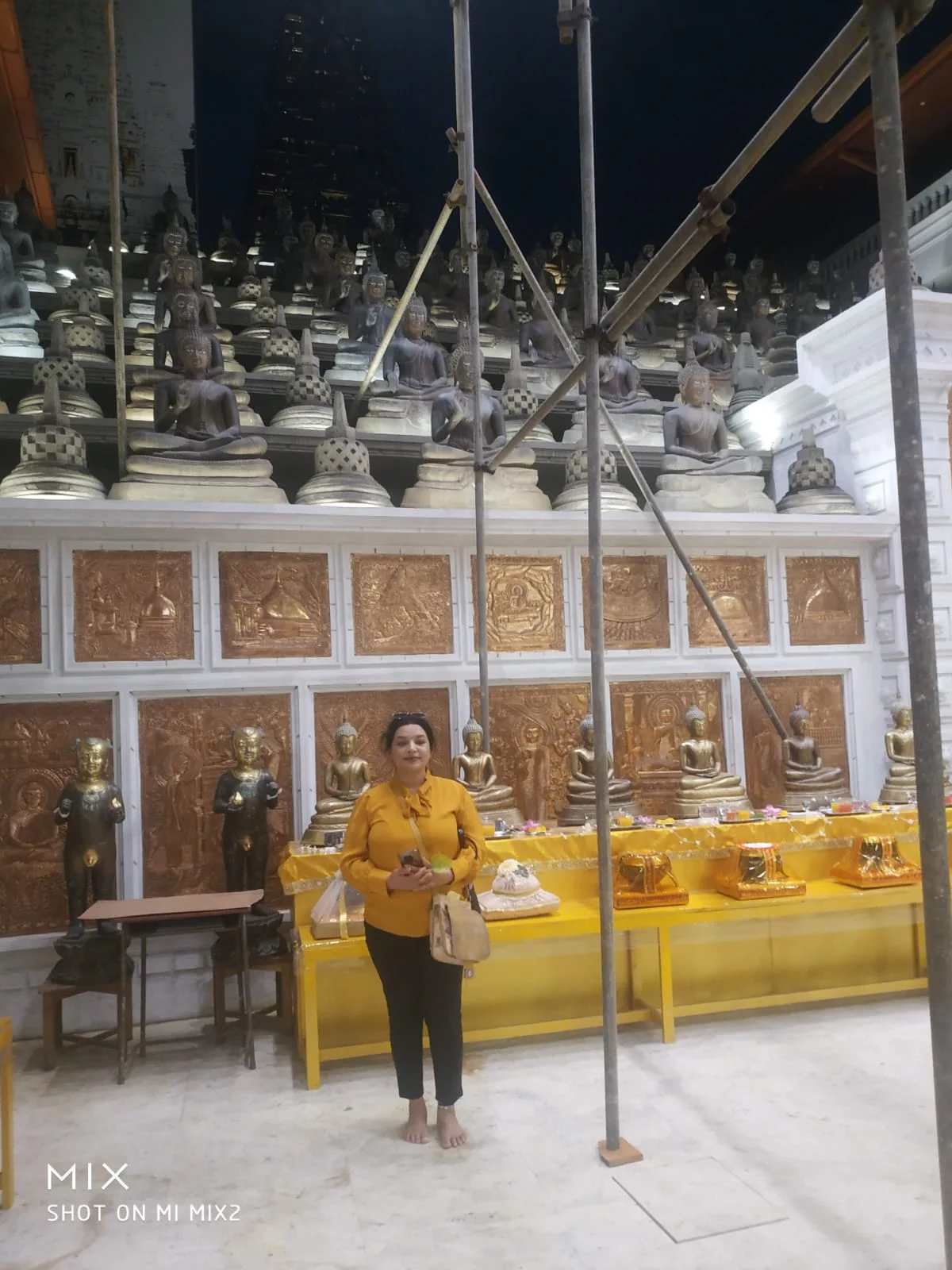
Monastic Museum Galleries
Glass vitrines holding precious ivory, bronze, and stone sacred relics donated by Buddhist communities from across Asia over generations.
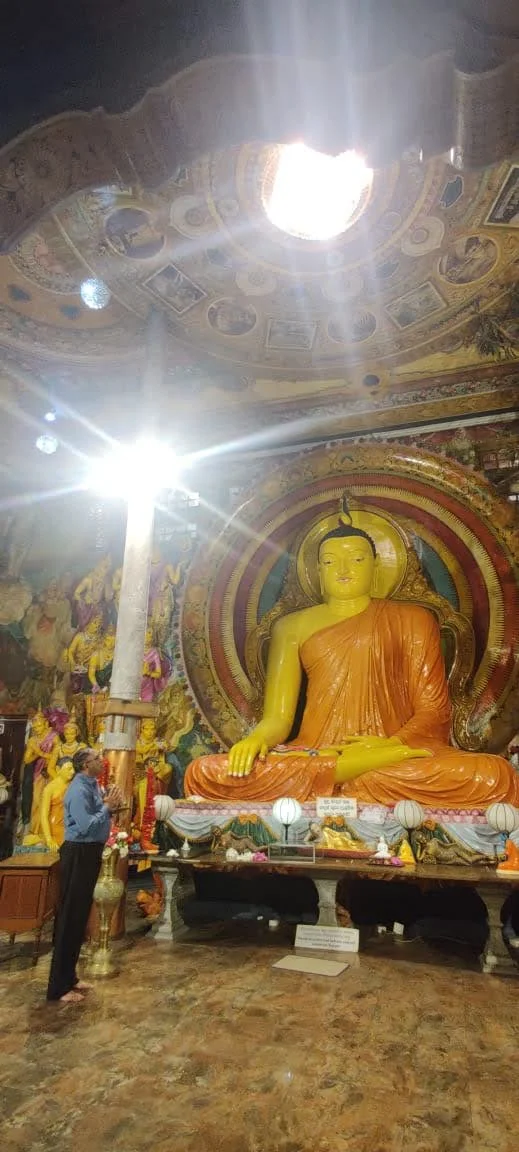
The Eclectic Shrine Hall
A dazzling assembly of golden statues, brass lanterns, and intricate wood carvings celebrating Buddhist devotion in Colombo.
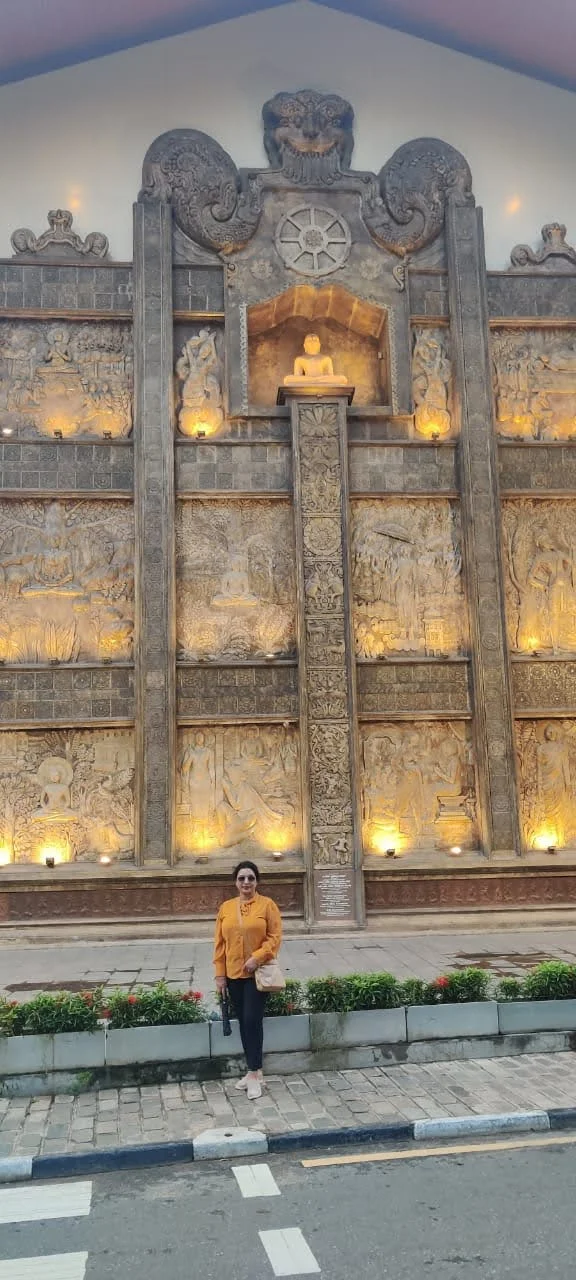
Geoffrey Bawa’s Serene Design
Row of meditative bronze Buddhas looking out across the tranquil waters of Beira Lake, creating an oasis of quiet contemplation.
Diffusion of Religion, Scripts, and Architecture Across the Indosphere
From ancient India across the Bay of Bengal to Sri Lanka, Myanmar, Thailand, Cambodia, Laos, Malaysia, and Indonesia: the movement of philosophy, Pali and Sanskrit canons, and temple artistry.
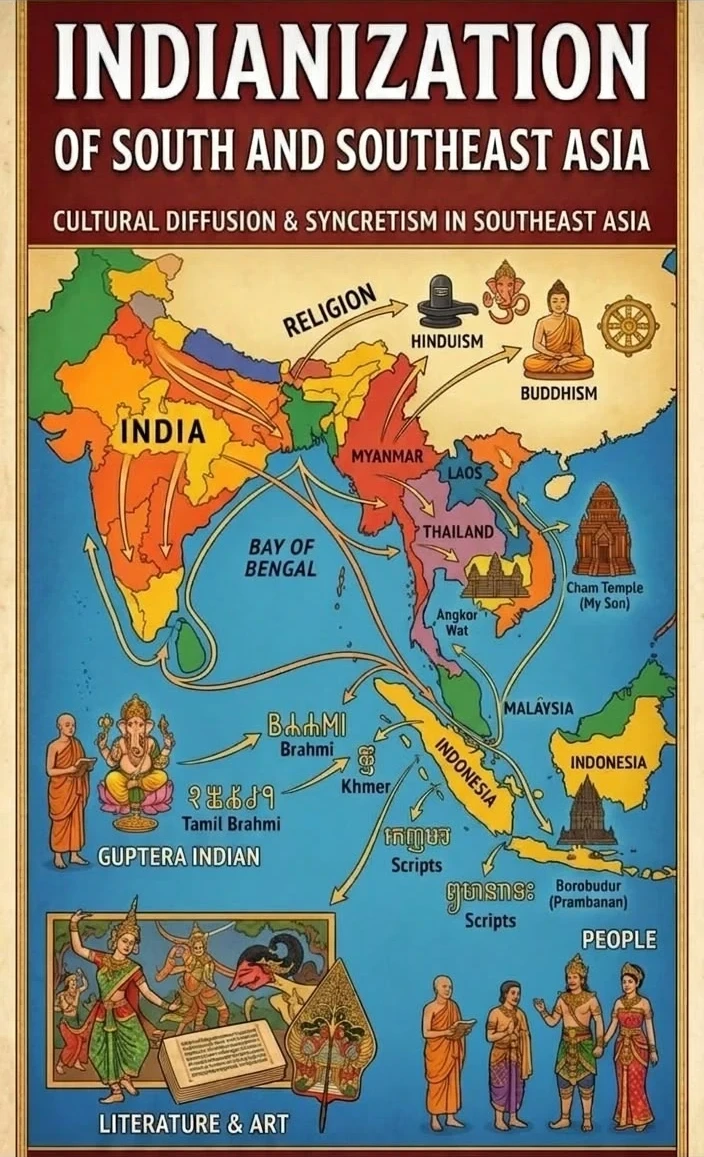
Cultural Diffusion Across the Indosphere
Tracing the transmission of Sanskrit, Pali, Brahmi scripts, Buddhist philosophies, and temple architecture from ancient India across South and Southeast Asia.
Tips for Visiting Dambulla Cave Temple
Essential Practical Guidance for Exploring Sri Lanka's Ancient Rock Sanctuary
To make the most of your visit to Dambulla Cave Temple and ensure a respectful, comfortable experience, keep the following practical recommendations in mind:
Wear Comfortable Footwear
The ascent involves a long series of stone steps. Comfortable shoes are useful for the climb, although you will need to remove them before entering the sacred temple areas.
Avoid the Midday Heat
Visit early in the morning or later in the afternoon when temperatures are significantly more comfortable on the open stone slopes.
Dress Modestly
Cover your shoulders and knees when visiting the temple, and follow local Buddhist guidance regarding appropriate, respectful attire.
Remove Your Footwear
Shoes must be removed before entering the sacred temple areas. You may want to bring a small bag for carrying your footwear with you if permitted, or utilize the official shoe holding counter.
Carry Drinking Water
The uphill climb can be tiring in warm weather. Stay hydrated and take shaded breaks along the stairway whenever necessary.
Allow One to Two Hours
This provides ample time to explore the five caves, Buddha statues, murals, and viewpoints at a relaxed pace. Allow longer if you wish to examine the ceiling frescoes in detail.
Enjoy the Views
The elevated location offers breathtaking panoramic vistas over the surrounding green plains and distant Sigiriya rock, so take time to appreciate the landscape.
Take the Climb at Your Own Pace
If you have difficulty climbing stairs, take frequent rests on the shaded landings and assess your physical stamina carefully in warm tropical weather.
Sri Lanka
A Living Testament to the Journey of Buddha’s Wisdom Across Distant Shores
Our journey through Sri Lanka revealed how deeply Buddhism is woven into the island’s spiritual identity, artistic traditions, and everyday life.
From the ancient cave sanctuaries of Dambulla to the colourful murals of Weherahena, the peaceful surroundings of Yatagala, the sacred atmosphere of Kandy, and the vibrant temple complex of Colombo, each destination offered a different perspective on the enduring legacy of Buddhism.
We encountered extraordinary works of art, sacred images, ancient traditions, and places where devotion continues to shape daily life. Yet some of our most memorable moments were also the simplest: sitting quietly in a temple, watching worshippers offer flowers, listening to the sounds of prayer, or finding stillness among the rocks and trees.
These experiences reminded us that Buddhism is not merely a historical tradition preserved in monuments. It remains a living spiritual path, carried forward through communities, religious practices, artistic expression, and the values of compassion and wisdom.
The journey also brought us closer to the historical connections between India and Sri Lanka. From the Buddhist missions associated with Emperor Ashoka to the development of Theravada traditions on the island, the movement of religious ideas across the Indian Ocean helped shape one of Asia’s most enduring cultural relationships.
Today, these connections remain visible in Sri Lanka’s temples, sacred relics, rituals, and artistic heritage.
As we travelled across the island, we felt that we were tracing more than the history of a religion. We were following the footsteps of an ancient cultural exchange that continues to connect people across borders and generations.
✨ FOLLOWING THE ECHOES OF INDIA ACROSS DISTANT SHORES ✨
TRAVELLING THROUGH THE TIMELESS LEGACY OF INDIAN CIVILIZATION ACROSS ASIA AND BEYOND
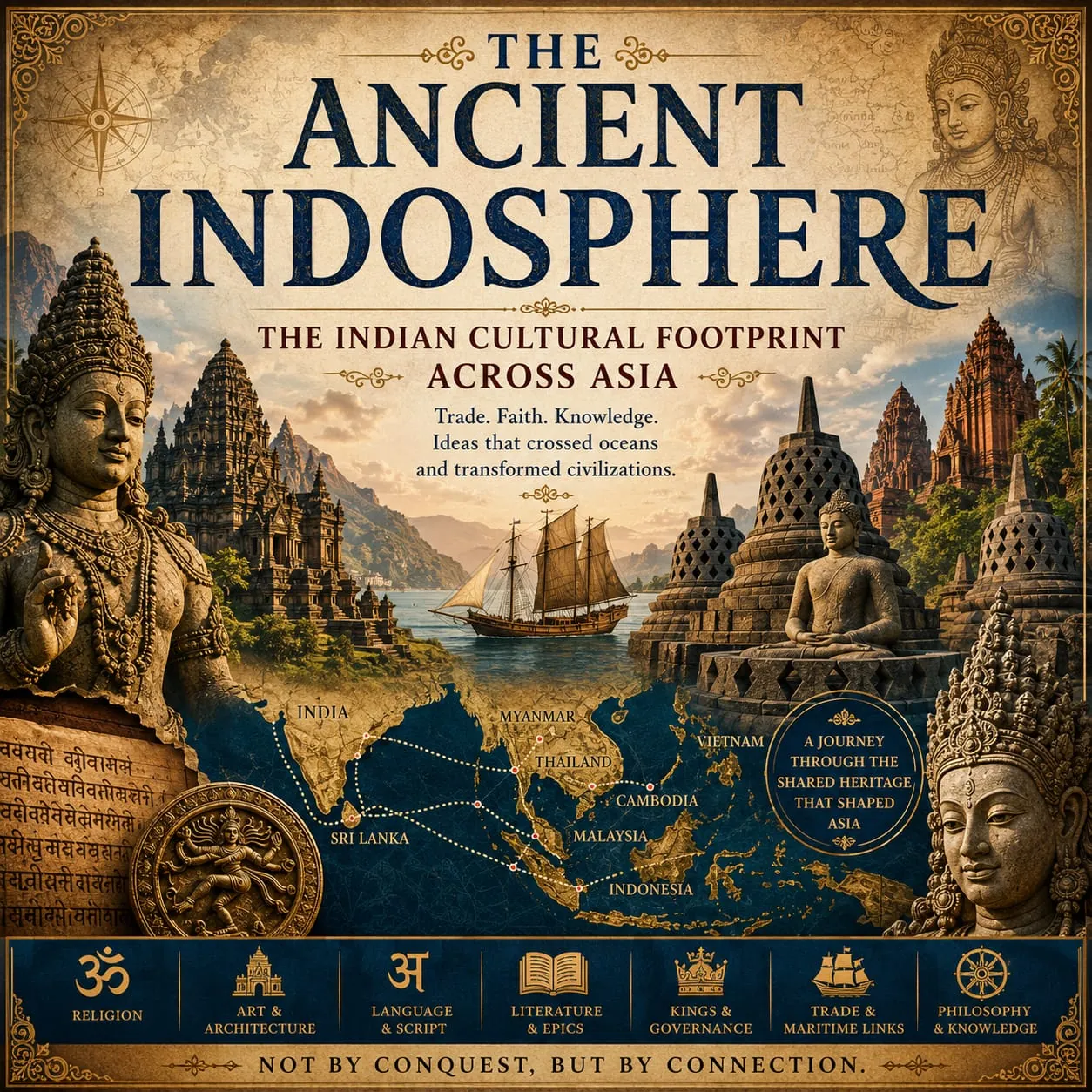
TRAVELLING THROUGH THE TIMELESS LEGACY OF INDIAN CIVILIZATION ACROSS ASIA AND BEYOND
“Not by conquest, but by connection.”
Across ancient temples, sacred stupas, and living cultural landscapes, the timeless traditions born in India continue to illuminate Asia with philosophy, art, and civilizational communion carried not by sword, but through dialogue and spiritual devotion.
CONTINUE THE SRI LANKA JOURNEY
Journey Through the Sacred Monuments of Sri Lanka