
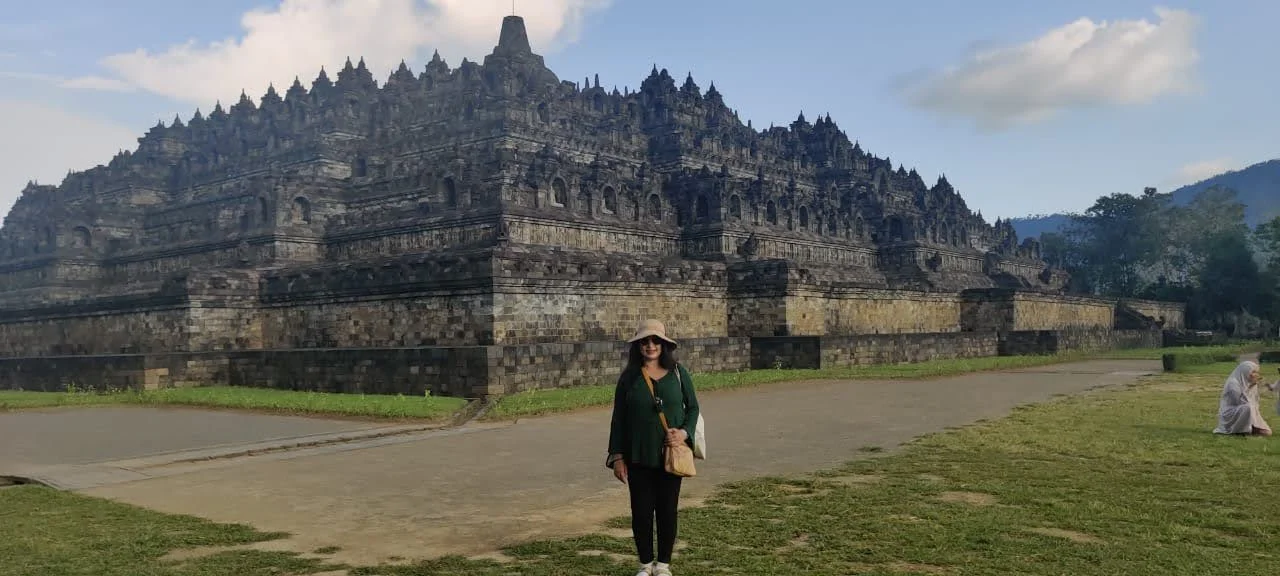
Borobudur: A Stone Symphony of Enlightenment
Borobudur — Java, Indonesia: A Journey To Enlightenment
Rising from the lush plains of Central Java, Borobudur is the world's largest Buddhist monument—a monumental 3D stone mandala with 2,672 relief panels and 504 Buddha statues built without mortar.
A day trip from Yogyakarta brought us to Borobudur, the world's largest Buddhist monument, set amidst the lush green countryside of Central Java. After arriving by taxi, every visitor was assigned a guide, and before climbing the ancient temple we were asked to wear soft sandals provided by the authorities to help protect the centuries-old stone from erosion. As we slowly ascended the monument, its magnificent stupas, serene Buddha statues, and intricate relief carvings revealed the timeless story of Buddhism.
Our guide carefully controlled the pace of the visit and did not allow us extra time to explore the monument on our own. While we understood the need to manage the large number of visitors, we wished we could pause longer to absorb the spiritual atmosphere and admire the exquisite carvings. Even within the limited time, Borobudur left me with a deep sense of peace and admiration—a monument where history, faith, and art come together in perfect harmony.
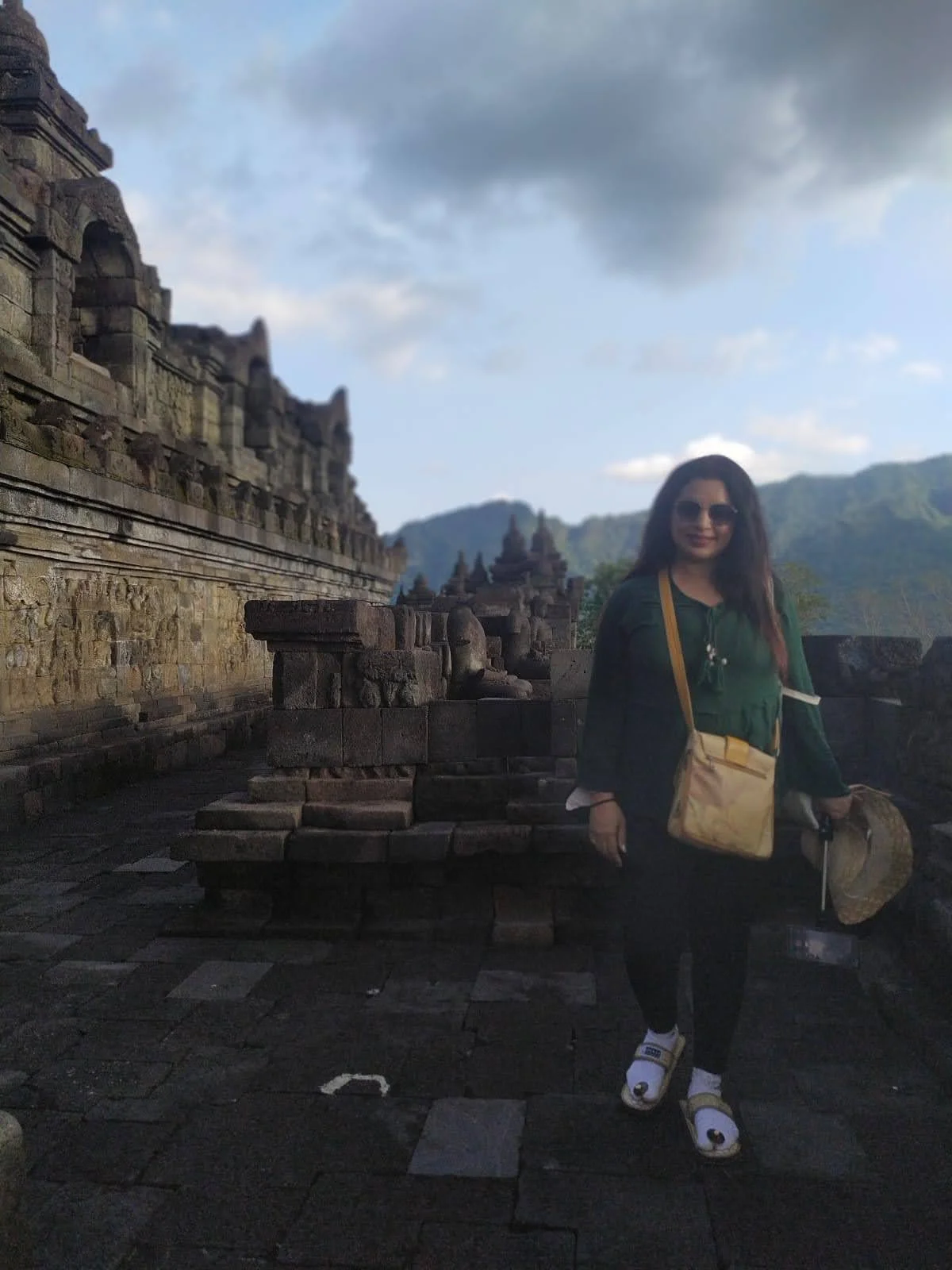
Ascending the ancient galleries wearing protective upanat sandals to preserve the 1,200-year-old stone floors
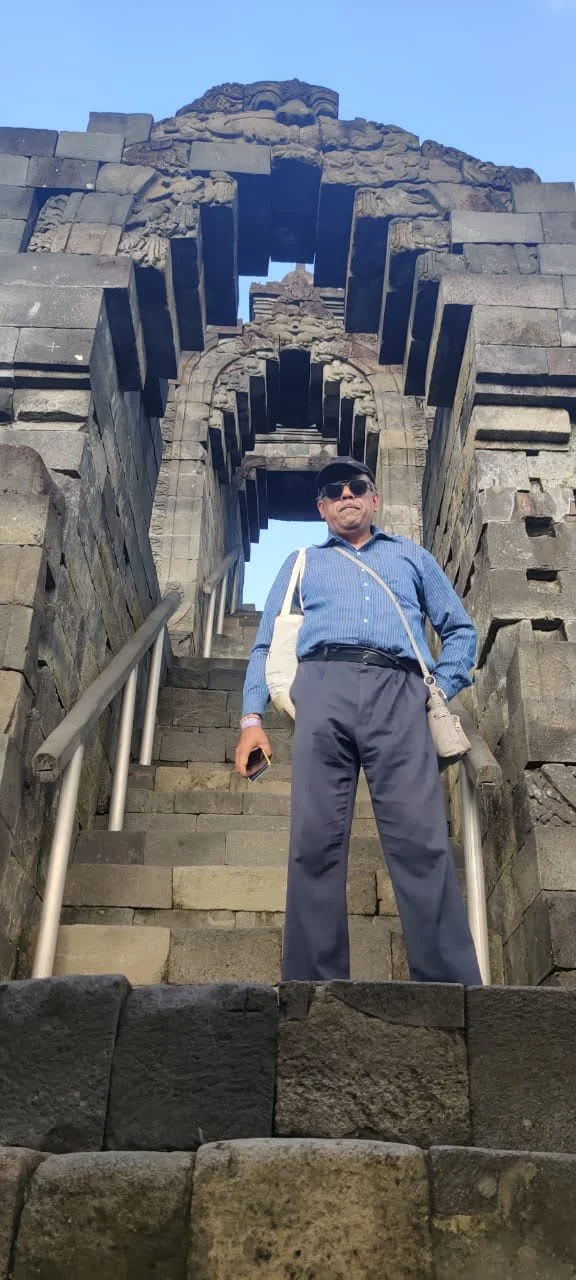
Ascending through the monumental arched gateway crowned by the protective Kala portal
Borobudur: Largest Buddhist Monument in the World
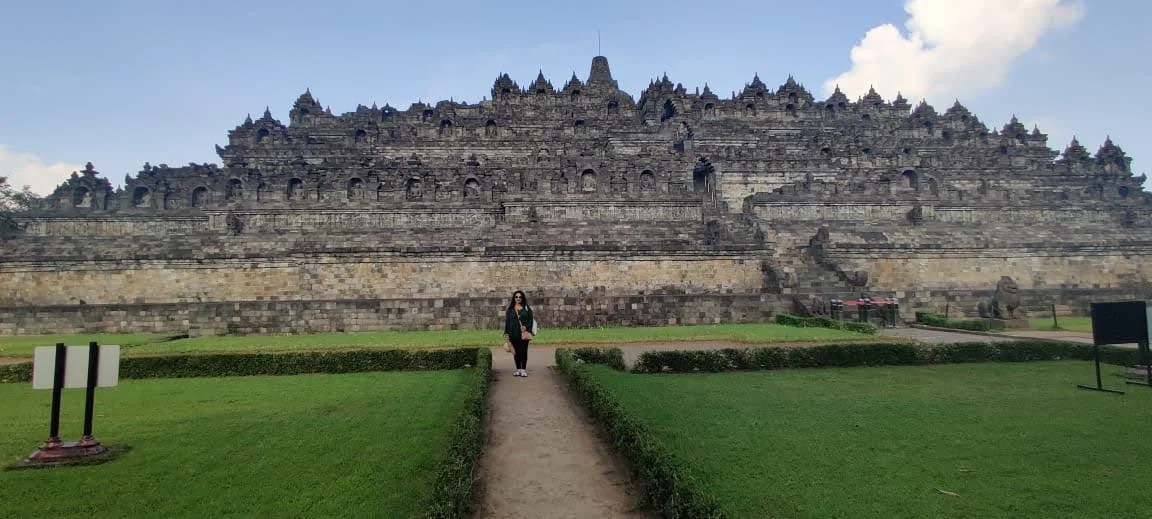
The grand multi-tiered pyramid of Borobudur, designed as a three-dimensional cosmic mandala rising over Central Java
Borobudur is the largest Buddhist monument in the world and one of the greatest architectural achievements in human history. Rising majestically from the lush plains of Java, the monument was built during the 8th and 9th centuries under the Sailendra dynasty. Constructed from millions of volcanic stone blocks, Borobudur was designed as a giant mandala representing the Buddhist path from earthly desire to spiritual enlightenment. Even after more than a thousand years, its terraces, stupas, and sculpted galleries continue to inspire travelers, historians, and pilgrims from around the world.
Enormous Area: Measures 123×123 Meters
It covers an enormous area, measuring 123 x 123 meters. The monument is a marvel of design, decorated with 2,672 relief panels and 504 Buddha statues. The architecture and stonework of this temple has no equal. And it was built without using any kind of cement or mortar! The structure is like a set of massive interlocking Lego blocks held together without any glue.
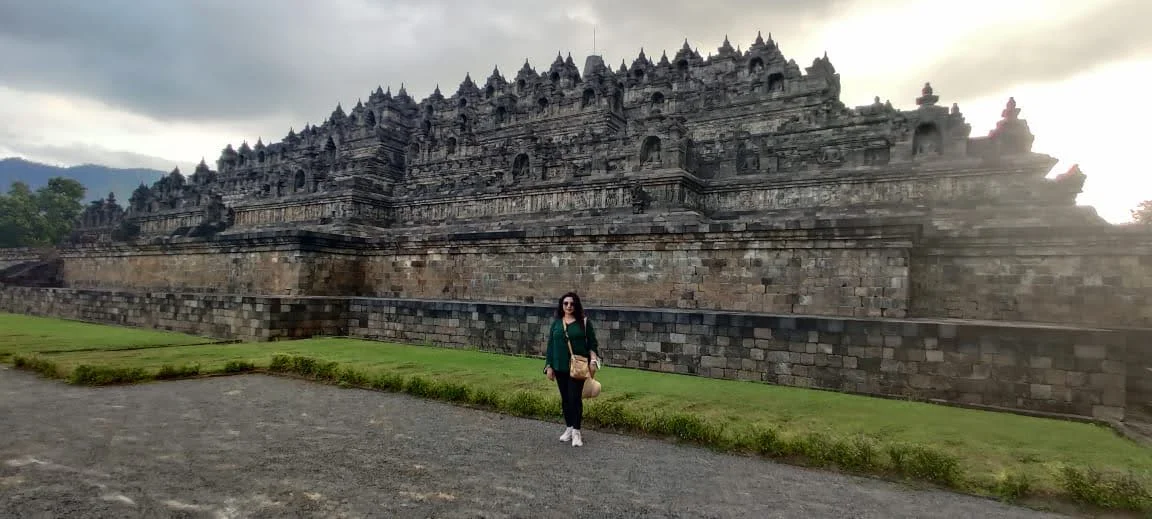
Massive interlocking andesite blocks forming the lower retaining walls and galleries
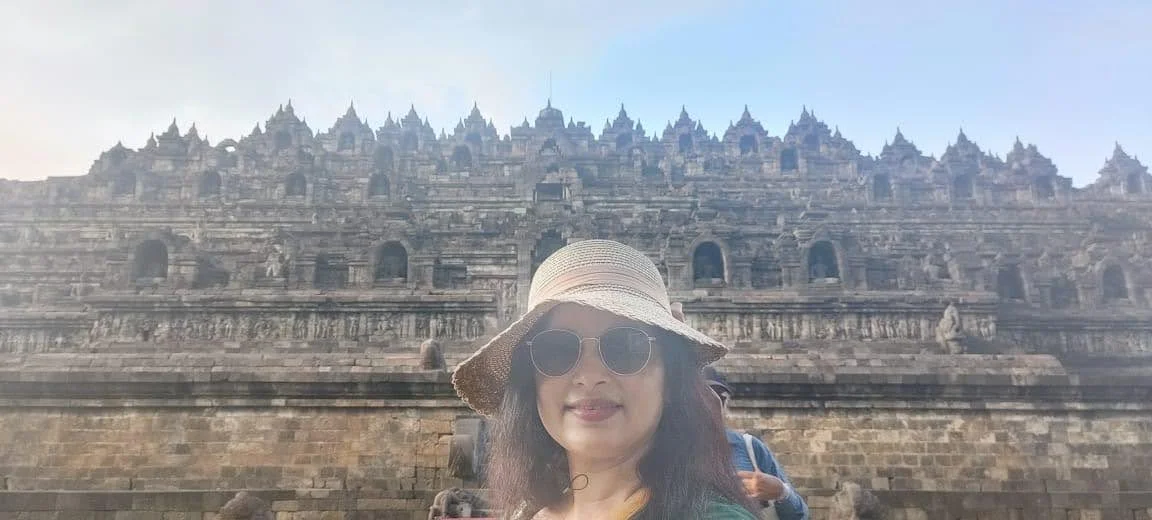
Admiring the precision and craftsmanship of the 1,200-year-old volcanic stonework
The Journey of the Dharma from India to Java
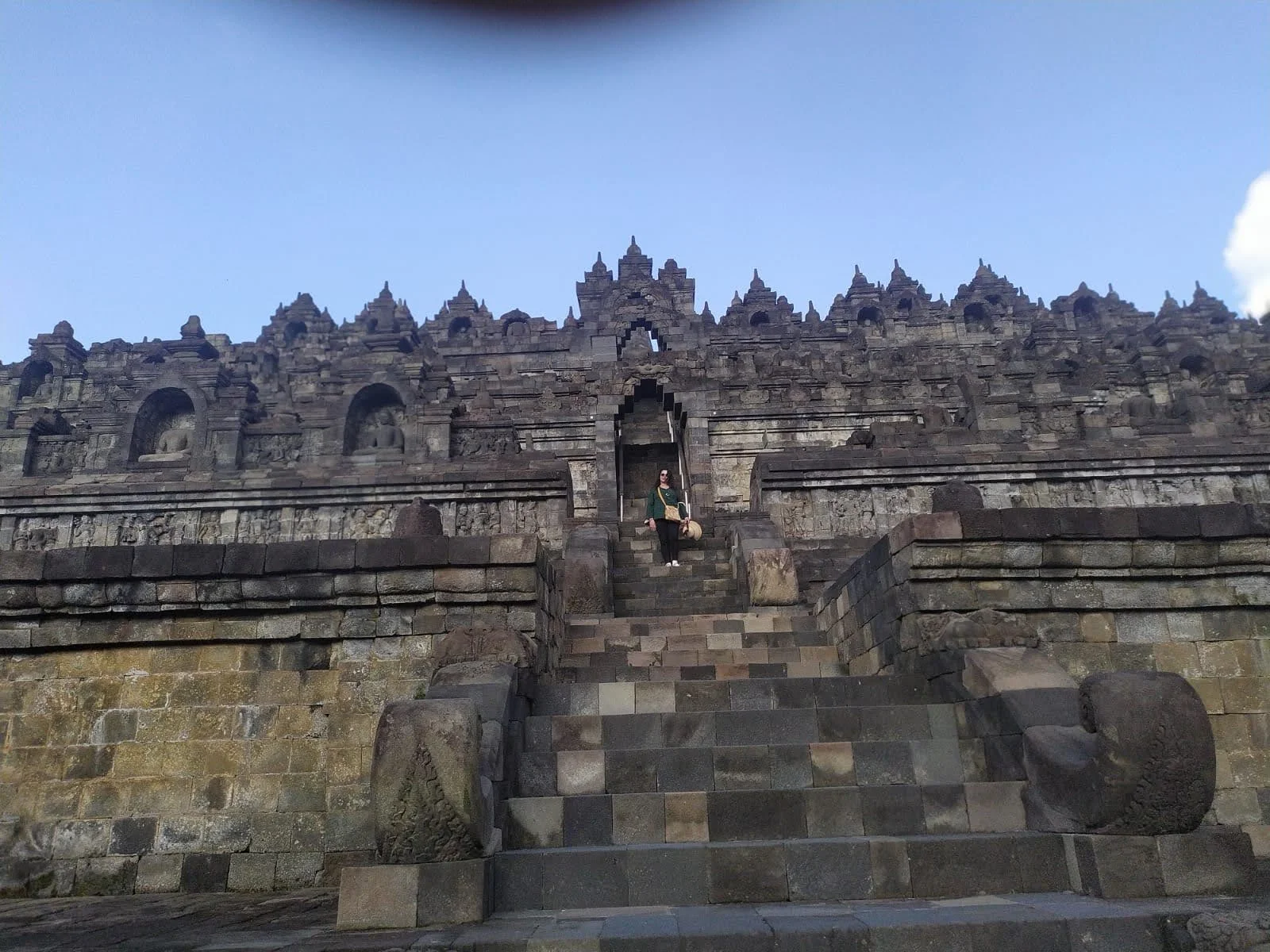
The monumental carved Kala portal gateway leading upward into the sacred relief galleries
What makes Borobudur especially significant for Indian travelers is its deep connection with Indian civilization and Buddhism. The spread of Buddhism from India across maritime trade routes profoundly shaped the culture of Southeast Asia, and Borobudur stands as one of the clearest symbols of that influence. Sanskrit inscriptions, Indian philosophical ideas, Buddhist cosmology, and artistic traditions traveled from the Indian subcontinent to Java, where they evolved into a magnificent local expression. The monument reflects not only Buddhist teachings originating in India but also the remarkable cultural exchange that linked ancient India with Indonesia for centuries.
Borobudur: Where Every Step Tells the Buddha's Story
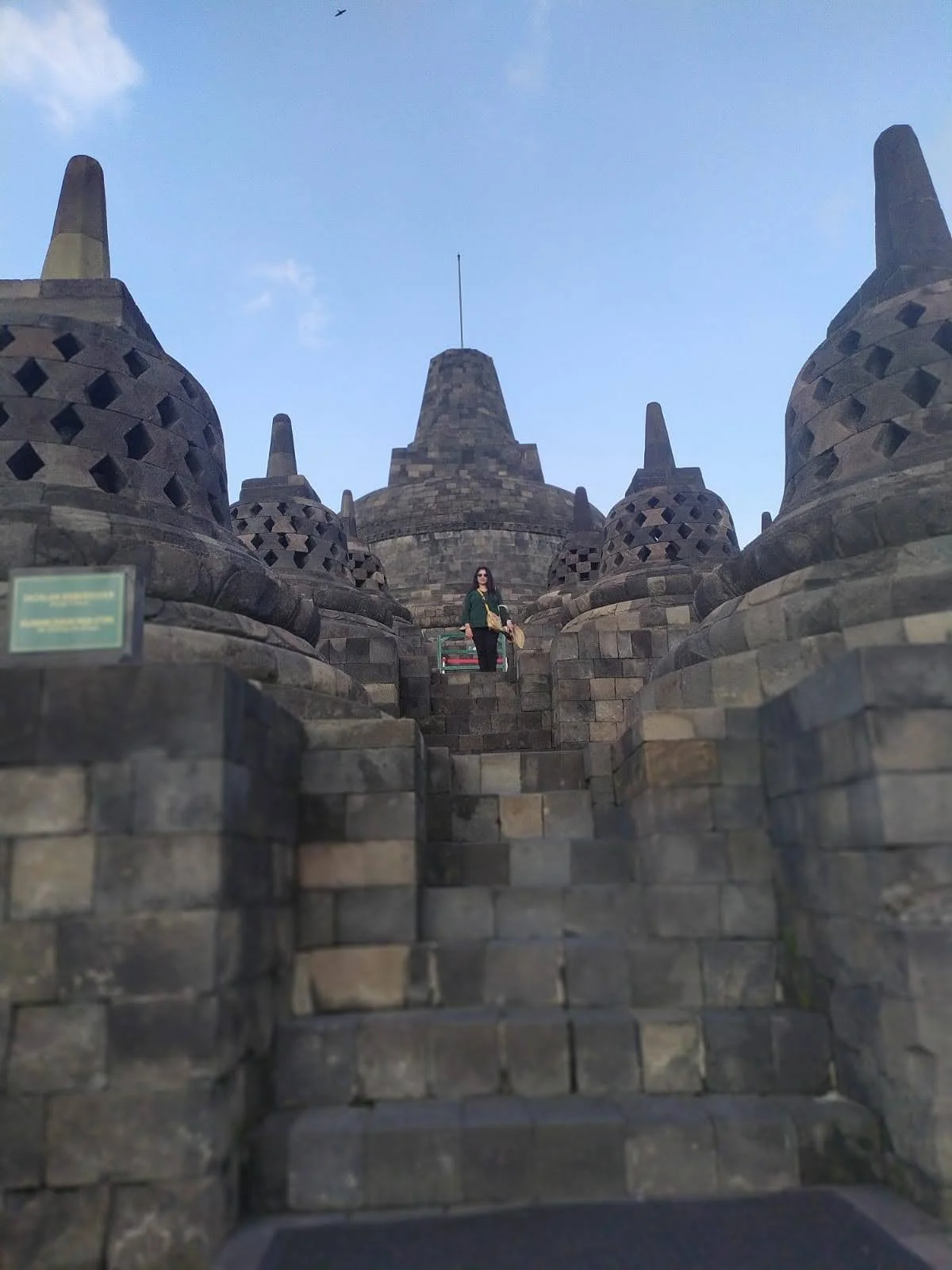
Central stairway ascending past carved stone relief galleries toward the summit stupas
The relief panels carved into Borobudur's walls narrate stories from Buddhist scriptures and the life of the Buddha with extraordinary detail and artistic refinement. Many scenes draw inspiration from Indian Buddhist texts and depict merchants, ships, royal courts, temples, forests, and everyday life in ancient Asia. Walking through the monument's galleries feels like reading a vast stone manuscript carved with spiritual wisdom and historical memory. For visitors familiar with India's Buddhist heritage at places such as Sanchi Stupa or Nalanda Mahavihara, Borobudur creates a powerful sense of continuity across the Indian Ocean world.
Borobudur: The Mountains of a Thousand Buddhas
Borobudur also reflects the extraordinary coexistence of Hinduism and Buddhism in ancient Java. During the same era, the nearby Prambanan Temple Compounds Hindu temples were constructed, demonstrating how Indian spiritual traditions flourished together in Indonesia. This shared heritage shaped Javanese culture, language, literature, architecture, and governance for centuries. Rather than copying Indian models directly, the people of Java absorbed these influences and transformed them into something uniquely Indonesian — elegant, harmonious, and deeply spiritual.
Moving past the base and through the four galleries, the devotee emerges onto the three upper terraces, encountering 72 stupas each containing a three-dimensional sculpture of a seated Buddha within a stone latticework. At the temple's apex sits the large central stupa, a symbol of the enlightened mind.
A World Heritage site which should not be missed.
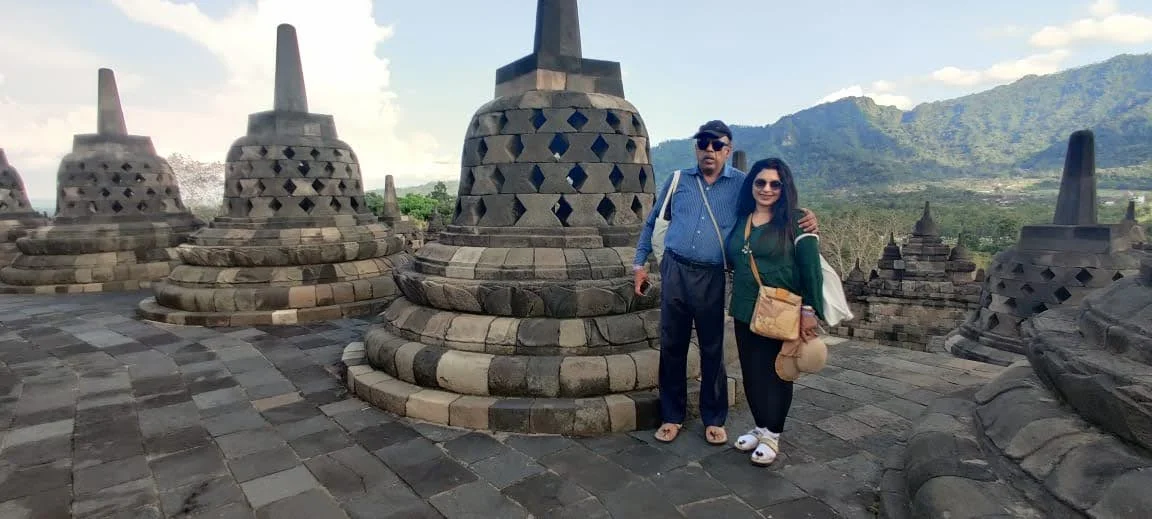
Emerging onto the upper circular terraces (Arupadhatu) among the diamond-perforated stupas
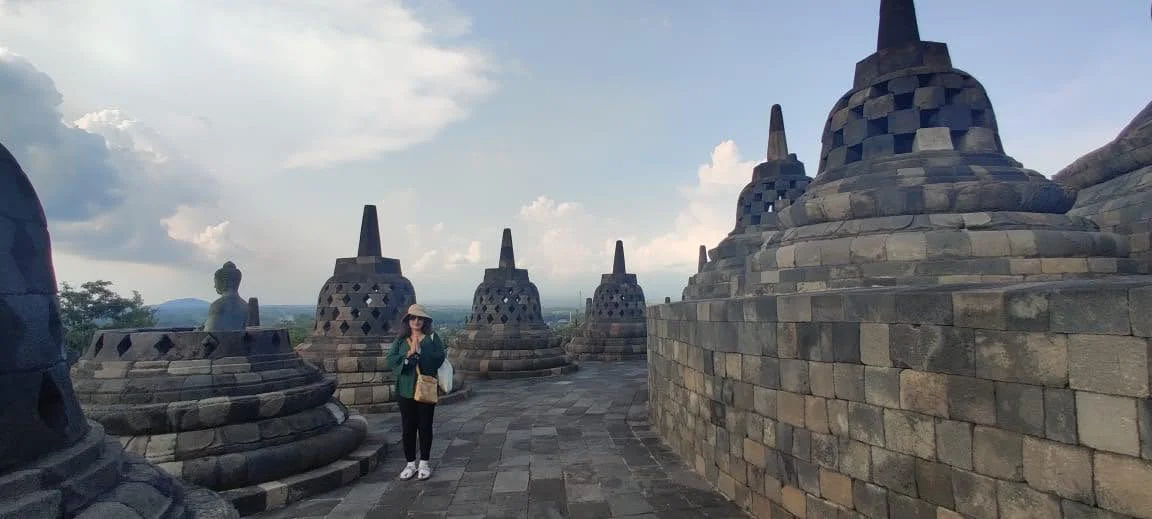
The uncovered Buddha statue on the circular terrace, gazing peacefully over the Kedu plains
Borobudur: Where India's Spirit Lives in Stone
More than a tourist destination, Borobudur is a monument to the movement of ideas, faith, art, and knowledge across Asia. It reminds visitors that India's historical influence extended far beyond its borders through philosophy, spirituality, and culture rather than conquest. For many travelers from India, standing atop Borobudur among the silent stupas creates a profound emotional connection with a shared past that once united the civilizations of South and Southeast Asia. It remains one of the finest examples of how Indian thought helped shape the cultural landscape of the wider Asian world.
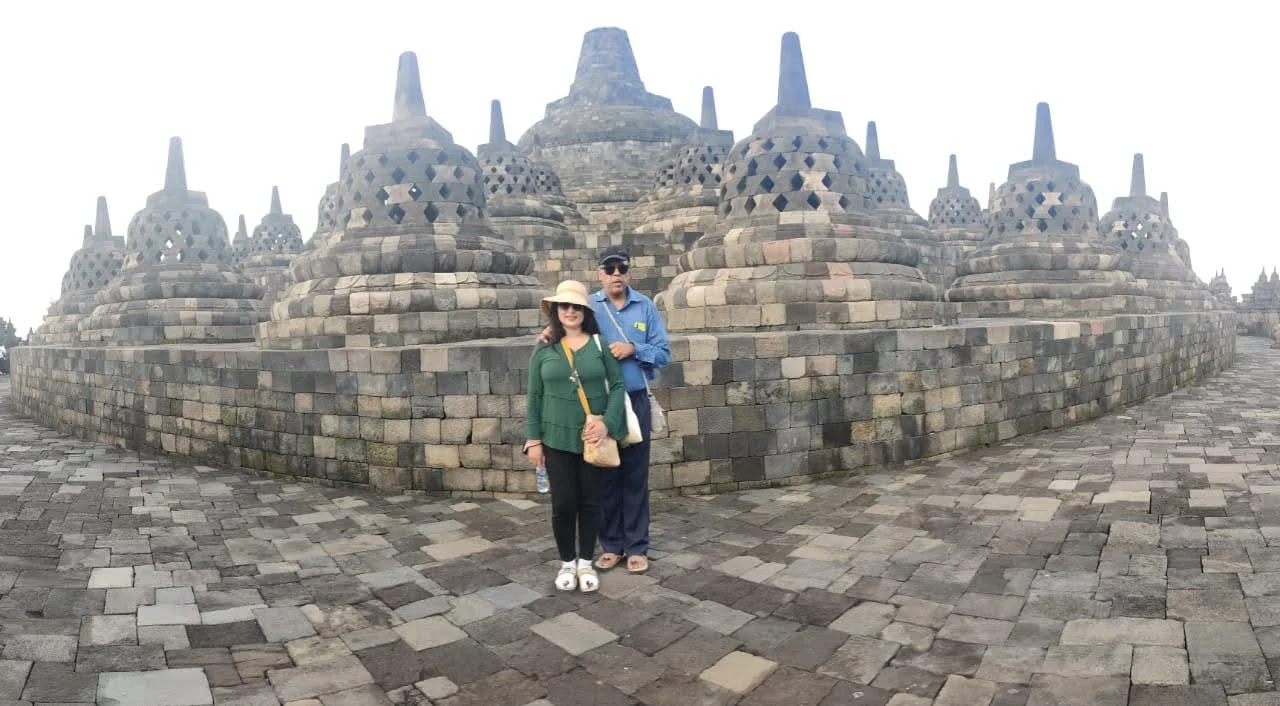
The Concentric Rings of 72 Stupas
Crowning the summit of Borobudur, perforated stupas house meditative Buddhas gazing outward over the volcanic horizons of Central Java.
Borobudur: Walking Through a Stone Mandala
Standing atop Borobudur, we realized we were not merely exploring an ancient monument but walking through a giant mandala carved in stone. In Buddhist tradition, a mandala represents the universe and the spiritual path to enlightenment. Every terrace, every staircase, and every stupa has a deeper meaning. As we slowly climbed the monument, it felt less like ascending a temple and more like following a sacred journey from the world of earthly desires towards inner peace and wisdom.
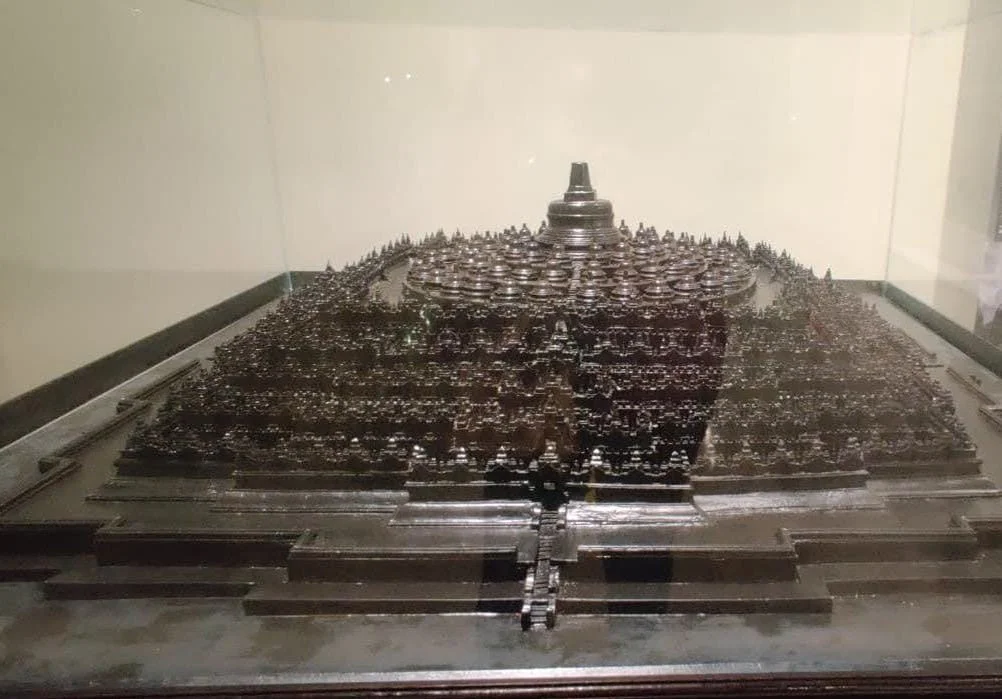
The 3D geometric mandala plan: square base transitioning into circular celestial planes
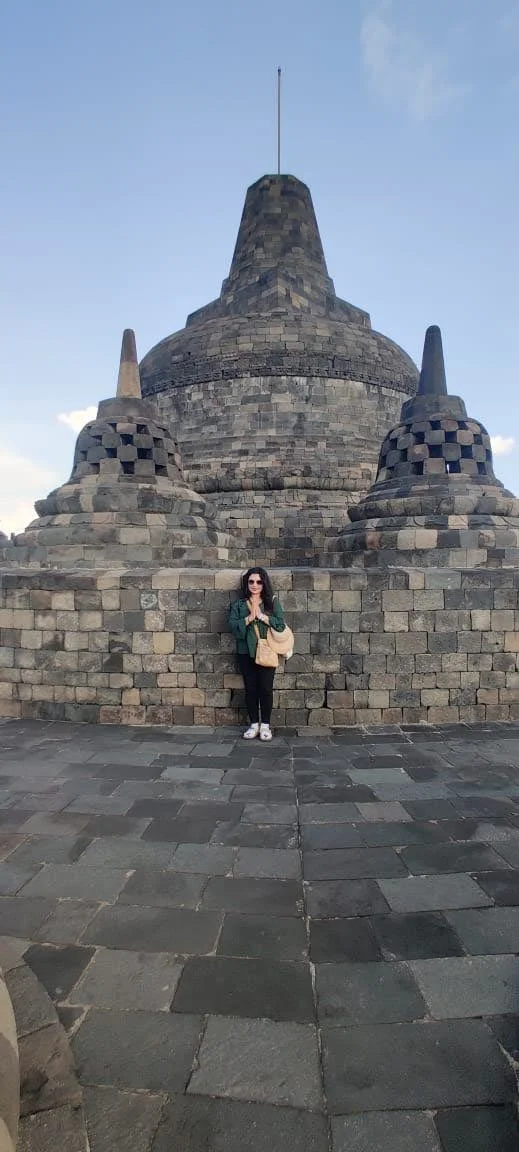
At the pinnacle of Borobudur: the sealed Central Stupa, symbol of the enlightened mind and Sunyata (Formlessness)
The design of Borobudur beautifully reflects this philosophy. Pilgrims traditionally walk clockwise around each level, contemplating the intricate reliefs depicting the life and teachings of the Buddha before finally reaching the circular terraces crowned by the great central stupa, symbolizing Nirvana. Although our visit was brief, we left with the feeling that Borobudur is not simply a masterpiece of architecture—it is a spiritual experience where every step invites quiet reflection and every stone whispers the timeless message of the Dharma.
Mendut Buddhist Monastery: A Quiet Finale to a Sacred Journey
After exploring the vast terraces of Borobudur, we were physically exhausted and ready to return to our hotel in Yogyakarta. Yet we pushed ourselves to visit the nearby Mendut Buddhist Monastery, knowing it was an essential part of the Buddhist pilgrimage. The peaceful surroundings and the striking white reclining Buddha statue immediately created a sense of calm, offering a welcome contrast to the crowds at Borobudur.
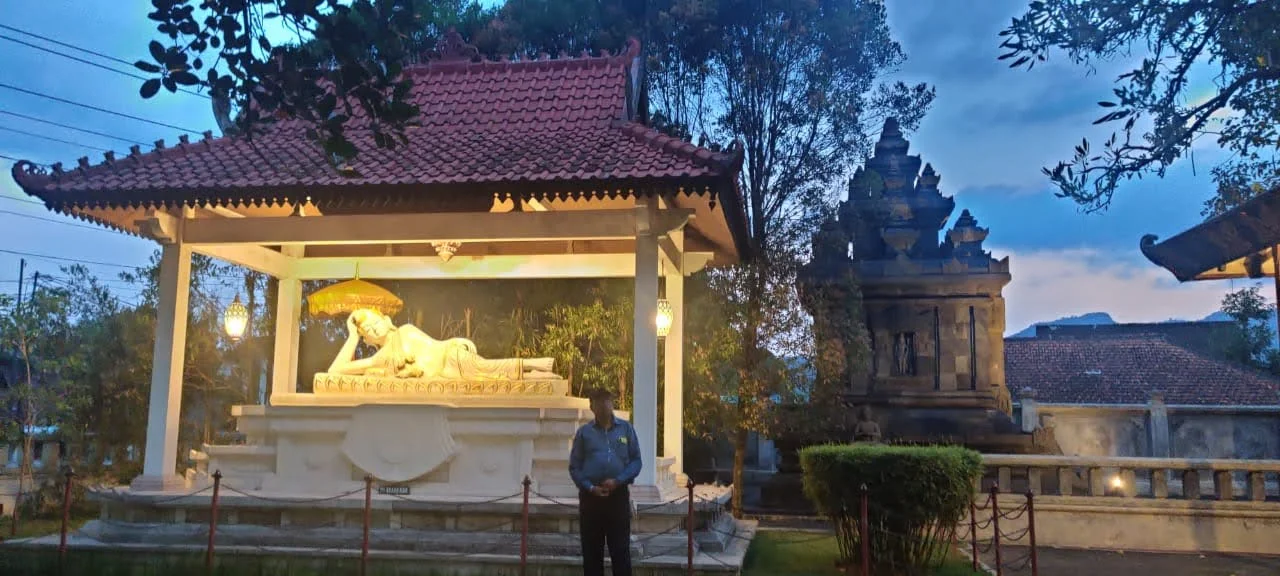
The luminous White Reclining Buddha (Mahaparinirvana) sheltered beneath a golden parasol at Vihara Mendut
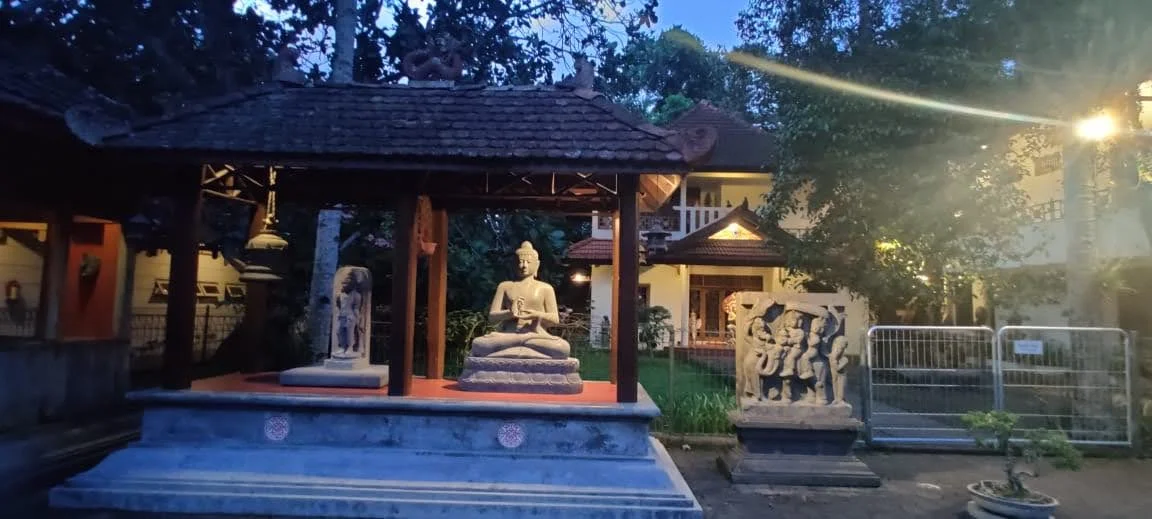
Monastery pavilion with seated Buddha statue, ritual bell, and carved stone relief stele
Dating back to the 9th century during the reign of the Sailendra dynasty, Mendut Temple is believed to have been built before Borobudur and forms a sacred alignment with Borobudur and the smaller Pawon Temple. Inside the ancient temple sits an impressive three-metre-high seated Buddha flanked by two Bodhisattvas, making it one of Indonesia's most important Buddhist shrines. Even today, Buddhist pilgrims begin their annual Vesak procession at Mendut before walking to Borobudur, following a tradition that has endured for centuries. As we quietly left the monastery, we felt that our day had ended not with another monument, but with a deeper understanding of Java's enduring Buddhist heritage.
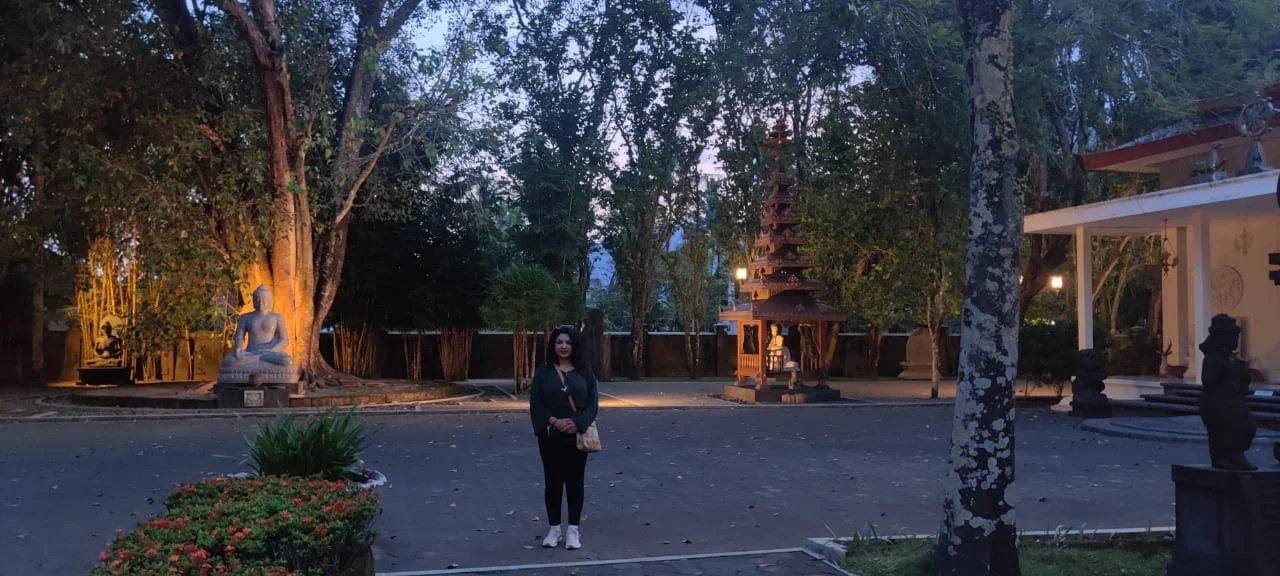
Dusk falling over the sacred grounds of Mendut Monastery under ancient Bodhi trees
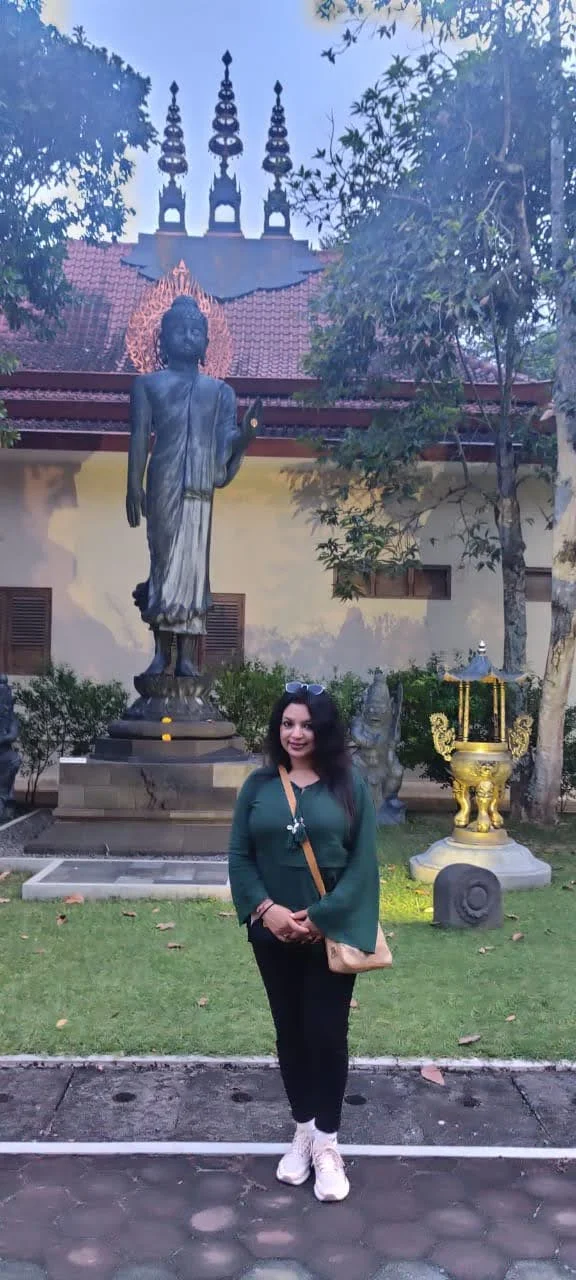
Standing bronze Buddha statue in Abhaya mudra with pagoda spire in the garden
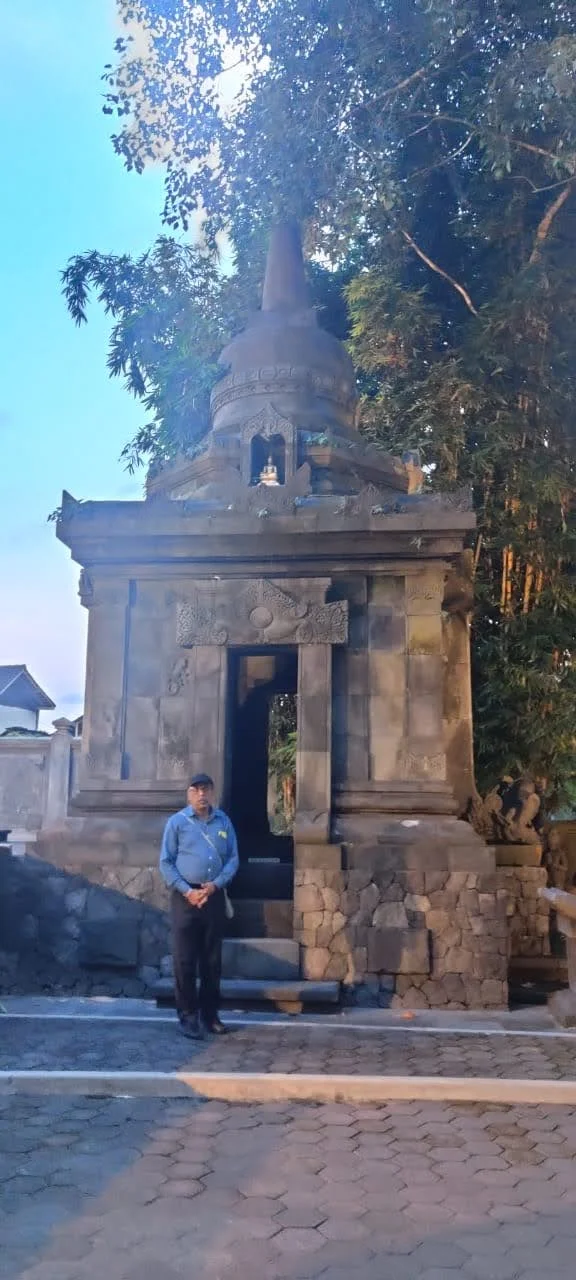
Stone candi shrine crowned with stupa at Vihara Mendut grounds
The Tears of Two Travellers
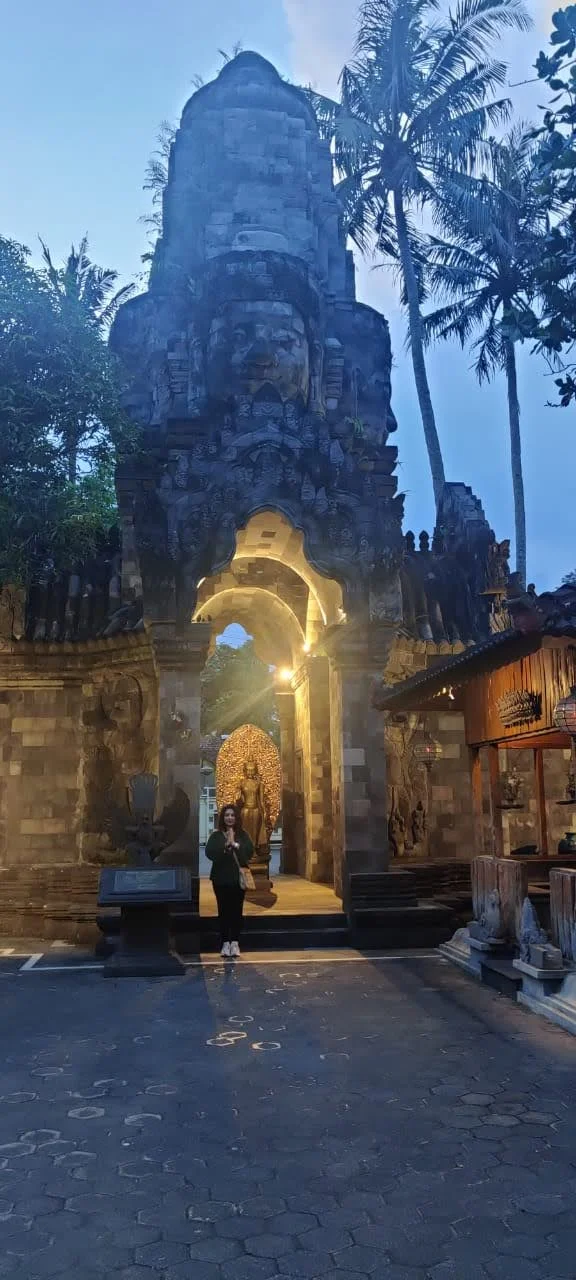
A moment of silent prayer and reverence before the golden gateway at dusk
As we drove back to our hotel in Yogyakarta, a journey of nearly one and a half hours, our minds remained at Borobudur. We could not stop admiring the vision, courage, planning, and extraordinary craftsmanship of the people who created a monument of such immense scale and breathtaking beauty over a thousand years ago. Just two days earlier, we had stood before the soaring towers of Prambanan, and now Borobudur had left us equally spellbound. Together, these masterpieces spoke of a civilization whose achievements continue to inspire awe even today.
As Indians, only one thought echoed in our minds: God, grant us just one wish—to touch the feet of the creators of these magnificent monuments. They could not have been ordinary men; they must have been demigods blessed with extraordinary talent and devotion. It was an intensely emotional moment. Overwhelmed by the grandeur of what we had witnessed and the enduring legacy of our shared civilizational heritage, we felt a few tears quietly roll down our cheeks—something we had not experienced in many years.
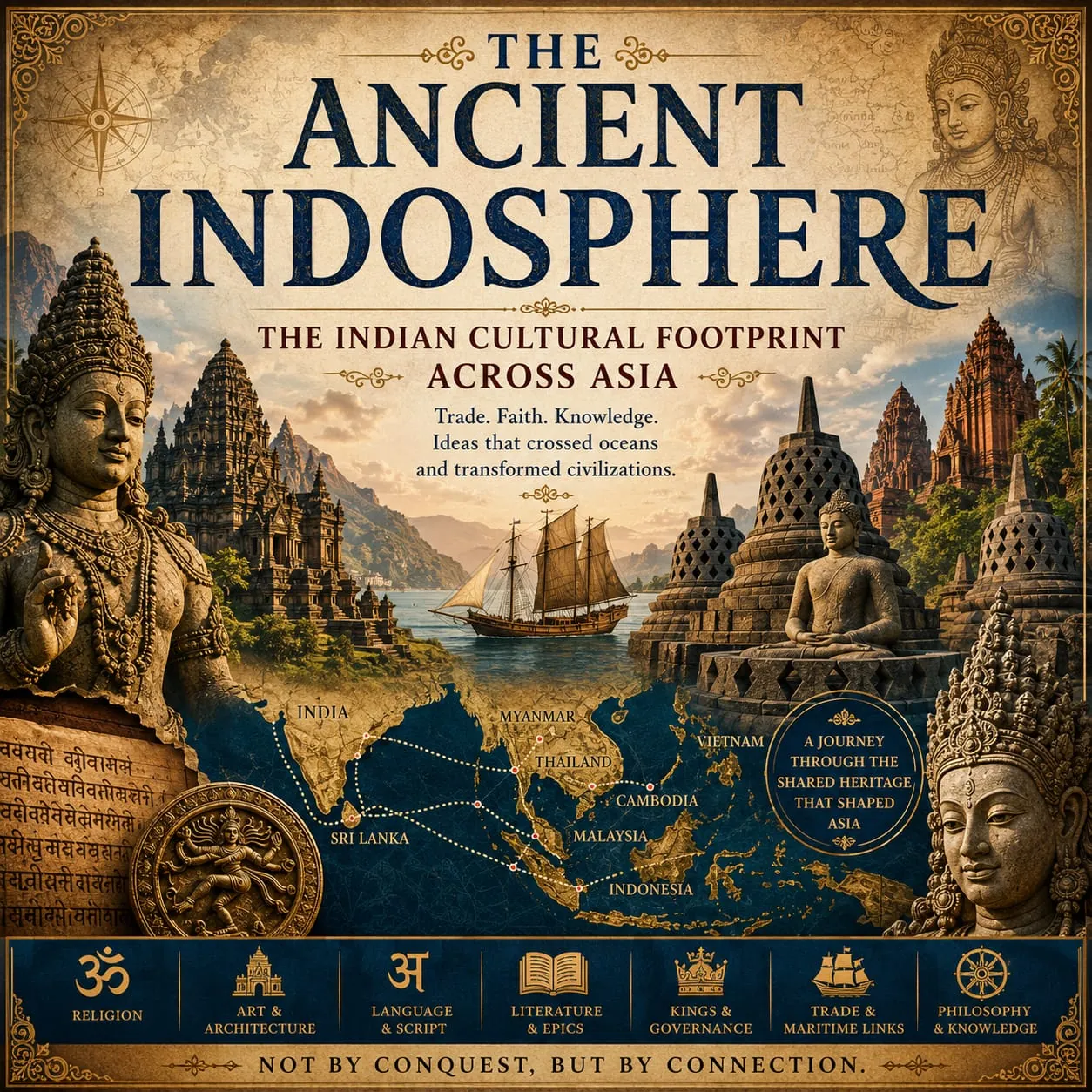
TRAVELLING THROUGH THE TIMELESS LEGACY OF INDIAN CIVILIZATION ACROSS ASIA AND BEYOND
“Not by conquest, but by connection.”
Borobudur stands as a sublime monument to the spiritual dialogue that connected ancient India to maritime Southeast Asia—a colossal stone mandala where Mahayana and Vajrayana Buddhist philosophy, relief narratives, and stupa architecture continue to illuminate the archipelago with wisdom and inner transformation.
Tips for Visiting Borobudur from Yogyakarta
Essential guidance for reservation permits, protective upanat sandals, guided climbs, and exploring the Kedu Plain pilgrimage shrines.
Distance & Travel
Located 40 km northwest of Yogyakarta, taking about 60 to 90 minutes via private taxi, hire car, or tour.
Protective Sandals
All visitors ascending the stone terraces receive soft woven upanat sandals to safeguard ancient andesite rock.
Guided Ascents
Temple terrace climbs are timed and led by knowledgeable guides in small batches to prevent overcrowding.
Best Time to Visit
Reserve early morning entry slots for comfortable temperatures and clear vistas over Mount Merapi and lush hills.
Mendut & Pawon
Include stops at Candi Mendut and Candi Pawon nearby, aligned on the sacred east-west Buddhist pilgrimage route.
Vesak Festival
During the May full moon, thousands of monks gather in saffron robes for peaceful candlelight lantern processions.
What to Wear & Carry
Dress modestly covering knees and shoulders, and bring a wide-brimmed sunhat, sunglasses, and bottled water.
Combination Tickets
Check online for joint Prambanan-Borobudur park admission passes to streamline your archaeological travels.
Complete Field Photography Index
All 20 client-provided photographs mapped with verified subjects, exact orientation, and focal point alignment.
World Heritage Wonder4:3Sacred Temple Mountain
Monumental stepped pyramid rising against tropical mist in the lush plains of Central Java.
Field Journey4:3Among the 72 Bell Stupas
Travelers taking in the sweeping panoramic view across the 72 latticed stupas overlooking the Kedu Valley.
Spiritual Horizon4:3The Circular Terraces
Moments of quiet contemplation amid the ancient stone stupas with distant volcanic peaks on the horizon.
Summit Sanctum3:4The Apex Stupa Sanctum
Traveler in namaste posture before the grand unperforated central stupa representing Arupadhatu, the formless realm.
Dhyani Buddha4:3The Open Stupa Buddha
One of the few stupas left uncovered, revealing the serene seated Dhyani Buddha meditating inside the stone lattice.
Ascent of Enlightenment3:4Stairway Between Stupas
The central flight of stone stairs opening onto the circular upper terraces lined with bell-shaped stupas.
Sacred Stairway3:4Ascending Kala Gateway
Climbing through the ornate monster-head Kala archway that purifies the pilgrim at each concentric terrace level.
Protective Iconography4:3Kala Portal Archway
Intricate monster-head Kala carving swallowing negative energy above the stone entrance portal.
Stone Narrative4:3Tiered Stone Facade
Over 2,670 individual relief panels illustrating the life of Buddha (Lalitavistara) and Jataka moral fables.
Stone Architecture4:3Lower Terrace Andesite
Precision interlocking volcanic stone blocks forming the square base representing Kamadhatu, the realm of earthly desire.
Pilgrim Journey4:3Upper Balustrade View
Traveler pausing along the stone-carved balustrade with views sweeping across green palm canopies to Mount Merapi.
Conservation Heritage4:3Upanat Protective Sandals
Specially designed woven pandan-leaf sandals required of all visitors to protect the 1,200-year-old stone floors.
Mandala Cosmology4:3Three-Dimensional Mandala
Viewing the concentric geometric structure that mirrors Buddhist cosmology and the journey to spiritual liberation.
Pilgrimage Axis3:4Mendut Golden Gateway
Offering reverence before the golden entrance arch of Vihara Mendut, sister temple of the Borobudur pilgrimage axis.
Monastery Grounds4:3Mendut Prayer Pavilion
Open-air wooden prayer hall surrounded by sacred lotus ponds, incense burners, and Buddhist scriptures.
Sacred Murti4:3Reclining Buddha Nirvana
Monumental golden statue of the reclining Buddha resting serenely amid tropical bamboo groves.
Sacred Art3:4Standing Buddha Garden
Graceful standing Buddha statue with mudra of blessing set amid manicured monastic water gardens.
Ancient Sanctuary3:4Ancient Candi of Mendut
The 9th-century andesite temple housing the famous three-metre enthroned Buddha with Avalokiteshvara and Vajrapani.
Twilight Serenity4:3Mendut at Twilight
Peaceful evening light illuminating the stone balustrade and tranquil gardens around Candi Mendut.
CONTINUE THE INDONESIA JOURNEY
Journey Through the Sacred Monuments of Indonesia